
Best D&D Classes for Experienced Players Who Want a Challenge
So you’ve run a Fighter through a few campaigns. You’ve kept a Cleric alive during a TPK-adjacent boss fight. You know what an opportunity attack is without checking the book. Congratulations, you’ve graduated from “learning the rules” to “wanting the rules to fight back a little.”
This guide is for that exact moment. We’re rounding up the D&D classes that reward system mastery instead of just handing you a strong number every level, based on the 2024 Player’s Handbook and the way its twelve classes were rebuilt from the ground up. If you want a character that gets more interesting the longer you play it, you’re in the right scriptorium.
🎯 What “hard” actually means in D&D
Before the list, a quick reframe. “Hard” doesn’t mean “bad at combat” or “confusing rulebook.” In the 2024 rules, Wizards of the Coast quietly labeled classes by complexity level so new players could avoid getting overwhelmed on session one. A class earns a “high complexity” tag when it asks you to track a lot of moving parts at once: spell lists, resource pools, stances, or decision trees that change every round (D&D Beyond, Updates in the Player’s Handbook 2024).
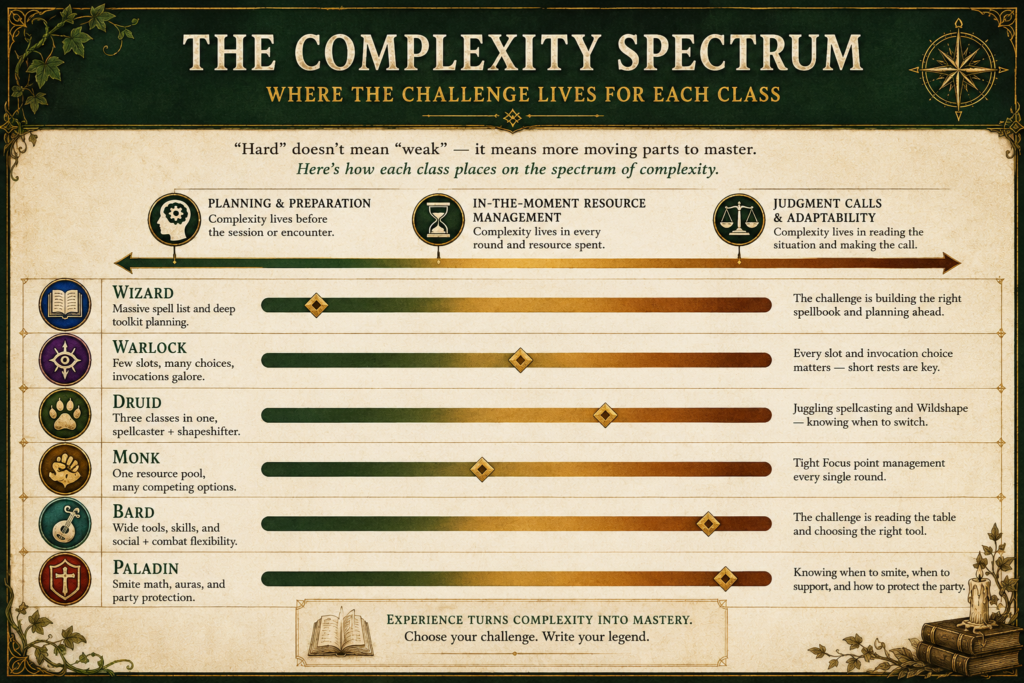
For experienced players, that complexity is the whole appeal. You’re not looking for the class that’s hardest to survive with. You’re looking for the class with the highest ceiling between “playing it correctly” and “playing it brilliantly.”
🧙 Wizard: the spellbook that never stops growing
Wizards look deceptively simple on a character sheet. Prepare spells, cast spells, done. The depth shows up in the sheer size of the spell list and how much of the game a Wizard can bend around a single well-timed counterspell, a shaped fireball, or a niche utility spell nobody else in the party even considered taking.
The 2024 Wizard also leans harder into subclass identity, with Abjurer, Diviner, Evoker, and Illusionist each pulling the class in a genuinely different direction (CBR, D&D 5e 2024 Player’s Handbook: Every Class With Subclasses). An experienced player gets to build a Wizard that solves problems no other class at the table can even attempt, which is exactly the kind of ceiling that keeps veteran players engaged.
Best for: players who like planning three turns ahead and building a toolkit rather than a rotation.
🔮 Warlock: small spell list, enormous decision space
Warlocks don’t get many spell slots. That sounds like a downside until you realize it’s the entire design. Every slot matters, so a good Warlock player is constantly weighing short-rest recovery, Eldritch Invocations, and pact features against each other instead of just casting the biggest spell available.
That invocation system is where the real complexity lives. Warlocks can lean full caster, full melee brawler with Pact of the Blade, or a genuinely strange hybrid, and the “right” build changes based on your party composition and the invocations you’ve collected along the way. It’s a class that punishes autopilot play and rewards players who’ve internalized action economy.
Best for: players who want a martial-caster hybrid with a shorter learning curve on the caster side but a long one on optimization.
🐺 Druid: the class that’s actually three classes
Wildshape is the reason Druid shows up on every “hard to master” list. You’re not just playing a Druid, you’re playing a Druid who can become a bear mid-fight and needs to track two completely different statblocks, action economies, and tactical options depending on which form you’re in.
The 2024 subclasses (Land, Moon, Sea, and Stars) each push Wildshape and spellcasting in different directions, so the skill ceiling isn’t just “remember your beast shapes,” it’s “know when spellcasting beats Wildshape and when it’s the reverse” (Wargamer, All DnD classes and subclasses explained). Experienced Druid players are essentially running two characters that share a soul.
Best for: players who like flexibility and don’t mind holding two rule sets in their head at once.
🥋 Monk: the tightest resource management in the game
Monks run on Focus points (the 2024 rename of Ki), and every single feature competes for that same shrinking pool. Flurry of Blows, Patient Defense, Step of the Wind, and subclass features all draw from one number, so a skilled Monk player is doing constant mental math about what’s worth spending Focus on this round versus banking it for later.
The rework in the new Player’s Handbook addressed some long-standing complaints about Monk feeling underpowered at low levels, but the resource-juggling core of the class stayed intact, which is good news if that tension is what drew you to Monk in the first place (ScreenRant, D&D: Every Class & Subclass In The 2024 Player’s Handbook). Add in movement, unarmed strike types, and stunning strike math, and you’ve got a class where good players are visibly better than average ones.
🎻 Bard: the hardest class to run badly
Bards get one of the widest spell lists in the game plus a stack of skill-boosting features, which means a Bard player has to be good at three different games simultaneously: combat spellcasting, social encounters, and utility problem-solving. The 2024 subclasses (Dance, Glamour, Lore, and Valor) each specialize that identity further, but a Bard is never just one of those things at the table.
Because Bards are asked to be flexible generalists, the skill involved isn’t mechanical complexity so much as judgment. When do you Cutting Words instead of casting a spell? When is Vicious Mockery actually the right call over a damage spell? Experienced players get more mileage out of Bard specifically because they’ve built the instincts to answer those questions fast.
Best for: players who like being the party’s Swiss Army knife and want every session to ask something different of them.
⚔️ Paladin: smite math under pressure
Paladin looks like a straightforward half-caster until you hit your first Divine Smite decision. Do you burn a spell slot to turn a hit into a pile of radiant damage, or save that slot in case someone needs healing in ten minutes? That single choice, repeated dozens of times across a session, is where Paladin’s real complexity lives.
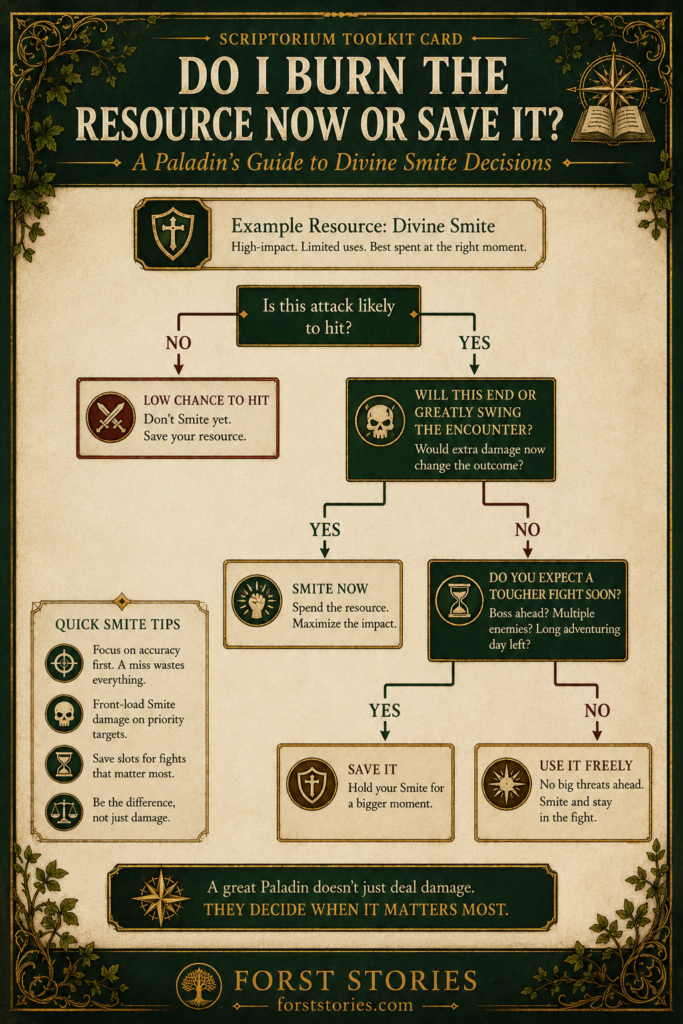
The 2024 subclasses (Devotion, Glory, Ancients, and Vengeance) add their own resource layers on top of Smite, and experienced Paladin players learn to read a fight well enough to know exactly when spending big pays off. It’s a much stealthier complexity than Wizard or Druid, but it separates good Paladins from great ones just as clearly.
Best for: players who want the discipline of resource management without a giant spell list to memorize.
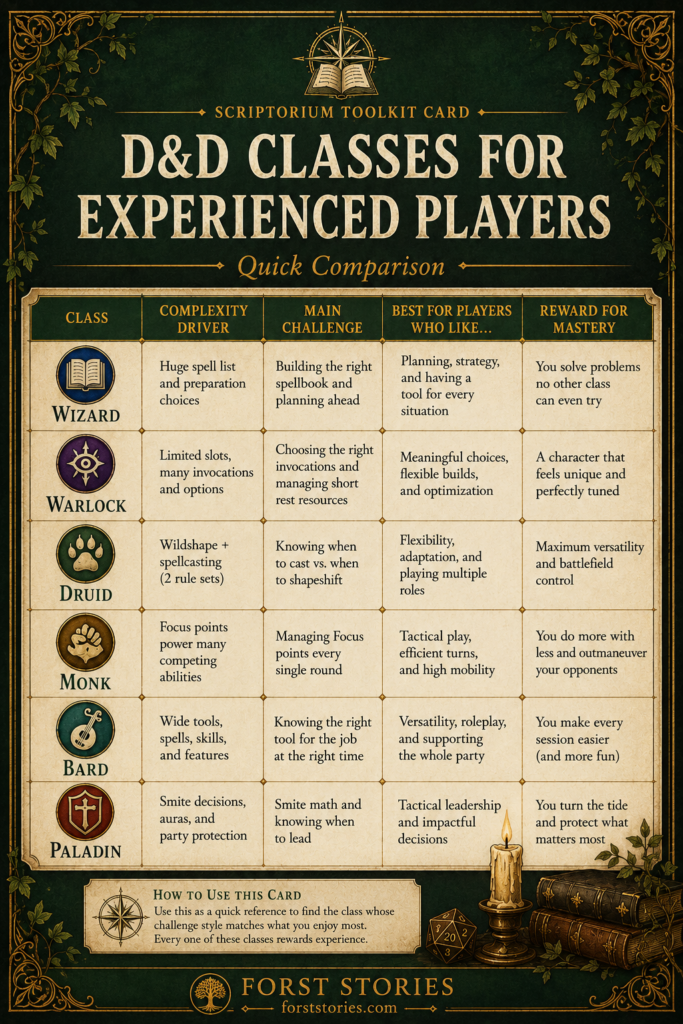
📋 Quick comparison
🗝️ How to pick if more than one of these appeals to you
If you’re torn, ask what kind of “hard” you actually enjoy. Wizard and Druid reward planning and system knowledge. Monk and Warlock reward tight resource management in the moment. Bard and Paladin reward judgment calls that depend on reading the table, not just the character sheet. None of these classes are objectively harder than the others, they’re just hard in different directions, and the best pick for an experienced player is usually the one that matches the kind of thinking you already enjoy doing outside of combat too.
It’s also worth running any of these past your table’s system, since a lot of the complexity discussion here is specific to the 2024 Player’s Handbook rather than the 2014 version, and homebrew or older-edition tables may see these classes play out differently.
🧩 Multiclassing makes all of this harder (in a good way)
Everything above assumes you’re playing a single class straight through to high level. Add multiclassing and the complexity ceiling goes up again, because now you’re managing two feature sets, two progression tracks, and the timing question of when to dip into a second class versus staying the course in your first.
Wizard and Warlock are a popular pairing for exactly this reason. A few levels of Warlock grants Pact Magic slots that recharge on a short rest, stacked on top of a Wizard’s normal long-rest slot pool, which means an experienced player willing to track two separate spell slot systems gets noticeably more actions per adventuring day than either class alone would provide. Paladin and Warlock is another classic combination, since both classes want Charisma and both benefit from burst damage windows, but making it work well means understanding exactly how smite damage and pact features interact turn to turn.
None of this is necessary to enjoy any of the six classes above. But if you’ve already got one of them under your belt and you’re looking for the next challenge, multiclassing is usually where that challenge lives.
🛠️ Common mistakes even experienced players make
A few patterns show up again and again at tables running these classes, even among players who’ve been at it for years.
Treating Wizard spell selection as a one-time decision. The whole point of prepared casting is that your available spells can shift between adventuring days. Players who “set and forget” their prepared list lose most of the class’s actual strength.
Wildshaping into a form and forgetting you can still cast some spells. Druids often assume Wildshape locks them out of spellcasting entirely. Depending on subclass and level, that’s not always true, and missing it means leaving options on the table mid-fight.
Burning all your Warlock slots in the first encounter of the day. Short rests recharge Pact Magic, but only if your party actually takes them. Players who play Warlock like a Sorcerer with fewer slots tend to feel weaker than they should.
Saving every Divine Smite “just in case.” Paladins who never spend resources end every session with a full pool of unused smites and a lot of missed damage. The skill is in spending confidently, not hoarding.
Ignoring Focus point costs on Monk stances. Some Monk features cost more Focus than they’re worth in a given fight. Knowing when not to spend is as much a skill as knowing when to.
Recognizing these patterns in your own play is often the fastest way to level up as a player, regardless of which class you land on.
RPG news, GM tips, and system deep dives — straight to your inbox, no filler.


