

D&D Backgrounds Guide: Which One Should You Choose?
You have picked a class and a species, and then the character sheet asks a deceptively small question: where did you come from? That is your background, and it quietly shapes your skills, your story and, in the newest rules, a chunk of your numbers too.
Choose well and your character feels alive from the first session. Choose carelessly and it becomes a line on the sheet you never think about again.
This guide is a decision guide, not an A to Z catalogue. We will look at what a background actually gives you, how it works in the 2024 rules (our main focus) and the 2014 rules, and how to pick one based on what you want from your character. Everything is explained from scratch, so no prior knowledge is needed.
📖 What Is a Background in D&D?
A background is a short description of what your character did before the adventure began. Were they a soldier, a scholar, a farmhand, a smuggler? It sits alongside your class (what you do in the adventure) and your species (what you are), and it answers the question of who you were before the dungeon door opened.
Mechanically, a background hands you a small package of benefits. Those include proficiency in a couple of skills (skills are things like Stealth or Persuasion, where proficiency means you add a bonus to your roll) and usually a tool proficiency, such as thieves’ tools or a musical instrument. It also comes with starting equipment.
Narratively, it hands you something even more useful: a past, a few likely relationships and a lens for how your character sees the world.
🆕 How Backgrounds Work in the 2024 Rules
In the 2024 Player’s Handbook, backgrounds do more heavy lifting than ever before. Each of the 16 backgrounds in the book offers three things: a short list of three ability scores, an origin feat, and a set of proficiencies. You also get starting equipment, or you can take gold instead and shop for your own kit.
Ability scores are the six core numbers on your sheet: Strength, Dexterity, Constitution, Intelligence, Wisdom and Charisma. In 2024, your background tells you which three of them it can boost. You either add 2 to one and 1 to another, or add 1 to all three, which means the background you pick directly shapes your numbers.
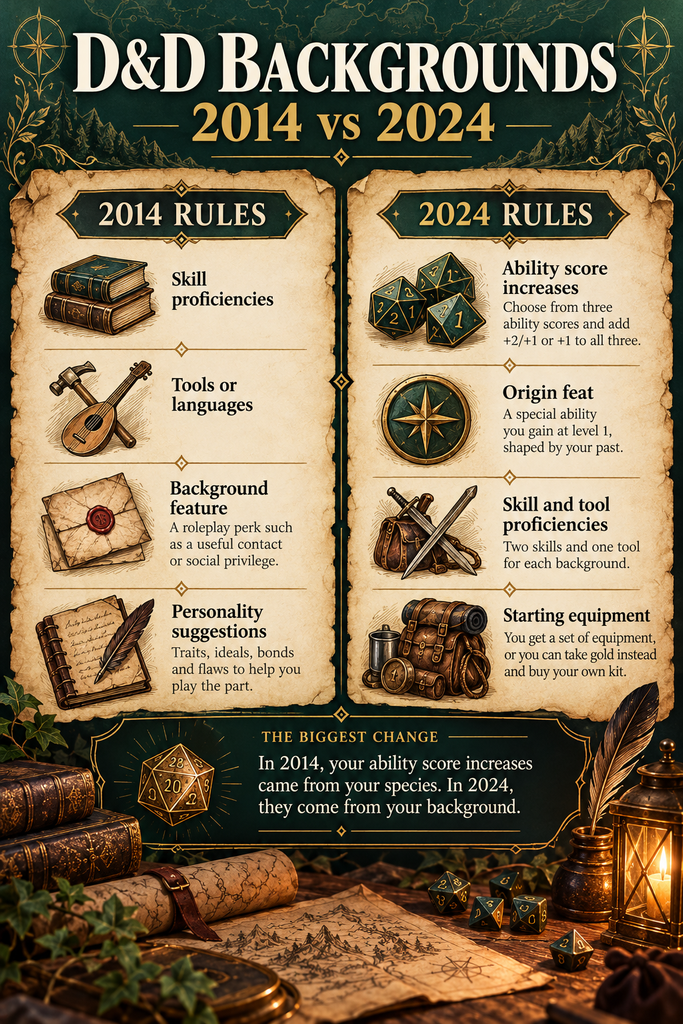
An origin feat is a small special ability that you gain at level 1, a signature trick from your past.
Examples include Alert, which helps you act early in a fight, Tough, which gives you extra hit points, and Lucky, which lets you nudge fate with a few luck points. Magic Initiate is another, and it gives you a small taste of spellcasting from a particular class list.
Then there are the proficiencies: two skills and one tool for each background. For instance, Sage grants Arcana and History, while Criminal grants Sleight of Hand and Stealth.
🕰️ How the 2014 Rules Handled It
If you are playing the 2014 version of fifth edition, backgrounds work a little differently. They still give you two skill proficiencies, some tools or languages, and starting equipment. They also include a feature, which is a roleplay perk such as a useful contact or a social privilege, and suggested personality traits to help you play the part.
The big difference is where your ability score increases come from. In 2014 they come from your species. In 2024 they come from your background, which is why the background choice now has numbers attached to it.
Both approaches are great fun. The 2014 version leans into flavour and social perks, while the 2024 version leans into a feat you can use in play. If you are still deciding which edition suits your table, our which D&D edition should you play guide will help, and the 5E versus 2024 comparison covers the wider changes beyond backgrounds.
🧭 Start With What You Want From the Character
Here is the core idea of this guide: do not scroll a list and pick whatever sounds coolest. Start by asking what you want the background to do for you. Most players are after one of three things, and it is worth knowing which one is yours.
- Mechanics: you want a specific origin feat, a useful skill pair or a particular ability score spread.
- Story: you want a hook, a motivation and a set of connections your GM can use.
- Roleplay: you want a voice, a set of habits and a way of seeing the world that is fun to perform.
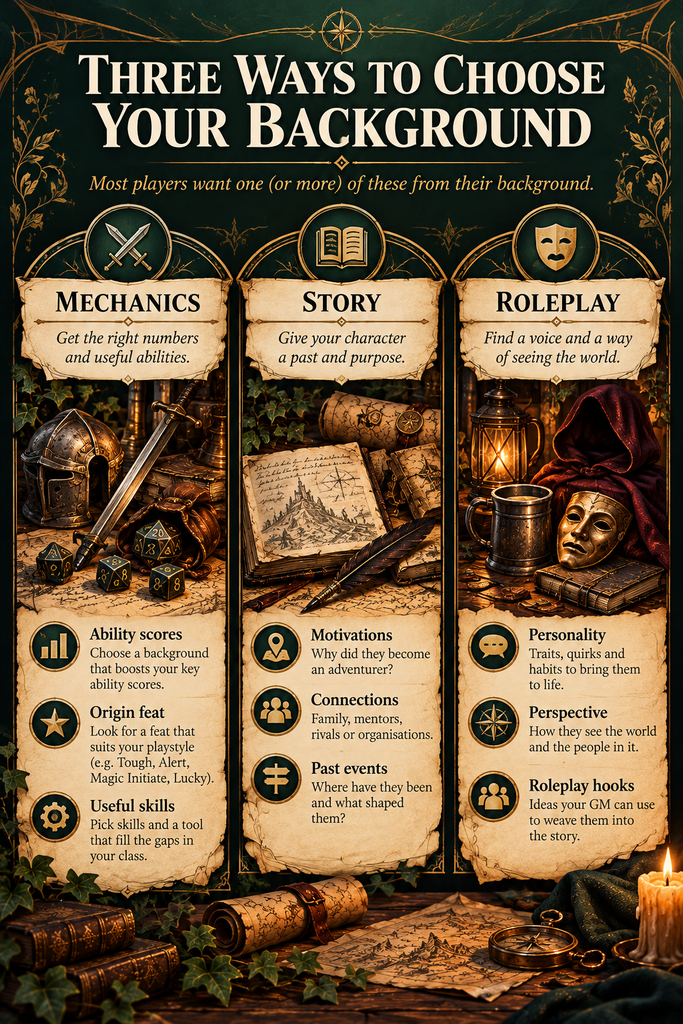
Most of the time you will want a mix, and that is fine. The trick is to know which goal leads, because that decides how you narrow things down.
🎲 Choosing for Mechanics
If you want the numbers to line up, begin with the ability scores. Look for a background whose three listed scores include your class’s most important one.
A character who relies on Dexterity will find plenty of options. Soldier, Criminal and Guide all list it, for example, while Strength-focused characters can look at Farmer, Guard or Noble.
Next, look at the origin feat, because each one pushes a particular playstyle.
Tough suits a character who expects to be on the front line, Alert suits someone who wants to act first, and Magic Initiate suits a character who fancies a little extra magic. Lucky is flexible for almost anyone, which is why it is such a popular pick.
Finally, check the skills. Your class already gives you a handful of skill choices, so look for a background that fills the gaps instead of repeating what you have.
If your class already covers Perception, for instance, a background that adds Persuasion or Survival might serve you better. Many tables also ask you to swap a duplicate for something else, so it is worth checking for overlap before you commit.
A quick word on class pairing: you do not need to match your background to your class in an obvious way. A Wizard with the Sage background is neat and tidy, but a Wizard raised as a Farmer or a Sailor is a far more interesting character. If you are still working out your class, our guide to the best D&D classes for new players is a good place to start.
🖋️ Choosing for Story
If story is your lead goal, ignore the numbers for a moment and read each background as a character seed. Ask yourself three questions.
- What did my character want before the adventure?
- Who do they still care about?
- What would they hate to lose?
The answers become your motivation and connections. A Hermit might be hiding from a past mistake, a Noble might be running from an arranged marriage, and a Guard might be searching for the captain who abandoned their post. Each of those is a thread your GM (the Game Master, who runs the world and its characters) can pull.
This is where backgrounds earn their place at the table. A GM who knows your character’s past can weave it into the plot, bring back an old rival or place a familiar face in a distant town. Players who offer hooks tend to get more spotlight.
Try finishing the line, “Before the adventure, I…” in two or three sentences and share it with your GM. A short backstory with open questions often works better than a long one. For more on shaping your table’s expectations, see our session zero strategies.
🎭 Choosing for Roleplay
If roleplay is your priority, pick the background that gives you the most fun to perform. Think about posture, speech and habits. An Entertainer might narrate their own fights, a Merchant might price everything they see, and a Scribe might correct everyone’s grammar in the middle of a battle.
A useful trick is to choose one small quirk and one strong belief. The quirk makes people smile, while the belief gives you something to act on when a hard choice arrives.
Do not feel locked in by the name on the sheet, because a Sailor does not have to love the sea. For more ideas on memorable personalities, our guide to advanced NPC creation works just as well for player characters.
🧩 A Quick Look at Some 2024 Options
You do not need every background in your head, so here are a few examples to show how different they can feel. Each is a legitimate mechanical choice and a story seed at the same time. Check the exact entries in your own rulebook.
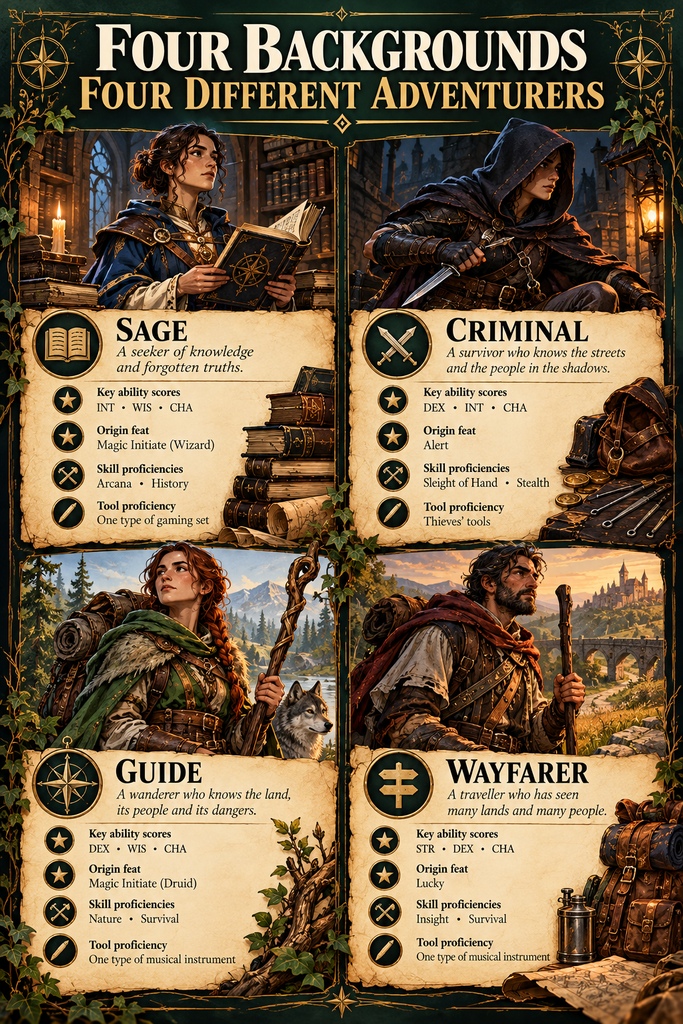
- Sage: Arcana and History, with the Magic Initiate (Wizard) feat. Perfect for a curious scholar or a bookish adventurer.
- Criminal: Sleight of Hand and Stealth, with the Alert feat. A natural fit for a streetwise character who is quick off the mark.
- Guide: Stealth and Survival, with Magic Initiate (Druid). A wilderness expert with a touch of nature magic.
- Wayfarer: Insight and Stealth, with the Lucky feat. A drifter who has seen a lot of roads and talked their way through most of them.
If you want the full list and the exact entries, the 2024 Player’s Handbook is the place to find them all in one spot, and it is handy to keep on the table during character creation.
🛠️ Customising or Building Your Own Background
What if none of the sixteen feels right? Many tables are happy to let you customise, as long as your GM approves. The usual idea is to keep the same overall package size, so you swap pieces rather than adding extras.
For example, you might keep the idea of a Soldier but change the story so that your character was a city watch officer, a caravan guard or a militia volunteer. You could also swap a skill or tool proficiency for one that suits your concept better, as long as your GM agrees it is balanced.
The golden rule is to talk to your GM first. Explain what you want and be ready to compromise, because a clear story and a fair trade are far more likely to get a yes.
If you are using an older published background in a 2024 game, there is a simple method for updating it: add your three points of ability score increases and, if the background does not already give a comparable perk, pick an origin feat. Ask your GM to confirm the approach before you rely on it.
⚠️ Common Mistakes to Avoid
Even a sensible choice can go wrong at the table. Here are the two mistakes we see most often, along with an easy fix for each.
Choosing only for min-maxing. Min-maxing means building a character purely for the highest numbers, which is a valid way to play.
The problem comes when the background you chose for the feat has no connection to your character’s story. You end up with a Guard who has never held a spear and cannot explain why they have the skills. The fix is to find one line of story that links the mechanics to the person, which usually takes thirty seconds.
Ignoring the background after session one. By session three, nobody at the table remembers what your Hermit was running from. Pick one small moment per session where your background can come up, such as using a skill in character, mentioning a contact or reacting to a place that reminds you of home.
If you want a deeper walk through the other parts of building a character, our step-by-step first character guide covers the whole process.
✅ Your Quick Decision Checklist
When you are ready to choose, work through these steps in order. They save you from second-guessing later.
- Decide your lead goal: mechanics, story or roleplay.
- Check the ability scores: does the background boost the scores your class cares about?
- Look at the origin feat: will you enjoy using it at the table?
- Compare the skills: do they fill gaps in your class list?
- Write one sentence of backstory: finish “Before the adventure, I…”
- Share it with your GM: ask for one hook they can use.
If two options still tie, pick the one that makes you smile when you imagine playing it. That feeling is a better guide than any spreadsheet.
🌟 Final Thoughts
A background is one of the smallest choices on your sheet and one of the most influential.
In the 2024 rules it gives you ability score increases, an origin feat and proficiencies. In the 2014 rules it gives you flavour, a feature and a past. Either way, it is your character’s first chapter, and you get to write it.
So decide what you want from your character, choose the background that supports it and hand your GM a hook or two. Then keep it alive in play, one small moment at a time.
RPG news, GM tips, and system deep dives — straight to your inbox, no filler.


