D&D 5e Multiclassing Guide: Requirements for Beginners
You’ve built your first D&D 5e character, survived a few sessions, and now you’re staring at the multiclassing rules wondering if that dense paragraph in the Player’s Handbook is trying to test you.
It isn’t. It’s just written for people who already understand ability score prerequisites and spell slot maths, which you don’t yet. This guide breaks down what multiclassing actually does, where beginners usually trip up, and when it’s worth doing at all.
🧙 What Is Multiclassing (and Why Bother)?
Multiclassing lets you take levels in more than one class as your character advances, instead of only ever levelling up your original class. Your character level is still the total of every class level combined, so a Fighter 3 / Rogue 2 is a 5th-level character with the features of both.
Say you’re playing a Fighter and you hit a level-up. Normally you’d take your 4th Fighter level. With multiclassing, you could instead take your 1st level in Rogue and pick up its starting features, like Sneak Attack and Expertise.
People multiclass for a few reasons. Some want a specific mechanical trick (a Fighter grabbing a couple of Cleric levels for healing spells), others are chasing a character concept that no single class quite covers, and some just want more tools at the table.
It’s worth saying plainly: multiclassing is entirely optional. Plenty of great characters never touch another class, and there’s no rule saying you have to multiclass to be effective. If you haven’t built your first character yet, our step-by-step 5e character creation guide is the better starting point before any of this becomes relevant.
🎲 Ability Score Prerequisites: The Number Every Beginner Trips On
Here’s the part that catches almost everyone out. To multiclass into a new class, you need a minimum ability score in that class’s key stat, and you need to still meet the prerequisite for your current class too. Miss either one and you can’t take the new class yet.
Under the 2014 core rules (still the most common ruleset at most tables), the thresholds are:
- Barbarian: Strength 13
- Bard: Charisma 13
- Cleric: Wisdom 13
- Druid: Wisdom 13
- Fighter: Strength 13 or Dexterity 13
- Monk: Dexterity 13 and Wisdom 13
- Paladin: Strength 13 and Charisma 13
- Ranger: Dexterity 13 and Wisdom 13
- Rogue: Dexterity 13
- Sorcerer: Charisma 13
- Warlock: Charisma 13
- Wizard: Intelligence 13
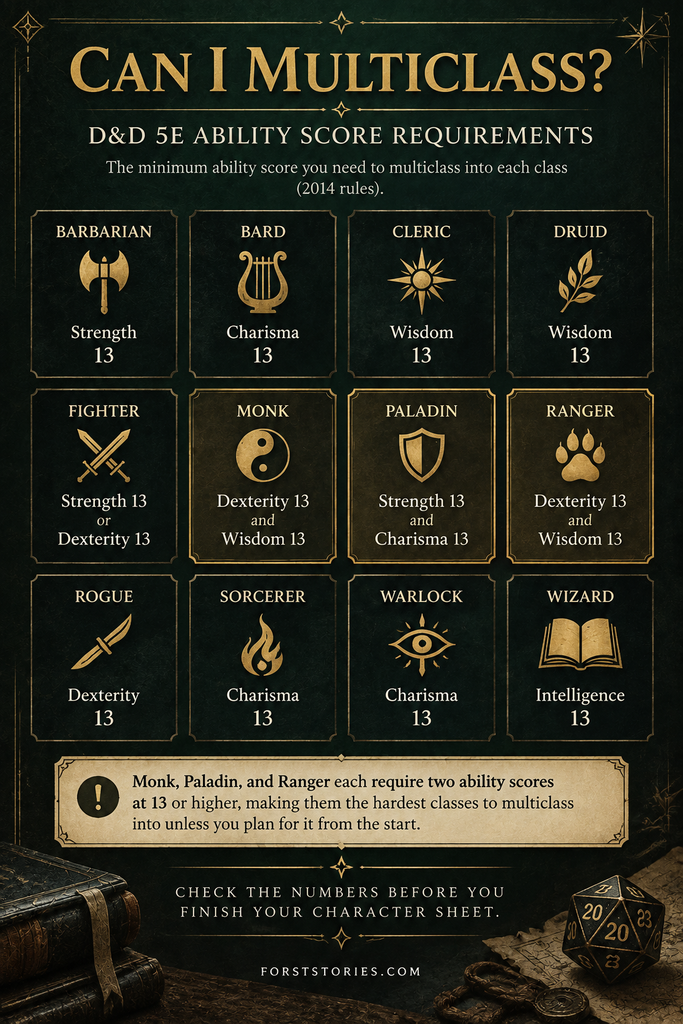
Notice that Monk, Paladin, and Ranger each need two scores at 13 or higher. That makes them the hardest classes to multiclass into unless you built your character with that in mind from the start, since the standard array and most point-buy spreads don’t leave much room to push two stats up at once.
A practical tip: if you think you might multiclass later, check these numbers before you finish your character sheet, not after. A Fighter with Strength 15 and Dexterity 13 can dip into Rogue any time. A Fighter with Strength 15 and Dexterity 10 cannot, at least not without an ability score improvement first.
✨ How Spell Slots and Spellcasting Actually Combine
This is the second big source of confusion, and it splits into two separate questions: what spells you know, and how many spell slots you have.
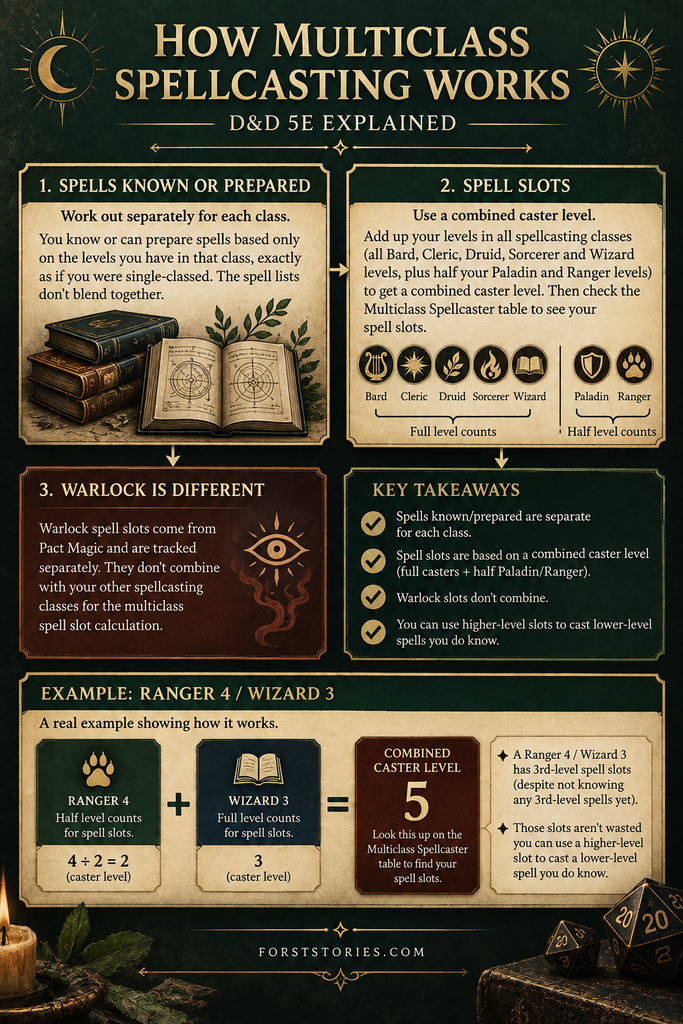
What you know or can prepare is worked out separately for each class, exactly as if you were single-classed in it. A Ranger 4 / Wizard 3 knows Ranger spells based purely on their Ranger levels, and knows Wizard spells based purely on their Wizard levels. The two lists don’t blend together.
Spell slots work differently. You add up levels across your spellcasting classes (all of your Bard, Cleric, Druid, Sorcerer, and Wizard levels, plus half your Paladin and Ranger levels) to get a combined caster level. You then look that total up on the Multiclass Spellcaster table to see your slots, the same table used for single-class spellcasters at that level.
That combined caster level can outpace what spells you actually know. A Ranger 4 / Wizard 3 counts as a 5th-level caster for slots, meaning they get a couple of 3rd-level slots despite not knowing any 3rd-level spells yet. Those slots aren’t wasted though, since you can use a higher-level slot to cast a lower-level spell you do know.
One exception worth flagging: Warlock spell slots come from a separate feature called Pact Magic, and they’re tracked on their own rather than folded into the combined total.
🛡️ Proficiencies: What You Gain (and What You Don’t)
New players often assume multiclassing hands them the full starting proficiency package of the new class. It doesn’t. When you take your first level in a class that isn’t your original one, you only get a trimmed-down list.
A few examples:
- Multiclassing into Cleric gets you light armour, medium armour, and shields, but no weapon training beyond what you already have.
- Multiclassing into Rogue gets you light armour, one skill of your choice, and thieves’ tools.
- Multiclassing into Wizard or Sorcerer gets you nothing extra at all beyond the class features themselves.
What you never get from multiclassing, no matter which class you dip into, is saving throw proficiency. Those only come from your very first class. This is worth factoring into which class you start as, since a Sorcerer who later multiclasses into Fighter will never gain Fighter’s saving throw proficiencies, only its armour and weapon training.
📖 A Quick Callout: What Changed Under the 2024 Rules
Quick note if your table has moved to the 2024 core rules: the ability score prerequisites weren’t removed, despite what you might have heard. They’re still there, still built around a 13-or-higher threshold, and classes like Paladin and Ranger still need two scores rather than one.
What did change is presentation. The 2024 Player’s Handbook gives every class a defined “Primary Ability” as part of its write-up, and multiclassing prerequisites hang off that instead of being scattered across a separate table. For a full side-by-side of what’s actually different between the two rulesets, our D&D 5E vs. D&D 2024 comparison covers it properly.
This guide sticks to the 2014 rules as the baseline, since that’s still what most existing characters and long-running campaigns are built on. If you’re picking up the game fresh and want the current core rulebook either way, the 2024 D&D Player’s Handbook is the one to grab.
⚔️ Three Beginner-Friendly Multiclass Combos
These three keep the bookkeeping light while still giving you a genuinely different character to play. None of them require juggling two separate spell lists at once.
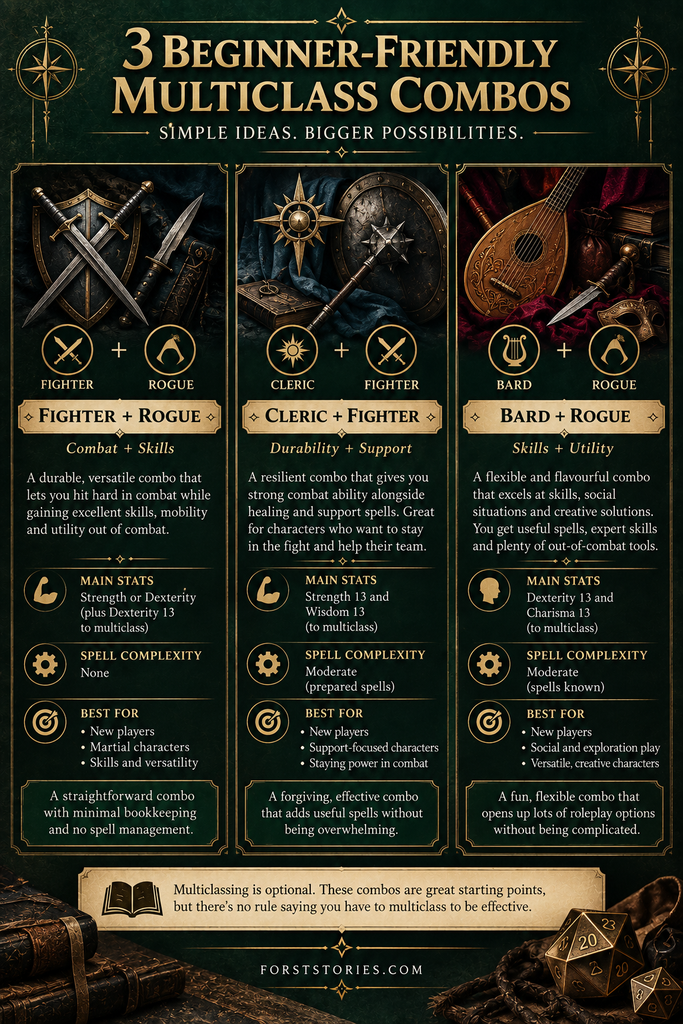
- Fighter / Rogue. Both classes work off Strength or Dexterity, so a Dexterity-based Fighter can dip into Rogue without needing a third good stat. You get martial reliability plus skill expertise and Sneak Attack, with no spellcasting to track at all.
- Cleric / Fighter. A few levels of Fighter on a Cleric adds Extra Attack and heavier armour and weapon options, while keeping your healing and support spells intact. It plays like a tougher, more durable Cleric rather than a different character entirely.
- Bard / Rogue. Both are Charisma-or-Dexterity skill classes, so they share a similar stat priority. This combo leans into face-of-the-party utility: lots of skills, Expertise from both classes, and a light dusting of Bard spells if you want them.
All three avoid the trap of needing three or four good ability scores at once, which is where multiclass builds usually go wrong for newer players.
⚠️ Common Mistakes and When Multiclassing Isn’t Worth It
A few mistakes come up constantly at tables that are new to this rule:
- Dipping into a class for one flashy feature without checking that the feature is actually available at level 1 of that class (many aren’t).
- Building a character around a two-stat prerequisite class like Paladin or Ranger without checking the numbers first, then discovering you can’t multiclass into it at all.
- Forgetting that starting equipment doesn’t carry over. You don’t get a new class’s kit when you multiclass into it, only its proficiencies and features.
- Assuming spell slots and known spells work the same way. As covered above, they don’t.
And sometimes the right call is simply not to multiclass. If you’re still learning your one class’s features, if your table hasn’t confirmed multiclassing is allowed (it’s an optional rule under the 2014 PHB, so check with your DM first), or if you want a spellcaster that feels powerful early rather than spread thin, staying single-class is a completely reasonable choice. Multiclassing is a tool for a specific kind of character concept, not a requirement for playing well.
RPG news, GM tips, and system deep dives — straight to your inbox, no filler.