Skills That Actually Matter in Call of Cthulhu
Building a new investigator for Call of Cthulhu often turns into a spreadsheet exercise: eighty-odd skills, a pile of points, and a rulebook that treats each one as equally worth considering. In practice, only a handful of those skills get rolled often enough to shape how a campaign actually plays out. This guide ranks skills by what happens at the table, not by where they sit on the character sheet, so new investigators can spend their points with intent and experienced players building a fresh character have a sharper lens for the next build.
🔍 Which Skills Actually Get Rolled at the Table
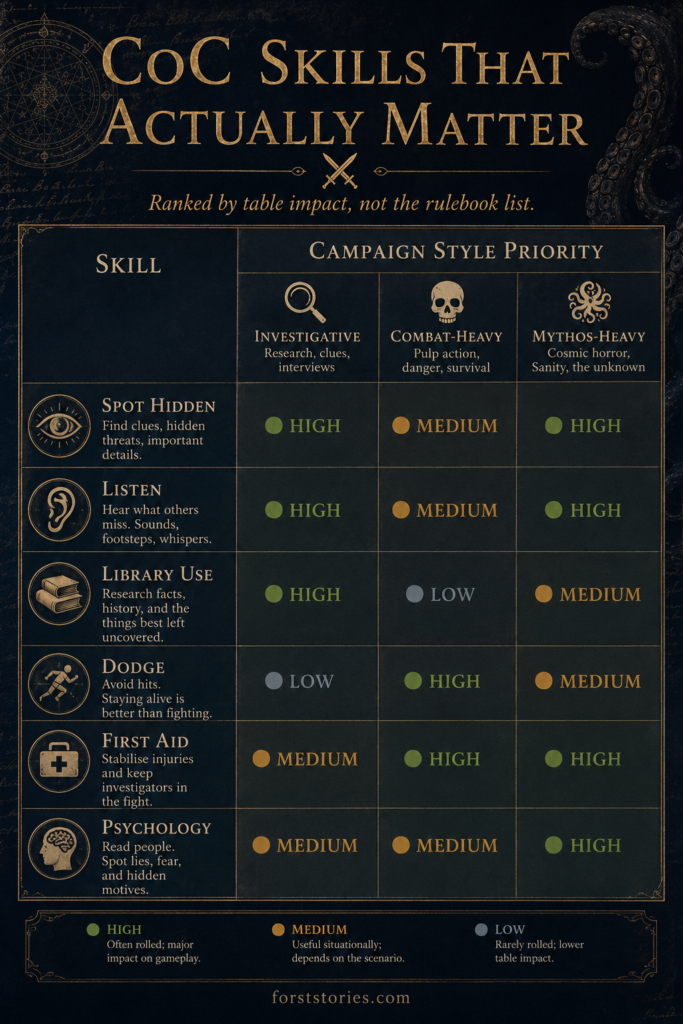
Ask any long-running Keeper which skill comes up most and the answer is rarely a combat stat. Spot Hidden earns its reputation because almost every scene with something to find, a clue, a hidden door, a detail the Keeper wants noticed, routes through it. An investigator who neglects Spot Hidden spends whole sessions missing information the rest of the table assumes they have.
Listen sits close behind it. Overheard conversations, footsteps in the dark, the wrongness in a sound that shouldn’t be there: Listen catches the details Spot Hidden can’t, and the two together cover most of an investigator’s awareness of their surroundings.
Library Use deserves more respect than beginners tend to give it. Investigative scenarios lean hard on research, and a low Library Use score means long stretches of a session where an investigator has nothing useful to contribute while their table mates dig through archives and newspaper morgues. For a game built around uncovering things that should have stayed buried, this is the skill that decides who gets to be part of that process.
None of these three skills feel dramatic on a character sheet. All three shape whether an investigator is present in the scenes the campaign is actually built from.
🩹 The Survival Skills Worth More Than You Think
Combat in Call of Cthulhu is built to be dangerous, so it’s tempting to assume investigators should pour points into offence. The skills that keep a character alive tell a different story.
Dodge matters more than any weapon skill for most builds, because avoiding a hit is almost always a better outcome than trading damage with something that can end an investigator in two or three rounds. A middling Dodge score is one of the cheapest ways to extend a character’s survival window in an encounter the table probably shouldn’t be having in the first place.
First Aid is the skill that turns a downed investigator back into a functioning one before the scene ends. Sanity loss and physical injury both tend to arrive in clusters, and a party without anyone competent at First Aid finds itself burning limited resources, or losing investigators outright, on injuries that a modest skill score would have handled on the spot.
By contrast, skills that look thematic on paper, such as specific weapon proficiencies beyond a single reliable option, rarely earn their point cost. Most tables reach for whatever weapon is on hand in the moment rather than the one an investigator specialised in six months of downtime ago.
🗣️ How Social Skills Shape the Investigator-NPC Relationship
Persuade, Psychology, and Fast Talk don’t just unlock dialogue options. They change how NPCs behave around an investigator for the rest of a campaign.
Psychology is arguably the most consistently useful of the three because it applies passively in almost every social encounter, letting a player read whether an NPC is lying, frightened, or hiding something before committing to an approach. Persuade and Fast Talk then decide what an investigator does with that read: a slow, credible case for cooperation, or a fast, risky bluff that either gets what’s needed immediately or burns the relationship.
A group with no strong social skills tends to solve every NPC interaction through combat or brute investigation, which works but closes off entire branches of a scenario that a Keeper built assuming someone could talk their way through. Investing in even one social skill changes which doors stay open.
🎭 The Occupation Skill Trap
Occupation packages are where a lot of skill points quietly go to waste. A skill can look perfect for an investigator’s backstory, Anthropology for an academic, Navigate for a sailor, a specific Art/Craft for a hobbyist, without ever coming up in the scenarios that character actually plays through.
The trap isn’t that these skills are bad. It’s that they’re chosen for flavour rather than for how often a Keeper’s scenario touches on them. Before locking in an occupation’s skill points, it’s worth asking what the campaign is actually about. A maritime horror campaign makes Navigate genuinely useful; a campaign set entirely in a university town does not.
🧭 Matching Skill Points to Campaign Style
The right allocation depends heavily on what kind of Call of Cthulhu game an investigator is walking into, and this is where a lot of generic advice falls short by treating all campaigns the same.
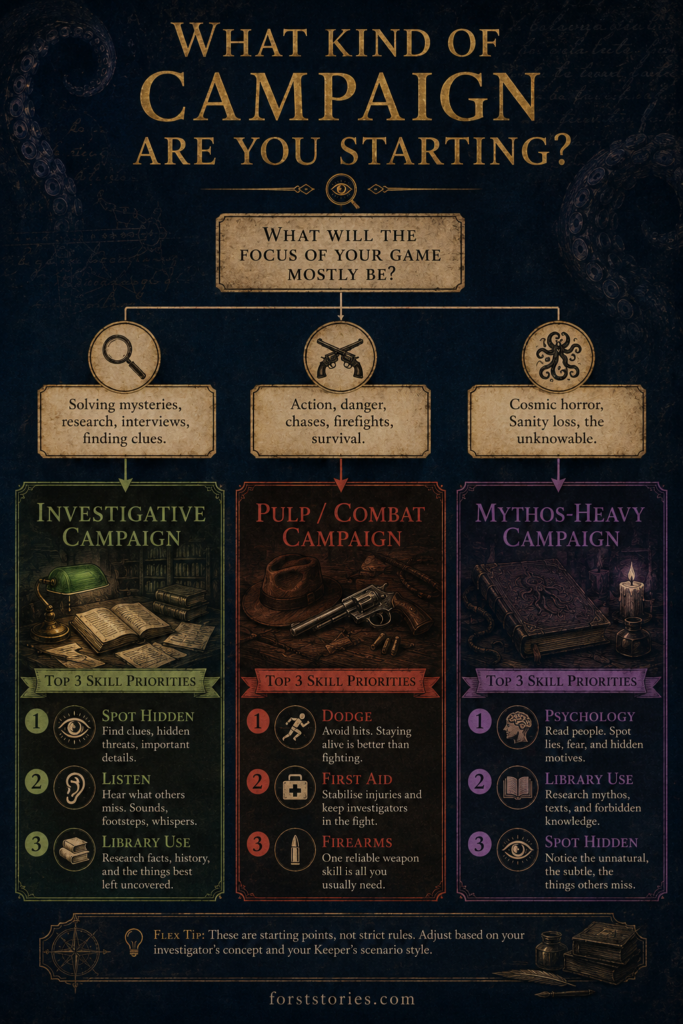
An investigative campaign built around research and interviews rewards heavy investment in Library Use, Spot Hidden, and the social skills. A combat-heavier campaign, common in pulp-style Call of Cthulhu, shifts value toward Dodge, First Aid, and one reliable weapon skill. A mythos-heavy campaign that leans on cosmic horror and long-term Sanity attrition benefits from Psychology, useful for reading fellow investigators as much as NPCs, and whatever knowledge skill lines up with the campaign’s specific mythology.
Asking the Keeper what style of campaign is planned before finalising skill points saves a lot of wasted allocation later.
🧩 A Starting Allocation, and Where to Refine From There
For a first Call of Cthulhu investigator with no strong sense yet of campaign style, a reasonable starting spread favours Spot Hidden, Listen, and Library Use as the investigative core, Dodge and First Aid as the survival core, and one social skill, Psychology being the most broadly useful, rounding things out. This spread keeps an investigator relevant in nearly any scene type without betting everything on a campaign style that hasn’t been confirmed yet.
Experienced players building a new character from this base have room to lean harder into a direction once they know what the campaign demands: push Library Use and a knowledge skill for an investigative-heavy game, or shift points toward Dodge and combat skills for something more pulp-flavoured. The starting spread is a foundation, not a fixed answer, and it holds up well enough that most investigators built from it survive their first few sessions with something useful to do in nearly every scene.
📌 The Takeaway
The skills that matter most in Call of Cthulhu aren’t the ones that sound impressive on a character sheet. Spot Hidden, Listen, and Library Use decide whether an investigator can participate in the investigation itself. Dodge and First Aid decide whether they survive it. Psychology and a chosen social skill decide how much of the story they can shape rather than simply react to. Everything else should earn its point cost based on what the specific campaign is actually about, not on what sounds thematic in isolation.
RPG news, GM tips, and system deep dives — straight to your inbox, no filler.