
Building a Balanced Triangle Agency Team: What Each Role Brings
Triangle Agency runs on the ARC system: Anomaly, Reality, Competency. Anomaly is the strange phenomenon your Field Team has been sent to contain. Reality is the fabric everyone is trying to keep from tearing. Competency is the one piece of that acronym that belongs entirely to the players, because it is the job each character actually does when the team gets thrown into a mission.
🧩 What Is a Competency, Really?
A Competency is not a class in the traditional sense. It is closer to a professional lane inside a very strange organisation. Where a fantasy adventuring party might divide labour into who hits things and who heals them, Triangle Agency divides labour into who talks to people, who researches the phenomenon, who handles the parts of the job nobody else wants, and so on.
That distinction matters more than it sounds. Competencies are not built to slot into a combat formation because Triangle Agency is not built around combat as its central loop. Missions are investigative and improvisational, and a Competency shapes how a character engages with that investigation rather than how hard they can hit an Anomaly.
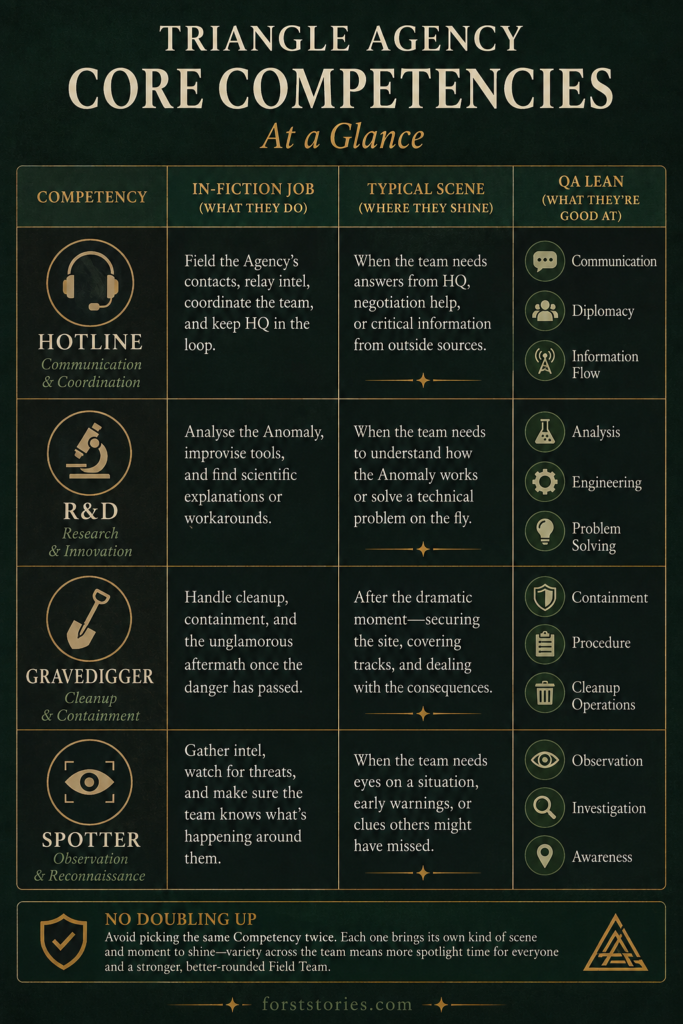
🚫 Why the Game Warns Against Doubling Up
Triangle Agency’s own guidance is direct about this: avoid repeating ARC pieces across a single Field Team. Two players choosing the same Competency is not against the rules, but the game itself nudges groups away from it, and the reasoning is worth sitting with.
It is not a mechanical balance issue the way a table might worry about two identical fighters. It is a spotlight issue. Each Competency comes with its own flavour of scene, its own kind of moment to shine in. Stack two of the same Competency and you have not doubled your effectiveness, you have halved how often each of those two characters gets a scene built around their specific skill set. Variety across the team is what keeps every session feeling like an ensemble rather than a duet with spectators.
🕵️ A Walkthrough of Several Competencies
Every Competency comes with its own in-fiction job description. A few examples give a sense of the range on offer.
Hotline leans into communication and coordination. This is the character who is fielding contact from the wider Agency, relaying information, and often serving as the connective tissue between what the team knows and what headquarters wants done about it.
R&D brings a research and applied-science lean to the table. This Competency is at its best when a mission needs someone to make sense of the Anomaly’s mechanics, or to improvise a tool or workaround the team did not walk in with.
Gravedigger covers the unglamorous side of fieldwork: cleanup, containment, and the parts of the job that happen after the dramatic moment has already occurred. It is a Competency built for consequences rather than confrontations, and it tends to generate some of the more grounded, human beats in a session.
There are others beyond these three, each carrying its own niche. For the full rundown, our breakdown of the Agent roles in Triangle Agency covers every Competency in more depth than fits here. The pattern across all of them holds steady: a Competency answers the question “what does this character actually do for the team,” not “how much damage can this character deal.”
🎯 How Competency Shapes Quality Assurances and Utility
A character’s Competency feeds directly into their Quality Assurances, the traits and abilities that define what they are reliably good at in the field. If you have not built a character yet, our complete ARC guide to character creation walks through how Competency choice translates into QAs at the table. Because Competencies are built around distinct professional lanes, the QAs attached to them tend to open different doors during a mission rather than the same door with a bigger number.
This is where team composition becomes a practical planning question rather than an abstract one. A Field Team built entirely around one Competency will find its QAs clustering around the same narrow set of tools, which means the same narrow set of problems get solved smoothly while everything else becomes improvisation without a safety net. Spreading Competencies across the team spreads that safety net wider.
🧭 Guidance for New Groups Choosing Competencies
New groups sitting down to build a Field Team have an easy heuristic available: look at what each Competency contributes in fiction, not just what it contributes on a character sheet, and try to avoid two players covering the same ground.
Forst Stories
Which Triangle Agency Competency Fits Your Playstyle?
Six scenes. One Field Team assignment.
Question 1 of 6
A few things worth talking through at session zero:
Ask what kind of scenes each player actually wants to be pulled into. Someone drawn to Hotline is signing up for a lot of talking, relaying, and improvised diplomacy. Someone drawn to Gravedigger is signing up for the aftermath scenes, the cleanup, the moments where the mission has already gone sideways and someone has to deal with it.
Think about pacing across a session rather than a single scene. A team with a good spread of Competencies tends to naturally rotate whose expertise is load-bearing from beat to beat, which keeps everyone engaged even when the mission’s current problem is not squarely in their lane.
Do not feel obligated to fill every possible Competency. The point is variety of contribution, not maximum coverage. A three-person team with three genuinely different Competencies will usually feel more balanced than a five-person team with two pairs covering the same ground.
🎲 Balance Here Means Narrative Balance, Not Combat Optimisation
It is worth restating plainly: none of this is about damage output, action economy, or the kind of min-maxing that shows up in combat-focused systems. Triangle Agency’s Competencies are a tool for making sure every player at the table gets scenes that belong to them specifically. A balanced team in this game is one where nobody’s expertise sits unused for entire sessions, and where the mix of professional lanes matches the mix of scenes the group actually wants to play.
Quick Answer
A balanced Triangle Agency Field Team is not built around combat roles. It is built by choosing Competencies that each bring a distinct in-fiction job, so the team’s Quality Assurances cover different kinds of problems and every player gets regular scenes built around what their character does best.
Continue Your Journey
RPG news, GM tips, and system deep dives — straight to your inbox, no filler.