Understanding RPG Dice: From d4 to d100
You’re sitting at the gaming table for the first time. The Game Master says, “Roll 2d6+3 for damage.” Everyone else grabs handfuls of colorful plastic polyhedrons while you stare blankly, wondering if you accidentally signed up for a geometry class.
We’ve all been there. RPG dice look intimidating at first, but they’re actually simple once you understand the basics. This guide breaks down everything you need to know about dice types, how to read notation, and the probability that helps you make smart choices at the table.

The Basic Set – Your Seven Essential Dice
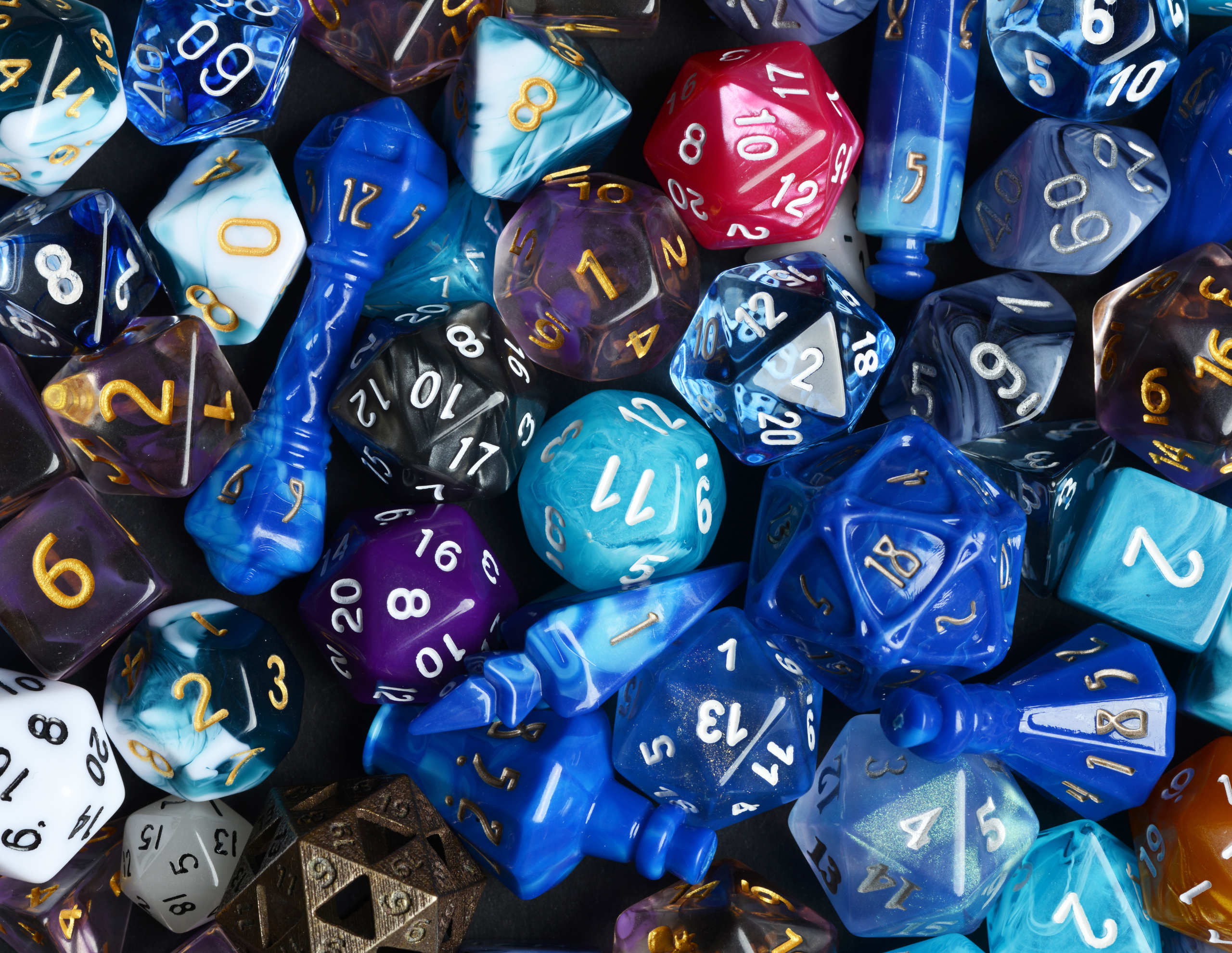
Walk into any game store and you’ll find “7-piece dice sets” everywhere. These seven dice form the foundation of most tabletop RPGs, especially Dungeons & Dragons and similar fantasy systems.
d4 (Four-Sided Die)
The d4 looks like a tiny pyramid or caltrop. Reading it can be tricky at first since the number you rolled appears at the base or point, depending on the design.
You’ll roll d4s for low damage weapons like daggers and darts. Most healing spells in D&D also use d4s (cure wounds is 1d4+modifier). Systems like Call of Cthulhu occasionally use them for skill bonuses or penalties.
Pro Tip: The d4 is notorious for being a “caltrop” because stepping on one hurts. Keep them contained in a dice tray.
d6 (Six-Sided Die)
The familiar cube from board games everywhere. While other dice are RPG-specific, you probably have dozens of d6s lying around your house already.
The d6 shows up constantly in RPGs. Some systems like Blades in the Dark use only d6s for all rolls. In D&D, they handle medium weapons like shortswords and firebolt cantrips. When creating your first 5E character, you might roll “4d6 drop lowest” to generate ability scores.
d8 (Eight-Sided Die)
This octahedron has eight triangular faces. The numbers are easy to read on top.
d8s represent medium-power weapons (longswords, battleaxes) and moderate healing spells. In Savage Worlds, attributes and skills use different dice sizes, and d8 represents above-average capability.
d10 (Ten-Sided Die)
The d10 usually shows numbers 0-9 or 1-10. Most sets include two d10s for a reason we’ll cover in a moment.
Systems like World of Darkness rely heavily on d10s. Call of Cthulhu uses percentile dice for most skill checks, which requires two d10s.
d12 (Twelve-Sided Die)
The twelve-sided dodecahedron is often called “the loneliest die” because it gets used less frequently than others.
In D&D, the d12 shines for greataxe damage and some barbarian features. Pathfinder 2E uses it similarly. If you’re playing a greataxe-wielding barbarian, you’ll love this die.
d20 (Twenty-Sided Die)
The iconic RPG die. This icosahedron represents the heart of D&D and many fantasy systems.

Most D&D rolls use the d20. Attack rolls, saving throws, and ability checks all rely on this die. Rolling a natural 20 (the die shows 20 before modifiers) usually means automatic success or critical hit. A natural 1 typically means automatic failure.
Fun Fact: When running your first TTRPG campaign, you’ll probably roll more d20s than all other dice combined.
d100/Percentile Dice
You create a d100 by rolling two d10s together. One die represents the tens digit, one represents the ones digit. Most dice sets include one d10 marked in increments of 10 (00, 10, 20, etc.) to make this easier.
Rolling percentile dice: If you roll a 70 and a 3, you rolled 73. If you roll 00 and 0, that’s 100 (not 0). Systems like Call of Cthulhu and older editions of D&D use percentile rolls extensively for skill checks and random tables.
Dice Notation Decoded
RPG books use shorthand to tell you which dice to roll. The format is simple once you know the pattern.
The Basic Formula: XdY+Z
- X = how many dice to roll
- d = die/dice (always lowercase)
- Y = what type of die (the number of sides)
- Z = modifier to add or subtract
Let’s break down some common examples:
1d20+3 means roll one twenty-sided die and add 3 to the result. This is a standard attack roll for a character with +3 attack bonus.
2d6 means roll two six-sided dice and add them together. A greatsword deals 2d6 damage in D&D.
4d6 drop lowest means roll four six-sided dice and drop the lowest result. This is common for creating your first D&D character’s ability scores.
3d10 means roll three ten-sided dice and total them. Some spells and abilities in various systems use this notation.
🎲 RPG Dice Notation Guide 🎲
Master the Language of Tabletop Gaming
Special Notation Systems
Different game systems add their own twists to dice notation.
Advantage and Disadvantage (D&D 5E): Roll 2d20 and take the higher (advantage) or lower (disadvantage) result. This replaces adding or subtracting small bonuses.
Exploding Dice (Savage Worlds): When you roll the maximum number on a die, you roll it again and add both results. Savage Worlds uses this extensively to create dramatic moments.
Critical Hits: Some systems double the dice rolled (roll 2d6 becomes 4d6), while others maximize the dice before adding modifiers.

Practice Examples
Try these in your head or with real dice:
- 2d8+4 – Roll two eight-sided dice, add them together, then add 4
- 1d12-2 – Roll one twelve-sided die and subtract 2
- 5d10 – Roll five ten-sided dice and total them
- 3d6+6 – Roll three six-sided dice, total them, and add 6
Probability Basics Every Player Should Know
Understanding probability won’t make you roll better, but it helps you make smarter choices and set realistic expectations.
Single Die Probability
A d20 gives each number an equal 5% chance (1 in 20). Need to roll 15 or higher? That’s 6 numbers (15, 16, 17, 18, 19, 20), so 30% chance. A +1 bonus shifts this to needing 14 or higher (35% chance).
This flat probability means rolling a 1 is exactly as likely as rolling a 20. Every roll has the same odds regardless of what you rolled before.
Multiple Dice Create Curves
Here’s where it gets interesting. Rolling 1d20 gives flat probability, but rolling 3d6 creates a bell curve.
With 3d6, rolling a 10-11 is much more likely than rolling a 3 or 18. The average result is 10-11, and most rolls cluster around the middle. This creates more predictable, reliable outcomes.
Games like GURPS use 3d6 instead of 1d20 specifically for this reliability. Blades in the Dark uses dice pools that create similar probability curves.
Quick Math for Common Rolls
- 1d20 averages 10.5
- 2d6 averages 7 (not 6!)
- 1d8+4 averages 8.5
- 3d6 averages 10.5
Why does 2d6 average 7? Because you can roll 1+6, 2+5, 3+4, 4+3, 5+2, or 6+1 to get 7, but only one way to get 2 (1+1) or 12 (6+6).
Understanding Difficulty Classes
When planning your first game session, understanding DC (Difficulty Class) helps balance challenges.
In D&D, difficulty breaks down roughly like this:
- DC 5: Very Easy (85% success with no bonuses)
- DC 10: Easy (55% success)
- DC 15: Medium (30% success)
- DC 20: Hard (5% success)
- DC 25: Nearly Impossible (requires bonuses)
A +5 bonus shifts everything up one tier. That DC 15 Medium check becomes 55% likely instead of 30%.
When Dice Betray You
You’ll have sessions where you can’t roll above 10. You’ll miss three attacks in a row with a 65% hit chance. This is statistically normal.
Probability describes what happens over thousands of rolls, not in any single session. Your dice don’t “remember” previous rolls. Each roll is independent with the same odds as before.
Beyond the Basic Seven
Most games stick with the standard seven dice, but specialty dice expand your options.
Uncommon Dice Sizes
- d2: Flip a coin. Useful for 50/50 decisions.
- d3: Usually created by rolling a d6 and dividing by 2 (rounding up). Some games use these for minor bonuses.
- d30: These exist but are rarely used. Some old-school D&D tables reference them.
- Physical d100: A golf ball-sized sphere with 100 faces. Impractical but impressive. Rolling two d10s works better.
Narrative Dice Systems
Some games abandon numbered dice entirely.
- Fudge/Fate Dice: Show minus (-), blank (0), or plus (+). You roll four and total the symbols. These create outcomes from -4 to +4 with a strong central tendency.
- Custom Symbol Dice: Fantasy Flight’s Star Wars RPG uses dice with success, advantage, threat, and triumph symbols. You roll pools and interpret the combined symbols narratively.
These systems focus on story outcomes rather than exact numbers. They work well for cinematic, narrative-focused games.
Substitution Methods
Don’t have the right die? Use these tricks:
- d2 from d4: 1-2 is result 1, 3-4 is result 2
- d3 from d6: 1-2 is result 1, 3-4 is result 2, 5-6 is result 3
- d5 from d10: Divide by 2, round up
- Any die from d20: Roll d20 and divide accordingly
Digital dice rollers also work great as backup. More on that in a moment.
What Dice Do You Actually Need?
Starting out? Get one complete 7-piece set. Budget sets cost $5-10 and work perfectly fine.
System-Specific Recommendations
D&D 5E or Pathfinder: One standard set works, but having extra d6s, d8s, and d20s helps. When creating characters or dealing damage, multiple dice speed things up.
Call of Cthulhu: Two d10s (for percentile rolls) and a d6 cover most needs. The Call of Cthulhu system relies on percentile rolls for skill checks.
Savage Worlds: One standard set plus extra d6s works well. This system uses variable die types based on character capabilities.
Blades in the Dark: You need 6-10 d6s since this system uses dice pools for resolution.
Quality Considerations
As a beginner, readability matters more than appearance. Make sure you can read the numbers clearly from across the table.
Metal dice look impressive but are expensive ($30-50+ per set) and can damage tables. Wood and resin offer middle ground. Standard plastic dice ($8-15) work great.
When running urban adventures or complex campaigns, having duplicate sets helps when multiple players roll simultaneously.

Digital Dice Tools
Sometimes physical dice aren’t practical. Digital rollers fill this gap perfectly.
When Digital Makes Sense
Online gaming requires digital dice. Platforms like Roll20 include built-in rollers. If you’re playing digital RPGs that don’t include automatic rolling, external tools help.
Missing a die? Digital rollers instantly provide any combination. Complex rolls (8d6+2d8+15) are faster digitally than with physical dice.
Some players prefer digital for accessibility reasons. Vision impairments or motor control issues make physical dice challenging.
Recommended Tools
- D&D Beyond: Free dice roller integrated with character sheets. Perfect for D&D 5E players.
- Roll20: Full virtual tabletop with advanced dice mechanics. Great for online campaigns.
- Mobile Apps: “Dice Ex Machina” and “RPG Simple Dice” offer clean, fast interfaces.
- Discord Bots: Avrae bot provides comprehensive dice rolling for online gaming groups.
Physical vs Digital
Physical dice create tactile satisfaction and table presence. Rolling real dice during intense combat scenes builds tension. Most players prefer physical dice when possible.
Digital dice offer convenience and speed but lack the ceremonial feel. When prepping sessions in 30 minutes, having both options available maximizes efficiency.
Your Next Steps
You now understand the seven essential dice, can read any dice notation, and know the probability behind common rolls. That’s everything you need to start playing confidently.
Get Your Dice: Buy one 7-piece set from your local game store or online. Budget-friendly options work perfectly for beginners.
Practice Reading Notation: Look through a rulebook for your chosen system and identify different notation types.
Try Rolling: Use online dice rollers to practice without buying physical dice first.
Learn Your System: Each game uses dice differently. D&D 5E emphasizes d20 rolls, while Call of Cthulhu uses percentile dice extensively.
Everyone starts as a beginner. The friendly person at your table who knows every dice combination by heart? They once stared at a d4 wondering which number they rolled. The RPG community loves helping newcomers, so ask questions when confused.
The math is simpler than it looks, the dice are easier to read than you think, and that first natural 20? That feeling never gets old, whether it’s your first session or your thousandth.
What was your first dice set? Share your dice stories in the comments below! If you found this guide helpful, check out our complete guide to running your first TTRPG campaign or learn about different RPG systems beyond D&D.
RPG news, GM tips, and system deep dives — straight to your inbox, no filler.