Running Urban Adventures — City Campaign Guide
Cities pulse with life. Behind every cobblestone lies a secret, beyond every market stall waits an opportunity for adventure. Urban campaigns offer Game Masters a unique canvas where political intrigue meets street-level action, where every NPC could be a potential ally or enemy.
This comprehensive guide provides the tools and strategies you need to create dynamic city-based adventures. Whether you’re designing sprawling metropolises or intimate borough neighborhoods, you’ll discover practical frameworks for building living cities that respond to your players’ actions. From the “City District Generator” table to political intrigue mechanics, this guide transforms complex urban environments into manageable, engaging adventures.
Core City Design Principles
Districts & City Structure
Cities aren’t monolithic blocks of buildings—they’re collections of distinct neighborhoods, each with its own personality and challenges. Divide your city into 4-8 districts maximum to keep things manageable. Each district should serve a different narrative function and social class.
Essential District Types:
- Wealthy noble quarter where intrigue thrives
- Bustling merchant district where information flows freely
- Shadowy docks where smugglers conduct business
- Working-class neighborhoods with tight-knit communities
Create geographic barriers that reinforce social divisions: bridges, walls, elevation changes, or magical wards can all serve as natural boundaries. Map these districts with overlapping spheres of influence rather than rigid borders.
Key Design Principles:
- Criminal underworld doesn’t respect noble property lines
- Merchants need access to multiple neighborhoods
- Overlap creates natural tension points where factions meet and conflict
Themes & Tone
Your city’s theme shapes every interaction and encounter. A noir-influenced city emphasizes shadows, moral ambiguity, and corruption in high places. A steampunk metropolis features technological wonders alongside industrial pollution and class warfare.
Reinforcing Theme Through Details:
- Crime-ridden cities: Obviously corrupt guards, frequently broken street lights, rare honest merchants
- Steampunk settings: Mechanical innovations, visible pollution, technology-driven class divisions
- Magical cities: Enchanted infrastructure, supernatural laws, arcane regulations
Weather, architecture, and even local accents all contribute to atmospheric immersion. Don’t try to incorporate every theme at once. Pick one primary tone and maybe one secondary element. A steampunk city with noir undertones works; a steampunk-noir-fantasy-western kitchen sink doesn’t.
Factions, Power Centers & Key Figures
Power in cities rarely rests with a single authority. Distribute influence among 3-5 major factions: the official government, merchant guilds, religious orders, criminal organizations, and perhaps a magical academy or foreign embassy.
Faction Design Essentials:
- Each faction needs clear goals that conflict with at least two others
- Merchant guild wants trade routes protected while thieves’ guild profits from dangerous routes
- City watch wants order while underground rebellion needs chaos to succeed
- Religious orders seek influence while secular authorities resist theocracy
Create memorable NPCs to represent each faction. Give them distinctive speech patterns, physical descriptions, and personal quirks:
- Guild master who counts coins obsessively
- Corrupt captain who always wears fresh flowers
- Rebel leader who quotes ancient poetry
These details make factions feel real rather than abstract political entities.
Types of Urban Encounters
Social Encounters
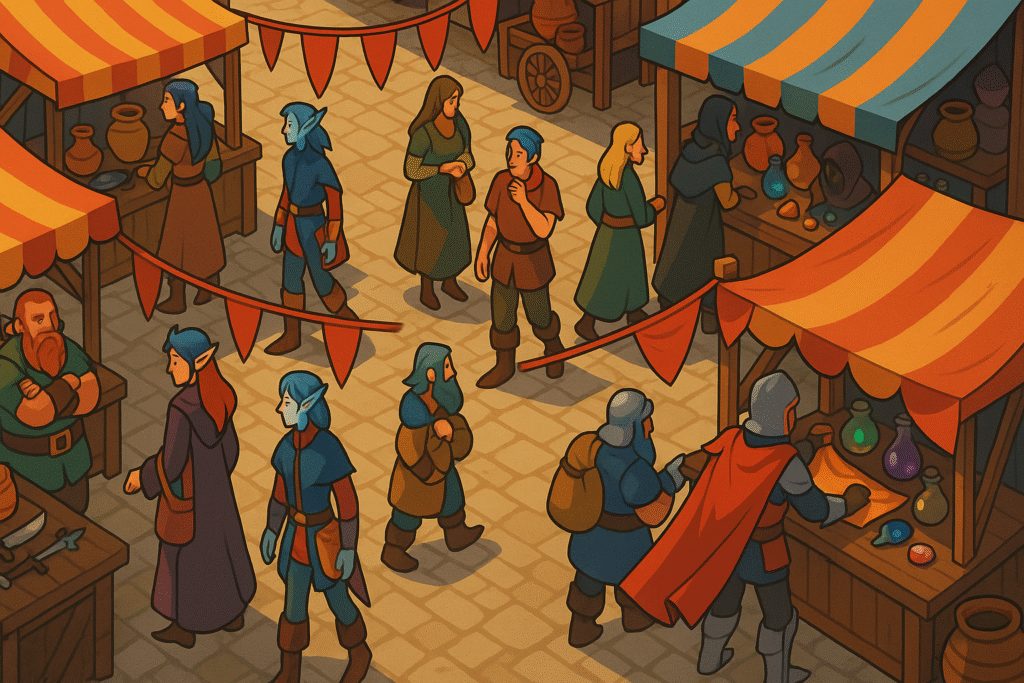
Cities thrive on conversation. Every street corner offers opportunities for social interaction, from haggling with merchants to gathering information from tavern patrons. Unlike dungeon crawls where encounters are discrete events, urban social encounters flow naturally into each other.
Information Exchange Framework:
- NPCs want news, gossip, favors, or payment before sharing what they know
- Create information webs where different sources provide conflicting details
- Street vendors know different gossip than noble servants
- Information accuracy varies based on source reliability
Public events create natural gathering points for social encounters:
- Festivals allow players to navigate crowds and overhear conversations
- Executions showcase the city’s current mood and political tensions
- Political speeches provide opportunities to gauge public opinion
- Market days concentrate diverse NPCs in accessible locations
These events also showcase the city’s current mood and political tensions while providing cover for clandestine activities.
Exploration Encounters
Urban exploration extends far beyond walking down streets. Cities offer vertical movement through sewers, rooftops, and abandoned buildings. Each level tells different stories about the city’s history and current state.
Environmental Challenge Categories:
- Locked gates requiring creative bypassing
- Crowded markets where stealth becomes difficult
- Construction sites providing temporary passages
- Weather events like fog, rain, or heat waves altering familiar routes
Design exploration with multiple valid approaches:
- Front doors: Social skills and proper credentials
- Rooftops: Athletics and climbing equipment
- Sewers: Endurance and navigation skills
- Magical shortcuts: Spells and arcane knowledge
Each route offers different information and encounters. Players who take the sewers might discover smuggling operations, while those using rooftops could witness secret meetings in supposedly private courtyards.
Combat & Chase Scenes
Urban combat rarely happens in empty rooms. Streets filled with civilians create moral complications and tactical opportunities. Crowds can provide cover or become hostages. Market stalls offer improvised weapons and barriers.
Chase Scene Design Elements:
- Create branching paths where player choices matter
- Narrow alley: Risks dead end but avoids crowds
- Main street: Multiple escape routes but draws unwanted attention
- Rooftop route: Spectacular but dangerous if you fall
- Sewer entrance: Hidden but potentially leads to worse dangers
Vertical Combat Opportunities:
- Rooftop pursuits with jumping between buildings
- Fights on bridges with water hazards below
- Combat that moves between building levels
- Balcony-to-street interactions during conflicts
Always consider what’s happening below during aerial scenes. Falling characters might crash through vendor stalls, land in hay carts, or unfortunately impact innocent bystanders. These consequences make urban combat feel more dynamic and morally complex than wilderness encounters.
Puzzles, Mysteries & Investigation
Cities excel at mystery scenarios because they contain so many interconnected elements. A single crime might involve multiple districts, factions, and social classes. Clues scattered across the city require players to explore thoroughly and piece together complex narratives.
Create investigation scenarios where NPCs remember different details about the same events. The street vendor saw the victim talking to a well-dressed stranger, while the beggar noticed the stranger’s expensive boots were muddy. Multiple perspectives reveal the complete picture gradually.
Urban mysteries benefit from false leads and red herrings that still provide value. The suspicious merchant might not be the murderer, but investigating them reveals information about smuggling operations that becomes useful later. Every clue should advance some aspect of the campaign.
Mechanics of Political Intrigue
Faction Goals & Rivalries
Track faction objectives using simple status trackers. Each faction pursues 2-3 major goals simultaneously: immediate needs (next week), short-term ambitions (next month), and long-term visions (next year). As players interfere with these plans, factions adapt and react.
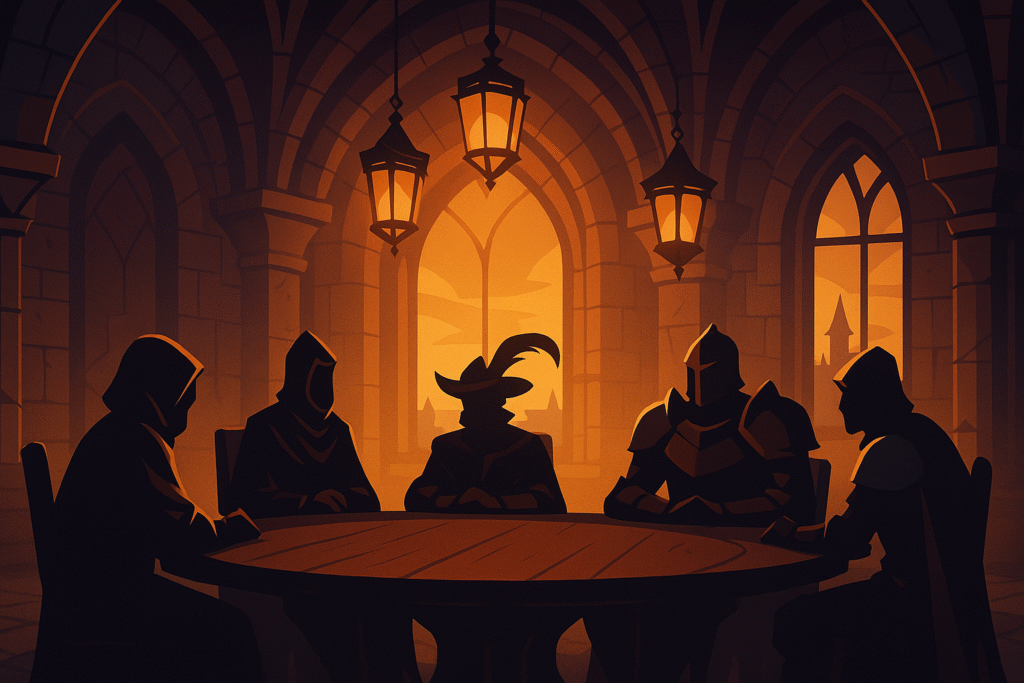
Create alliance webs that shift based on circumstances. Traditional enemies might cooperate against a greater threat, while allies could become rivals when their goals conflict. Document these relationships visually—a simple diagram helps track changing dynamics.
Secret agreements between factions add layers of complexity. The city guard might secretly cooperate with certain criminal elements to maintain order, while officially opposing all illegal activity. Players discovering these arrangements can leverage them for their own purposes.
Player Influence & Social Leverage
Implement a simple reputation system tracking how different factions view the party. Use a scale from -5 (actively hostile) to +5 (trusted allies), adjusting based on player actions. Reputation affects prices, information access, and NPC cooperation.
Track favors owed and debts incurred. When players help NPCs, note what they’ve done and who owes them return favors. Similarly, track when players ask for help they can’t immediately repay. This creates an ongoing network of obligations that drives future encounters.
Blackmail material and compromising information serve as adventure currency. Players might discover a corrupt official’s secret dealings or witness a faction leader’s embarrassing moment. These secrets become tools for negotiation and influence.
Consequence & Escalation
Urban adventures shine when player actions create cascading consequences. A simple theft might anger a merchant, who complains to the guard, who increases patrols, which interferes with smuggling operations, leading to conflict between criminals and authorities.
Design escalation chains where small actions grow into major events. Start with personal stakes (someone’s angry at the party), expand to factional concerns (guild policies change), and potentially reach city-wide implications (riots or political upheaval).
Let players see their impact on the city. NPCs reference past events, laws change in response to player actions, and new opportunities arise from previous adventures. This feedback loop makes the city feel responsive and alive.
Roleplaying Power: Council Meetings & Trials
Formal political scenes like trials or council meetings provide great opportunities for roleplay without combat. Structure these as social encounters with clear stakes and multiple possible outcomes.
Give each NPC in formal settings distinct motivations beyond their official positions. The judge might be personally honest but politically compromised. Council members could have hidden agendas that don’t align with their public statements.
Create procedures that players can learn and exploit. Understanding how council voting works, what evidence courts accept, or which officials can be bribed helps players navigate political challenges strategically. Rules create opportunities for creative solutions.
Using the City District Generator Table
What is a City District Generator?
The City District Generator helps create coherent neighborhoods quickly, whether you’re planning ahead or improvising during play. Each roll provides a district name, key features, power centers, secrets, and atmosphere. This ensures every neighborhood feels distinct and offers adventure opportunities.
Use the generator to spark creativity rather than restrict it. The results provide starting points that you can modify to fit your campaign’s needs. Roll multiple times and combine interesting elements, or use single results as inspiration for custom districts.
City District Generator Table
| d12 | District Name | Notable Features | Faction/Power Center | Secrets/Plot Hooks | Mood |
|---|---|---|---|---|---|
| 1 | Iron Wharf | Shipyards, warehouses, crane towers | Dockworker’s Guild | Smuggling ring operated by guild leaders | Foggy, industrial |
| 2 | Goldspire Heights | Elegant mansions, private gardens, statue-lined boulevards | Noble families coalition | Ancient family curse affects bloodline | Pristine, exclusive |
| 3 | Tanner’s Quarter | Leather workshops, pungent smells, working-class housing | Crafters’ Union | Illegal magical experiments in basement labs | Gritty, aromatic |
| 4 | Scholar’s Grove | Libraries, academies, bookshops, student lodging | Arcane University | Forbidden knowledge hidden in rare book collection | Intellectual, studious |
| 5 | Beggar’s Bridge | Ramshackle shelters, soup kitchens, temporary camps | Thieves’ Guild front operation | Underground tunnel network connects entire city | Desperate, hidden |
| 6 | Temple Ward | Multiple shrines, meditation gardens, prayer halls | Religious council of high priests | Secret war between competing deities | Sacred, tense |
| 7 | Merchant’s Row | Bustling markets, banks, trading houses, auction halls | Trade consortium board | Price-fixing conspiracy involving foreign agents | Prosperous, busy |
| 8 | Artisan’s Corner | Workshops, studios, galleries, apprentice quarters | Independent creators collective | Magical artworks contain trapped spirits | Creative, mystical |
| 9 | Foreign Quarter | Embassy buildings, exotic restaurants, cultural centers | Ambassador’s council | Spy network operates through diplomatic immunity | Cosmopolitan, secretive |
| 10 | Old Town | Crumbling walls, ancient architecture, narrow alleys | Historical preservation society | Buried ruins contain portal to other plane | Historic, mysterious |
| 11 | Garden District | Parks, greenhouses, botanical collections, nature shrines | Druid circle | Sentient plants plot against urban expansion | Verdant, alive |
| 12 | Undercity | Sewer tunnels, abandoned foundations, hidden chambers | Outcast community leaders | Lost heir to throne lives among refugees | Dark, forgotten |
On-the-Fly City Building
When players unexpectedly explore new areas, roll on the generator table and adapt results to fit your campaign’s established facts. If the result doesn’t match your city’s geography, use the concepts but change the details. “Iron Wharf” might become “Iron Foundry” in a landlocked city.
Combine elements from multiple rolls to create unique districts. Take the “Elegant mansions” from Goldspire Heights and the “Religious council” from Temple Ward to create a district where wealthy families fund competing religious orders.
Connect new districts to existing campaign elements. If players are investigating smuggling, the Iron Wharf becomes immediately relevant. If they’re dealing with noble politics, Goldspire Heights offers new complications and opportunities.
Practical GM Tips & Tools
Prepping for Urban Play
Create modular encounter sets that work in multiple districts. A “street robbery” encounter adapts differently in the wealthy quarter (hired thugs sent by enemies) versus the poor district (desperate families seeking food money). This preparation approach saves time while maintaining variety.

Essential Preparation Elements:
- Develop rumor tables specific to your city (20-30 rumors mixing truth and fiction)
- Include current events, historical facts, and deliberate misinformation
- NPCs share rumors appropriate to their social class and neighborhood
- Tavern workers know different gossip than noble servants
Safety Zone Guidelines:
- Establish safe and dangerous areas clearly
- Temple district might be completely safe during daylight
- Same area becomes dangerous after dark when different factions take control
- Players need to understand consequences of their location choices
- Reputation and faction standing affect safety in different districts
Handling City Movement & Time
Use abstract movement for most city travel. Unless the journey itself creates interesting encounters, simply ask players where they’re going and skip to their arrival. Save detailed movement tracking for chase scenes, stealth missions, or time-critical situations.
Create random encounter tables for different districts and times of day. Not every random encounter should be combat—social interactions, environmental challenges, and information opportunities provide variety. Weight encounters based on district characteristics and current campaign events.
Track time in broad strokes: morning, afternoon, evening, night. Different NPCs are available at different times, and some encounters only make sense during specific periods. The corrupt guard captain might only accept bribes after midnight, while the merchant guild meets every morning.
Maps & Visual Aids
Start with simple district maps showing major landmarks and connections between neighborhoods. Add detail gradually as players explore specific areas. Hand-drawn maps often work better than complex digital creations because they’re easier to modify during play.
Create handouts that reinforce your city’s atmosphere. Wanted posters, broadsheets announcing new laws, letters between NPCs, and guild membership papers all help players feel immersed in the urban environment. Simple props significantly enhance the experience.
Use battle maps only when positioning matters for combat or complex encounters. Most social interactions and exploration scenes work fine with verbal descriptions and simple sketches. Save your detailed mapping time for encounters where it adds real value.
Managing Complexity
Keep faction relationship charts simple and visible. A single page showing major groups, their goals, and current conflicts provides quick reference during play. Update this document as relationships change based on player actions.
NPC Organization Systems:
- Use index cards or digital tools to track important NPCs
- Include name, faction, personality traits, and what they know or want
- Sort these by district for quick access during exploration
- Cross-reference cards when NPCs know each other
- Note relationship changes after each session
Campaign History Tracking:
- Create campaign journals tracking major events and consequences
- Note what players did, how NPCs reacted, and what changes resulted
- This history helps maintain consistency and provides inspiration
- Reference past events to show long-term impact of player choices
- Use previous adventures as springboards for new complications
Understanding how to effectively set up your TTRPG campaign provides the foundation for successful urban adventures. Similarly, running proper session zero strategies becomes especially important when establishing the complex social expectations of city campaigns.
Advanced Options
Magic & the Urban Environment
Magic fundamentally changes urban dynamics. Teleportation spells might make walls and gates meaningless, while divination magic could eliminate most criminal investigations. Establish clear rules about magical limitations and detection to maintain narrative tension.
Consider magical infrastructure. Do mage lights illuminate streets, making night encounters different from medieval settings? Can magical communication replace messengers, changing how quickly information spreads? These details create unique tactical and social considerations.
Regulate magic through laws and social conventions. Perhaps spellcasting requires licenses, certain spells are prohibited in specific districts, or magical duels follow formal protocols. These restrictions create adventure opportunities while preventing magic from solving every problem.
Intercity & Underworld Connections
Design sewer systems and underground areas as separate adventure environments with their own rules and inhabitants. Underground communities might follow different laws than surface dwellers. The undercity could house exiled groups, escaped criminals, or creatures that prefer darkness.
Connect your city to broader regional politics through trade routes, diplomatic relationships, and shared threats. Events in neighboring settlements affect your city’s economy, refugee populations, and security concerns. This broader context provides adventure seeds and explains recurring NPCs.
Create pathways that bypass normal city access: smuggler tunnels, thieves’ highways across rooftops, magical portals controlled by specific factions. These routes provide alternatives to conventional travel while creating opportunities for clandestine encounters.
Sample City: Rivenhaven Quick-Start
Rivenhaven sits where two rivers converge, creating natural districts separated by water. The wealthy Goldbridge District occupies the high ground north of the main river. Merchant’s Landing spreads along the eastern riverbank where most trade enters the city. The Warrens fill the marshy southern lowlands with working-class housing and workshops.
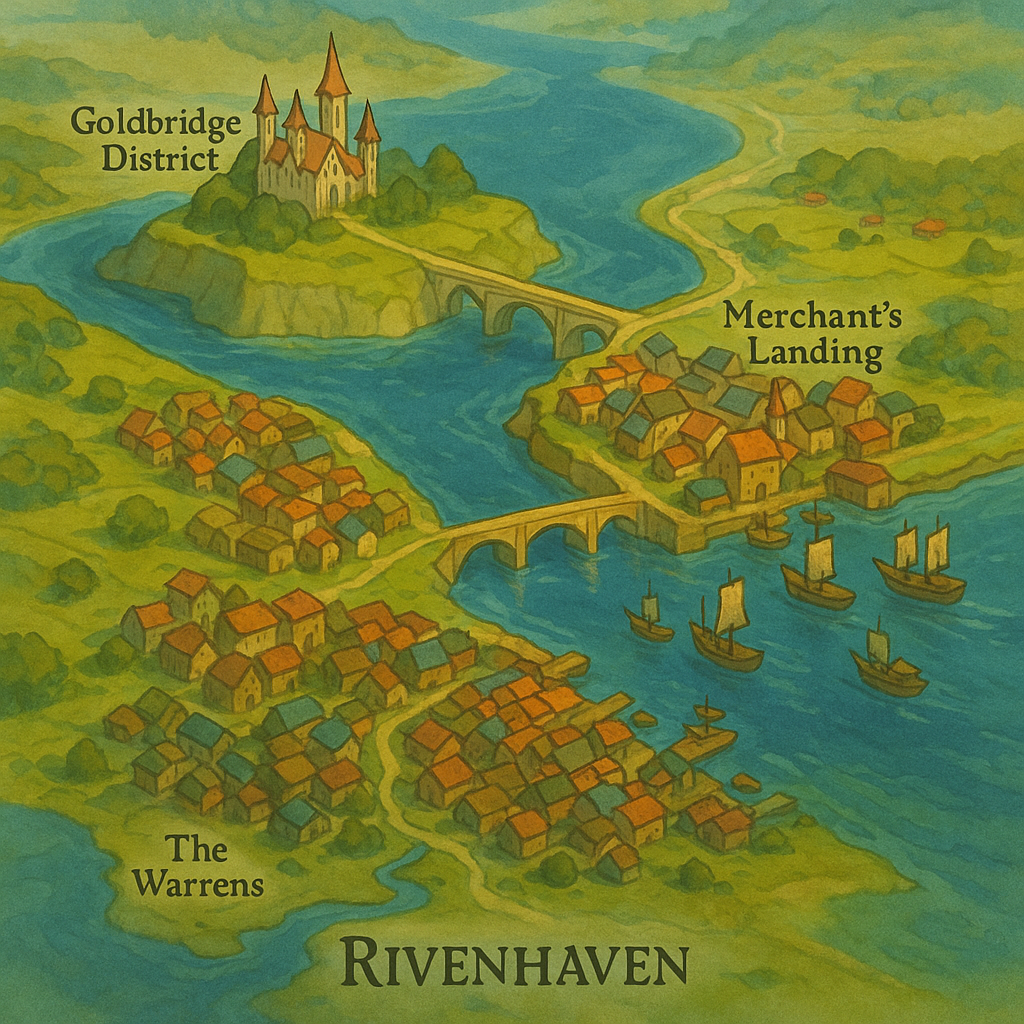
Three major factions vie for control. House Aldermere has ruled for generations but faces growing challenges to their authority. The Riverstone Trading Company commands enormous economic influence through their control of shipping and banking. The Whispering Tide operates from the shadows, running smuggling operations and information networks.
Current tensions center around a proposed new bridge connecting Goldbridge District directly to the eastern trade roads. House Aldermere supports the project to increase tax revenue. Riverstone Trading opposes it because their ferries currently provide the only river crossing. The Whispering Tide sees opportunity in the conflict, selling information to both sides while pursuing their own agenda.
Recent adventures might involve players investigating mysterious accidents plaguing bridge construction, mediating between feuding merchants and nobles, or discovering the Whispering Tide’s plans to profit from prolonged conflict. Each faction offers different rewards and requires different approaches.
The generator table easily expands Rivenhaven. Rolling “Temple Ward” creates the Sacred Isle, a small island between the rivers housing competing religious orders. “Iron Wharf” becomes Ironwater Docks, a section of Merchant’s Landing where metalworkers cluster near the shipping facilities.
🏰 City District Generator
Adventure Hooks & Campaign Arcs
The Vanishing Merchants: Successful traders disappear mysteriously, leaving behind only their empty homes and confused families. Investigation reveals a complex web involving identity theft, magical disguises, and foreign agents seeking to destabilize the local economy.
Election Chaos: The city prepares to elect a new council member, but campaigns turn violent when anonymous threatening letters target candidates. Players must protect the democratic process while uncovering who benefits from electoral chaos.
Underground War: Two criminal organizations clash in the city’s depths, creating dangerous conditions for surface dwellers as their conflict spills into public areas. Players must navigate between the warring factions or find ways to resolve their dispute.
The Noble’s Secret: A prominent aristocrat requests help retrieving stolen personal property, but the theft reveals embarrassing family secrets that could destroy their political standing. Players must balance their client’s privacy against growing evidence of corruption.
Plague of Nightmares: Citizens report shared disturbing dreams that leave physical marks upon waking. The supernatural threat requires investigation into both magical research facilities and underground cult activities that might be connected.
Revolutionary Uprising: Economic inequality reaches a breaking point as working-class districts organize protests that threaten to become violent revolution. Players must choose sides or find peaceful solutions while various factions attempt to exploit the unrest.
Foreign Intrigue: Diplomatic tensions escalate when a foreign ambassador’s daughter disappears, potentially triggering international conflict. The investigation uncovers spy networks, romantic scandals, and political conspiracies that extend far beyond simple kidnapping.
Guild War: Traditional craft guilds clash with innovative merchants introducing new technologies and business practices. Economic disruption affects the entire city as strikes, boycotts, and sabotage create opportunities for both profit and adventure.
Long-term campaign arcs develop when multiple adventure hooks interconnect. The vanishing merchants investigation might reveal foreign agents working to destabilize the city before the revolutionary uprising. Characters who help resolve guild conflicts earn influence that proves crucial during election chaos.
Urban campaigns excel at creating these interconnected storylines because cities contain so many overlapping interests and relationships. Every adventure creates consequences that influence future events, building toward major story moments where player choices determine the city’s ultimate fate.
For Game Masters seeking to enhance their urban campaigns further, consider how balancing combat and roleplay becomes especially important in city settings where social encounters often prove more significant than physical conflicts. Additionally, implementing props and handouts can greatly enhance the immersive experience of navigating complex urban environments.
Conclusion & Next Steps
Urban adventures offer Game Masters unique opportunities to create layered, responsive campaign settings where player choices ripple outward through interconnected communities. Cities provide natural frameworks for political intrigue, social encounters, and complex mysteries that unfold over multiple sessions.
Start small with a single district and a few key NPCs, then expand organically as your players explore and your confidence grows. Use the City District Generator as inspiration rather than restriction—adapt, modify, and build upon the results to create the perfect urban environment for your campaign.
The tools and strategies in this guide provide starting points for creating memorable city campaigns. Experiment with different approaches, pay attention to what your players enjoy most, and don’t hesitate to adjust your methods based on what works best at your table.
Urban adventures reward preparation, but they also thrive on improvisation. Build your foundation carefully, then trust yourself to adapt and create during play. Your city will come alive through the collaborative storytelling between you and your players.
Remember that the most engaging urban campaigns balance structure with flexibility. Prepare your factions, districts, and key NPCs thoroughly, but remain ready to incorporate unexpected player ideas and actions into your evolving city narrative. The best urban adventures emerge from this dynamic collaboration between careful preparation and creative spontaneity.
Appendix: Expanded Resources
Quick NPC Generator
When you need an NPC on the spot, roll or choose:
- Name Generation: Combine elements from your setting’s naming conventions
- Motivation: What do they want right now?
- Secret: What would they prefer to keep hidden?
- Distinctive Feature: One memorable physical or behavioral trait
- Faction Connection: How do they relate to major power groups?
Urban Encounter Prompts
- Morning: Market opening, shift change, morning prayers, early trade meetings
- Afternoon: Business peak, court sessions, guild meetings, public announcements
- Evening: Tavern crowds, shift change, private meetings, entertainment events
- Night: Illicit activities, guard patrols, emergency situations, secret gatherings
Faction Relationship Tracker
Create a simple matrix showing how each faction views every other faction:
- Allied (+2): Actively cooperate
- Friendly (+1): Generally supportive
- Neutral (0): No strong feelings
- Suspicious (-1): Distrustful but not hostile
- Hostile (-2): Actively oppose each other
Update these relationships based on player actions and ongoing events to maintain dynamic political landscapes that respond to the campaign’s progression.
The key to successful urban adventures lies in understanding that cities are characters in their own right—living, breathing entities that react to and shape the stories unfolding within their borders. Embrace this complexity, and your urban campaigns will provide countless hours of engaging, memorable adventures for you and your players.
RPG news, GM tips, and system deep dives — straight to your inbox, no filler.