How to Build Dread in CoC: Atmosphere, Pacing, and the Slow Reveal
You know the rules. Your players know the rules. And yet the last three sessions felt like a checklist: clue, clue, Sanity roll, combat, done. If your Call of Cthulhu games have started to feel flat despite knowing the system inside out, the problem usually isn’t the scenario, it’s that dread is built through structure, not description. This is a look at atmosphere, pacing and the slow reveal as three linked Keeper techniques, with concrete table-usable examples for Keepers who are past the basics and want their sessions to actually unsettle people again.
👁️ Dread vs. Shock: Why Anticipation Beats the Jump Scare
Shock is a monster jumping out. Dread is knowing something is wrong three rooms before you find out what. The first gets a reaction; the second gets a table that goes quiet on its own.
A jump-scare reveal (the tentacled horror bursting through a door) spends its tension the moment it happens. Dread works the opposite way: it accumulates. Implication, the wrong smell in a room, a detail that doesn’t add up, a witness who won’t finish their sentence, does more long-term work than a full monster description ever will, because the players’ imagination fills the gap, and imagination is always scarier than a stat block.
🕯️ Atmosphere: Sensory Detail, Restraint, and Silence
Good atmosphere isn’t about describing more, it’s about describing the right sense at the right moment. A cold draft from nowhere, the specific quality of a silence, the texture of damp wallpaper under a hand, land harder than a paragraph of visual description, because they’re details players don’t expect to be handed.
Restraint is the actual skill here. Give one or two sharp sensory details and stop, let the silence after you stop speaking do its own work. A Keeper who fills every gap with narration robs the table of the moment where they sit with what they just heard. Practice pausing after a key detail before anyone asks a question; it feels uncomfortable to do at first, and that discomfort is exactly the effect you want in the room.
Mundane wrongness is one of the most underused dread tools in Call of Cthulhu. A perfectly ordinary object in the wrong place, all the clocks in a house stopped at the same minute, a child’s toy facing the wall, unsettles more effectively than anything overtly supernatural, because it hasn’t confirmed anything yet. It just makes the players ask a question you don’t have to answer immediately.
📈 Pacing: Structuring a Scenario as a Slow Escalation
Dread needs a shape across the whole session, not just within individual scenes. A useful structure runs calm, unease, clues, pressure, breaking point, five loose phases that give you a map for where tension should sit at any given moment in the story.
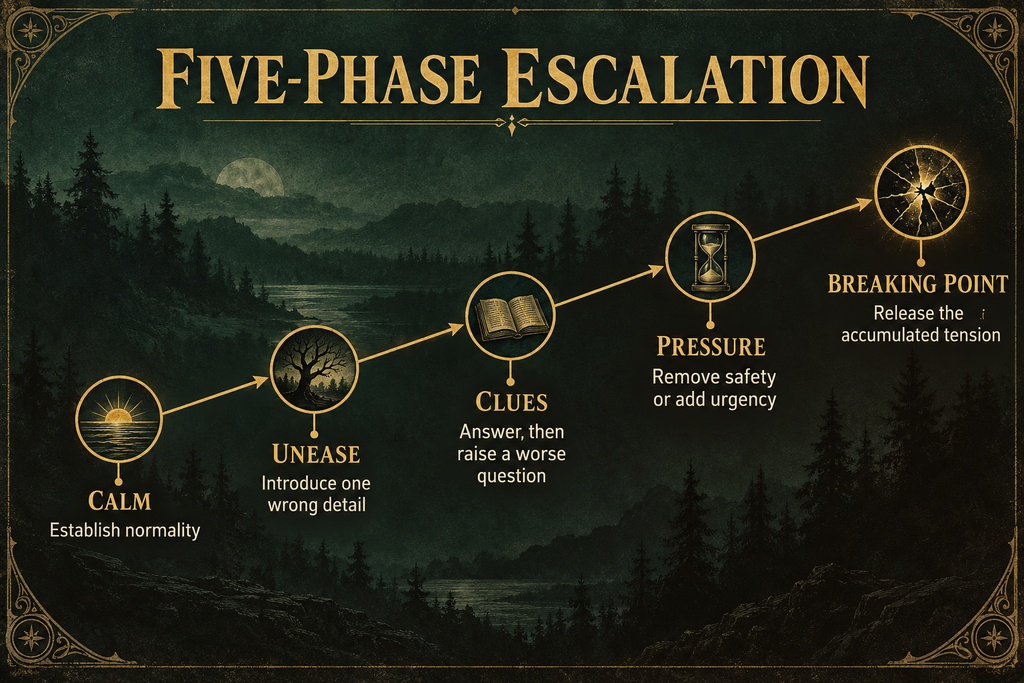
Calm establishes normal, the investigators’ everyday world, briefly, so there’s something to lose. Unease introduces the first wrong note, small enough that players might dismiss it, which is exactly right; you want them second-guessing, not already alarmed. Clues escalate concrete information, but concrete doesn’t mean comfortable, each clue should raise a worse question than the one it answered. Pressure is where the walls start closing in: a countdown, a suspicious NPC, a location that’s no longer safe to return to. The breaking point is the session’s climax, and it lands harder specifically because everything before it was paced to build toward it rather than arriving all at once.
At the table, this means resisting the urge to front-load your best material. A Keeper who reveals the scenario’s central horror in session one has nothing left to escalate toward; a Keeper who rations reveals across three sessions gives dread room to actually build.
🔍 The Slow Reveal: Rationing Information and Clue Layering
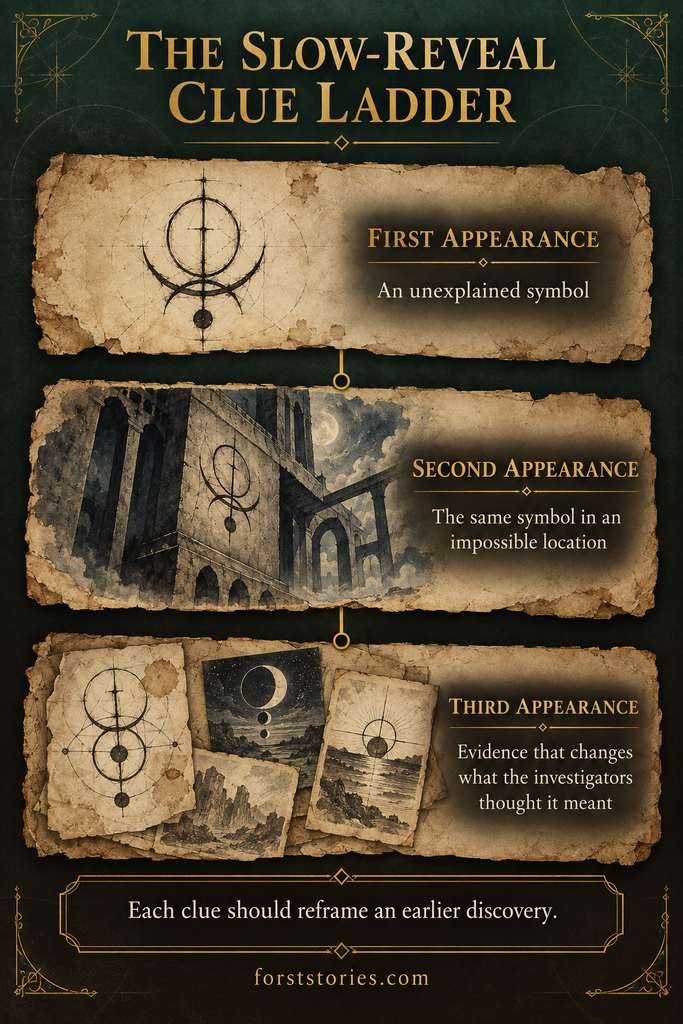
The slow reveal is pacing applied specifically to information. Rather than handing over what a clue means the moment it’s found, layer it: a document that raises more questions than it answers, a witness who only tells half the story under pressure, a symbol that means nothing until the third time it appears somewhere else.
Clue layering works best when each piece of information reframes something the players already thought they understood, rather than simply adding a new fact to the pile. If the investigators found a “ritual site” in scene two, a piece of evidence in scene five that suggests it wasn’t the only one, or wasn’t what they assumed, does more for dread than a brand new location introduced from nowhere.
Keep the Mythos itself mostly offscreen for as long as the scenario allows. The specific Great Old One or cult’s full agenda should stay implied rather than stated outright for most of the session; once it’s fully named and explained, a lot of the uncertainty that was generating dread evaporates. If you’re building your own scenario and want a primer on the wider Mythos before deciding how much to reveal, our beginner’s guide to the Cthulhu Mythos is a useful reference for what’s actually out there without spoiling any specific published scenario.
🎲 Using Rules as Dread Tools
The Sanity and Luck mechanics aren’t just bookkeeping, they’re tension levers you can call on deliberately. A Sanity check called at the right dramatic beat (not just whenever a monster appears, but whenever something genuinely threatens an investigator’s understanding of reality) reinforces that the fiction has real mechanical weight behind it.
Pushed rolls are one of the sharpest tools available to a Keeper who wants to raise stakes without changing the scene. When a player asks to push a failed roll, that’s your cue that they’re willing to risk more for a better outcome, and a failed pushed roll should carry a consequence that’s memorably bad, not just a second miss. Skills that actually matter in Call of Cthulhu is worth a look if you want a clearer sense of which skills are worth building pushed-roll tension around versus which barely come up.
Knowing when not to call for a roll matters just as much. Forcing a Sanity check for every minor unpleasantness dilutes its impact; save it for moments that genuinely threaten a character’s grip on what’s real, and the check itself becomes a signal to your players that something important just happened.
⚠️ Common Mistakes That Undercut Dread
Over-describing is the most common trap, even for experienced Keepers. Three sentences of vivid detail lands harder than ten; the extra seven sentences usually dilute the sharp ones rather than adding anything, and they give players time to relax into narration mode instead of staying tense.
Front-loading the monster is a close second. Showing your full horror too early removes the not-knowing that made it scary in the first place; once players have seen the thing clearly, later reveals about it can only add information, not dread. And rushing to the climax, skipping the calm and unease phases because you’re excited to run the big scene, robs that scene of the contrast it needs to actually land. A breaking point only feels like one if there was real quiet before it.
🌫️ Bringing It Back to the Table
None of this requires new rules or a different scenario, it’s the same Call of Cthulhu you already run, paced and described with more restraint. Start small: pick one upcoming session and commit to rationing your best reveal, pausing after key sensory details, and calling Sanity checks only when they’ll actually land. If you’re still building foundational Keeper habits alongside this, our guide to running Call of Cthulhu for the first time covers the session-zero and prep groundwork this post assumes you already have in place.
RPG news, GM tips, and system deep dives — straight to your inbox, no filler.