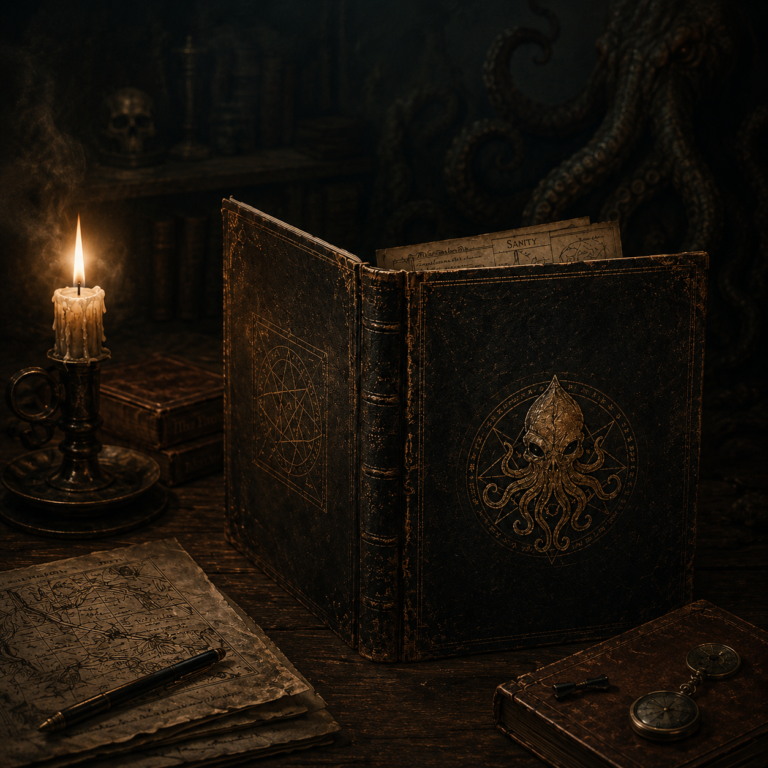
A Beginner’s Guide to the Cthulhu Mythos: Who Are the Great Old Ones?
If you’ve ever picked up a Call of Cthulhu rulebook, chances are you felt the weight of something ancient before you even started reading. The game doesn’t ease you in gently. It assumes the universe is full of things far older than humanity, far more powerful, and entirely indifferent to whether we survive. At the centre of that cosmology sit the Great Old Ones — entities so far beyond human comprehension that even naming them feels like reaching into the dark.
This guide is for anyone who wants to understand what the Great Old Ones actually are before they sit down at the table. You don’t need to have read Lovecraft. You don’t need a philosophy degree. You just need to be ready to accept that the universe is stranger than it looks.

What Is the Cthulhu Mythos?
Before we get to the entities themselves, it helps to understand the setting they inhabit. The Cthulhu Mythos is a shared fictional universe built on the horror stories of H.P. Lovecraft, written primarily in the 1920s and 1930s. Lovecraft invented much of the foundational lore — the language, the locations, the sense of cosmic dread — and other writers later expanded the universe, adding their own creatures, cults, and forbidden texts to the pile.
The key idea underpinning the whole thing is cosmic insignificance. Humanity isn’t the centre of the universe in the Mythos. We’re not even a footnote. We’re a brief, fragile experiment on an obscure planet, surrounded by forces that were ancient before the first animal climbed out of the sea. Horror in this setting doesn’t come from monsters you can fight. It comes from the realisation that the universe simply doesn’t care whether you live or die.
That’s what makes the Mythos genuinely unsettling — and what makes Call of Cthulhu such an effective tabletop game.
So Who Are the Great Old Ones?
The term “Great Old Ones” refers to a specific category of entities in the Mythos: ancient, non-human beings of immense power that have a particular connection to Earth, its history, and its inhabitants. In Lovecraft’s original story “The Call of Cthulhu,” cultists describe them as beings who existed long before humanity, sleeping in sunken cities and dead stars, waiting for the right alignment of cosmic forces to awaken.
Call of Cthulhu · Cthulhu Mythos
The Great Old Ones: Quick Reference
Six key entities — their domains, threat level, and best scenario use
Lies sleeping in sunken R’lyeh. His dreams seep into human minds, driving artists and sensitives to obsession. Vast, tentacled, and ancient beyond reckoning.
Cult investigations, maritime horror, dreams that escalate to waking dread. Works best offstage — his influence is more useful than his presence.
Unique among Great Old Ones — active, cunning, and endlessly masked. The Crawling Chaos. The Black Pharaoh. Takes a genuine, malicious interest in human suffering.
Urban conspiracies, cults with a hidden patron, long-arc campaigns. Can appear in any form, in any setting — the ultimate flexible antagonist.
Exists coterminously with all of spacetime. Sees everything that was, is, or will be. Sorcerers seek his knowledge — the price is never what they expected.
Occultist-centred scenarios, temporal horror, forbidden rituals. Best used when investigators stumble upon a sorcerer’s bargain gone wrong.
The Black Goat of the Woods with a Thousand Young. Associated with grotesque fecundity, ancient rural worship, and the Dark Young — shambling masses of black tentacles.
Folk horror, remote villages, woodland investigations. Harvest festivals, disappearing livestock, communities with very old traditions.
Associated with the colour yellow, the city of Carcosa, and a play whose second act drives readers insane. A figure of artistic corruption and impossible knowledge.
Scenarios involving writers, artists, theatre companies, or literary scholars. Anything built around forbidden text or creative work that crosses a line.
Ancient deity of the deep ocean, worshipped by the hybrid Deep Ones. At home in anything maritime — the coastal town with strange customs, the lighthouse gone silent.
Coastal and maritime scenarios, fishing villages, port cities, Deep One hybrid communities. “Shadow Over Innsmouth” is the template.
A few things distinguish the Great Old Ones from ordinary monsters:
They are not gods in any traditional sense. They don’t grant wishes, answer prayers, or take a meaningful interest in individual humans. They existed before humanity had the capacity for worship, and they’ll exist long after we’re gone. The cults that serve them aren’t getting any favours in return — they’re simply drawn to something vast and incomprehensible, the way moths circle a flame.
Their presence reshapes sanity. Encountering a Great Old One doesn’t just endanger your body. It endangers your mind’s ability to function within a reality that suddenly seems much smaller and more fragile than it did before. This is why Call of Cthulhu uses a Sanity mechanic rather than just a hit point system — the game understands that the real horror isn’t the monster. It’s what seeing the monster does to you.
Call of Cthulhu · Interactive Tool
Investigator Sanity Tracker
Apply Mythos encounters and watch your investigator’s mind unravel
No encounters yet. The horror has not found you.
They cannot be defeated in any permanent sense. They can be driven back, contained, or delayed. They can be returned to sleep through rituals your investigators barely understand. But “winning” against a Great Old One doesn’t mean killing it. It means surviving long enough to prevent something catastrophic — and hoping you’re still sane enough to care.
A Brief Roster: The Most Important Great Old Ones
You don’t need to memorise every entity in the Mythos. But knowing the major players gives you a map of the territory.
Cthulhu
The anchor of the whole setting. Cthulhu lies sleeping in the sunken city of R’lyeh somewhere in the Pacific Ocean, imprisoned by geography and cosmic timing. His dreams reach human minds as vague, disturbing impressions — enough to drive artists, sailors, and sensitive souls to obsession without ever fully surfacing into waking consciousness.
Physically, Cthulhu is described as enormous and vaguely octopoid, with tentacles where a face should be and vast, leathery wings. But the description almost doesn’t matter, because the point isn’t what Cthulhu looks like. The point is what it means that something like Cthulhu exists and is merely sleeping.
For a Call of Cthulhu Keeper, Cthulhu functions best as a presence and a threat rather than a creature your players encounter directly. The cultists who serve him, the dreams that reach susceptible investigators, the fragments of R’lyeh breaking the surface during storms — these are how you bring Cthulhu into a campaign without using him as a final boss.
Nyarlathotep
Where most Great Old Ones are content to sleep or wait, Nyarlathotep is active, cunning, and deeply interested in humanity — in the way a cruel experimenter is interested in the rats in their maze. He takes on thousands of forms, appears in different cultures under different guises, and seems to take genuine pleasure in spreading chaos and madness wherever he goes.

He is the Crawling Chaos. The Haunter of the Dark. The Black Pharaoh. Each mask conceals the same intelligence, working toward goals that remain deliberately unclear. Nyarlathotep is a favourite for Keepers precisely because he can appear in almost any scenario and in almost any form, serving as a manipulator behind the scenes of larger conspiracies.
Yog-Sothoth
Yog-Sothoth sits at a slightly different position in the Mythos — technically described by some scholars as an Outer God rather than a Great Old One, though the distinction blurs depending on which version of the lore you’re working from. For beginners, the important thing to know is this: Yog-Sothoth is the gate and the key. He exists coterminously with all of space and time, seeing everything that was, is, or will be.
If Cthulhu represents the horror of something sleeping beneath the surface, Yog-Sothoth represents the horror of something that perceives you completely and always has. He appears frequently in Lovecraft’s work as an entity that sorcerers attempt to contact for knowledge — and the price of that knowledge is rarely one they’d have accepted if they’d understood it fully.
Shub-Niggurath
The Black Goat of the Woods with a Thousand Young. Shub-Niggurath is a fertility entity of sorts, though that description sanitises something that is genuinely horrifying. She is associated with forests, with dark rural places, with the fecund and grotesque abundance of the natural world when it turns hostile. Her offspring — the Dark Young, shambling masses of black tentacles that smell of forest rot — appear in scenarios set in remote countryside or ancient woodland.
She works well in campaigns that play with folk horror themes: the village where something is wrong, the forest where livestock disappear, the harvest festival that predates Christianity by several thousand years.
Hastur
Hastur is unusual because his presence in the Mythos was partly shaped by earlier writers before Lovecraft adopted and adapted him. He is associated with the colour yellow, the city of Carcosa, the Lake of Hali, and most famously with the King in Yellow — a play whose second act drives readers mad. He is a figure of artistic corruption and forbidden knowledge, making him a natural fit for scenarios involving writers, painters, or theatre companies who have encountered something they can’t unsee.
Dagon and Tsathoggua
Dagon is an ancient deity of the deep ocean, worshipped by the hybrid Deep Ones who feature in Lovecraft’s “The Shadow Over Innsmouth.” He functions well in coastal and maritime scenarios — the fishing village with strange customs, the lighthouse keeper who stopped responding to correspondence, the sailor who came home changed.

Tsathoggua is a toad-like entity of ancient lineage, sleeping in caverns deep beneath the earth. He is associated with sluggishness and dark, subterranean places, and he has a following among scholars of the occult who appreciate his relative passivity. His cults tend to be older and more secretive than those of Cthulhu.
Great Old Ones vs. Outer Gods: Do You Need to Know the Difference?
The short answer is: not immediately.
The longer answer is that the Mythos developed over decades and across many writers, so the taxonomy is genuinely messy. In rough terms, the Great Old Ones are ancient entities with a particular connection to Earth — they slept here, they were imprisoned here, they have cults here. The Outer Gods are usually conceived as even more alien and remote: the blind idiot god Azathoth at the centre of ultimate chaos, Yog-Sothoth coterminous with all of spacetime, Nyarlathotep serving as their messenger.
In practice, different Keepers and different sourcebooks draw these lines differently. The Call of Cthulhu Keeper Rulebook contains the detailed bestiary you’ll want for actual play. For now, knowing that the Mythos contains layers — that Cthulhu is terrifying but there are things even Cthulhu might be subordinate to — is enough to give you a feel for the scale of the horror.
Why the Great Old Ones Work So Well in Call of Cthulhu
The reason these entities translate so effectively to the tabletop is that they’re designed to be uncovered rather than confronted. Your investigators aren’t heroes on a quest to destroy evil. They’re researchers, journalists, detectives, and academics who stumble into something that should have stayed hidden.
Call of Cthulhu · Scenario Finder
Which Mythos Scenario Fits Your Group?
Answer three questions to find your ideal starting point
The arc of a great Call of Cthulhu scenario looks like this: something is wrong, and you’re not sure what. You investigate. Gradually, a picture forms — a cult, a ritual, a location, an entity. By the time you understand what you’re dealing with, the question isn’t “how do we defeat it” but “how do we stop this specific thing from happening right now, and can we get out before our minds give way?”
That structure — investigation first, horror second, sanity loss throughout — is what sets Call of Cthulhu apart from fantasy RPGs where the goal is to level up until the final boss is manageable. If you’re curious about how it compares to other horror-adjacent systems, our Call of Cthulhu alternatives overview covers some of the other games playing in this space.
The Great Old Ones are also excellent for Keepers because their power makes them useful at every scale. An early-campaign scenario might involve a cult devoted to Dagon in a coastal town. A more experienced group might piece together a connection to Cthulhu’s dreaming influence across a whole region. The entities scale with the stakes of the story you’re telling.
Cults, Forbidden Knowledge, and Why Humans Keep Getting Involved
One of the most useful pieces of lore for new players and Keepers is understanding why humans worship the Great Old Ones at all. The cults aren’t simply evil people doing evil things — they’re people who have glimpsed something real about the universe and made a terrible bargain with that knowledge.
Some cultists seek power. If Cthulhu returns, those who served him might survive or receive special treatment. This is almost certainly a delusion, but it’s a coherent human motivation. Others have been driven to devotion by prolonged dream contact — their minds simply can’t accommodate what they’ve seen, and worship becomes the only way to organise the experience. A few are hereditary devotees, born into communities that have served these entities for generations without any individual choice in the matter.
This complexity is what makes cult members effective antagonists in scenarios. They’re not simply obstacles — they’re people who made a wrong turn somewhere and ended up somewhere unthinkable. The best Call of Cthulhu expansion books develop this texture in scenarios that make the cultists feel like people with history and motivation, not just gatekeepers for the monster reveal.
What This Means at the Table
If you’re new to Call of Cthulhu — whether as a player or a Keeper — the most important thing the Great Old Ones teach you about the game is its tonal contract. This is not a game where your character grows more powerful until the threats become manageable. This is a game where the threats are always beyond you, and success means preventing catastrophe rather than defeating evil.
That shift in expectation changes how you play. As an investigator, you’re looking for information, not a fight. You’re managing your character’s sanity the way a tactical RPG player manages hit points — carefully, with an eye on what you can afford to lose. You’re making decisions about how much you want to know, because in this world, knowing more isn’t always safer.
For Keepers, the Great Old Ones are structural tools as much as setting elements. They give every scenario a weight that extends beyond the immediate plot — a sense that what your investigators are dealing with is a fragment of something vastly larger. A well-run session in Call of Cthulhu makes players feel that weight without ever needing to bring a Great Old One directly on stage. The entity’s influence is enough.
If you want to understand how that atmosphere compares to the contemporary espionage horror of Delta Green, that’s a useful companion read — the Great Old Ones appear in both settings, but they feel very different depending on the fictional frame around them.
Where to Start if You Want to Go Deeper
The Great Old Ones are the reason the Mythos feels bigger than any single story. They turn the universe itself into a source of dread — not because they’re lurking around every corner, but because knowing they exist changes how the entire rest of reality looks. That’s the insight at the heart of Call of Cthulhu, and it’s what has kept the game in print since 1981.
For new players, the Keeper Rulebook is your most essential resource — it has the full bestiary, the scenario design guidance, and the historical background that makes the setting feel grounded. If you’re exploring supplementary material, our Call of Cthulhu expansion books guide covers the most worthwhile additions to the core game.
You don’t need to memorise every Great Old One to enjoy the game. Start with Cthulhu and Nyarlathotep, get a feel for how they function in play, and let the rest of the pantheon reveal itself as your campaigns develop. The Mythos has been growing for a century. There’s no rush.
Continue Your Journey:
- Call of Cthulhu RPG: A Complete Introduction — everything you need to know before your first session
- Call of Cthulhu vs. Delta Green — two takes on cosmic horror, compared
- The Best Call of Cthulhu Expansion Books — recommended supplements to take your campaign further
- Call of Cthulhu Alternatives — other horror RPGs worth exploring
- What Is a TTRPG? — new to tabletop gaming entirely? Start here
Which Great Old One do you find most unsettling — and which would you most want to feature in a campaign? Share in the comments below.
Want more RPG content, GM tips, and system guides delivered straight to your inbox? Subscribe to The Scriptorium Newsletter for weekly roundups and exclusive resources.
RPG news, GM tips, and system deep dives — straight to your inbox, no filler.