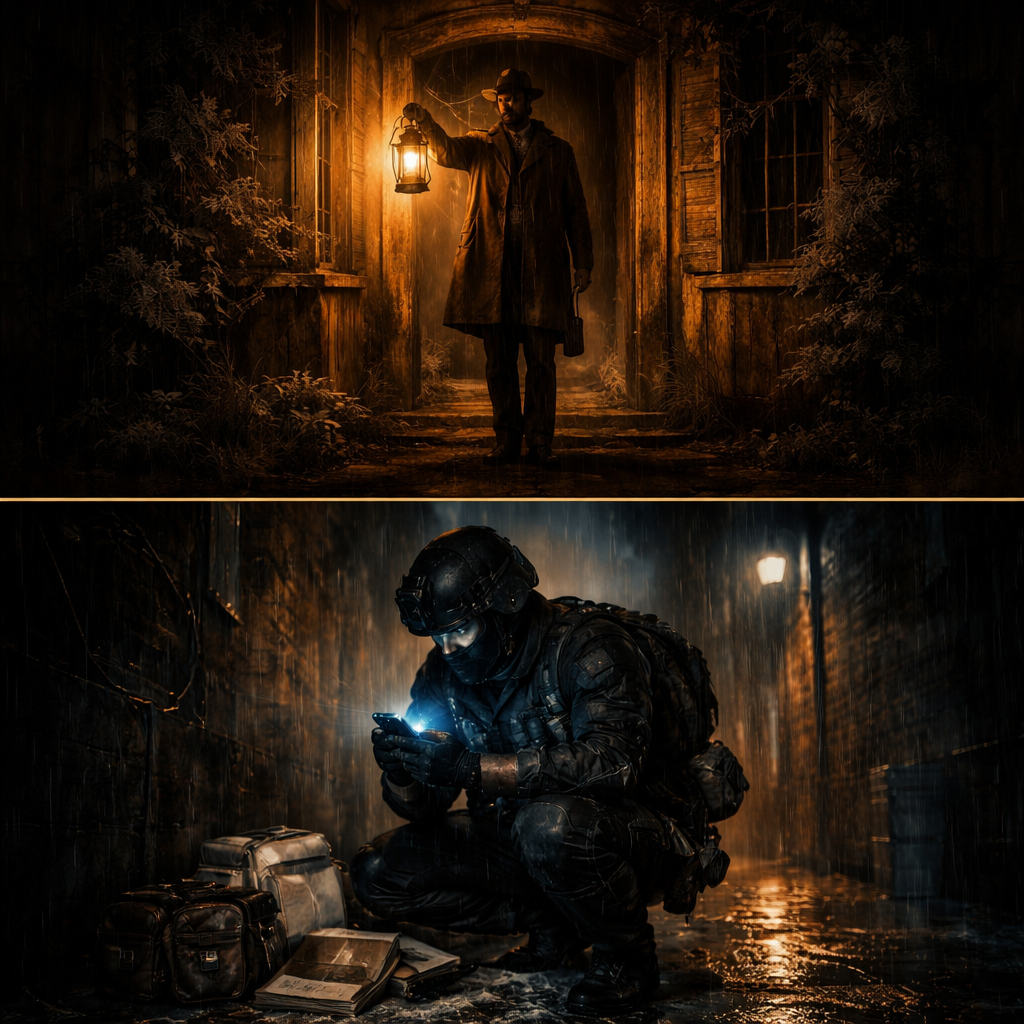
Call of Cthulhu vs. Delta Green: Same Universe, Very Different Tone
They share the same monsters. They draw from the same cosmic horror tradition. At the table, though, they feel almost nothing alike. Call of Cthulhu and Delta Green are both Lovecraftian roleplaying games, but the experience each one delivers is so distinct that choosing between them isn’t really about mechanics — it’s about what kind of horror you want to live through.
If you’ve been curious about either system, or you’re already a Call of Cthulhu player wondering whether Delta Green is worth exploring, this breakdown will tell you exactly what separates them and which one might be right for your table.
The One-Sentence Difference
Here’s the fastest way to understand the split: Call of Cthulhu is about discovery. Delta Green is about containment.
In Call of Cthulhu, your characters are usually ordinary people — academics, journalists, private investigators — who stumble into something they were never meant to know. The horror is in the revelation, the slow realisation that the world is far stranger and more dangerous than anything they imagined. In Delta Green, your characters already know. They’re agents of a secret government programme who have seen the impossible before, and their job is to suppress it, erase the evidence, and make sure the public never finds out. The horror is in what that costs them.
That shift in premise changes everything about how the two games feel at the table.
Tone: Dread vs. Paranoia
Call of Cthulhu is built on slow-burn dread. Sessions tend to follow a mystery structure — something is wrong, the players investigate, the truth turns out to be cosmic and terrible. The tension comes from feeling small and fragile against forces that don’t even register human existence. Characters are breakable. Sanity erodes. The best sessions leave players with a creeping unease that lingers after they’ve left the table.
Delta Green is darker and more paranoid. The horror here is bureaucratic as much as it is supernatural. Your agents have handlers, missions, cover stories to maintain. When something goes wrong — and it will — you have to figure out how to file a report that doesn’t expose the programme. The emotional weight lands differently too: it’s less about cosmic insignificance and more about the moral compromise that comes from continuing to do this work. Characters carry psychological damage between sessions, and the game doesn’t let them forget it.
If Call of Cthulhu is the horror of learning the truth, Delta Green is the horror of being the people who have to deal with it.
Setting and Player Fantasy
Call of Cthulhu: Ordinary People in Over Their Heads
One of Call of Cthulhu’s great strengths is its flexibility. The game works across historical periods — the roaring twenties, Victorian England, the modern day — and the default assumption is that your investigators are civilians. A professor, a nurse, a dilettante with too much free time. They don’t have training for this. They have intellect, curiosity, and very bad luck.
That setup creates a particular player fantasy: the idea that regular people, through courage and determination, can push back against the unknowable. Even if they don’t win — and Call of Cthulhu is not a game that guarantees heroic victories — there’s meaning in the attempt. You can explore this feeling even further in Beyond the Mythos: Alternative Horror TTRPGs for Call of Cthulhu Fans, which looks at what other systems capture a similar spirit.
Delta Green: Damaged Professionals Doing Impossible Work
Delta Green’s characters aren’t civilians. They’re operatives — FBI agents, military personnel, intelligence analysts — who have been read into a programme that officially doesn’t exist. They have skills and training. They also have histories, and the game is very interested in what this work does to a person over time.
The player fantasy here is closer to a bleak procedural. You’re not uncovering the truth for the first time; you’re managing it. Success often looks like surviving, filing the cover story correctly, and making it to the next operation. There’s a strong vein of moral ambiguity running through everything, and the game actively asks players to grapple with what their characters are willing to sacrifice — and who they’re willing to sacrifice it for.
Mechanics and the Feel of Play
Both games use skill-based systems with percentile dice (roll under your skill percentage to succeed), so the mechanical DNA is similar. The feel of play, though, reflects each game’s different priorities.
Investigation and Sanity in Call of Cthulhu
Call of Cthulhu is built around the Keeper (the GM) constructing a mystery and the investigators unravelling it. The skill list is wide, covering everything from Library Use to Spot Hidden to Occult, and sessions often involve a lot of research, interviews, and careful exploration before the horror reveals itself fully.
Sanity is the central resource. Every encounter with the genuinely unnatural costs something, and characters who survive long enough will carry lasting psychological damage. The system is designed to make you feel human and breakable — which is exactly the point. The Essential Guide to Call of Cthulhu Expansion Books is worth a look if you want to see how much the official material has developed the investigation structure across different settings.
Operations and Stress in Delta Green
Delta Green keeps the horror but changes the operational frame. Scenarios are structured more like missions — the programme needs something done, and your cell is the one doing it. There’s always a clock ticking and information that needs to be suppressed.
The stress mechanics push harder on the personal cost of the work. Characters can develop disorders, lose relationships, and find their grip on normal life slipping session by session. Where Call of Cthulhu might track your Sanity as a single score, Delta Green is interested in the specific shape of your damage — what triggers your character, what they can still hold together, and what’s already broken.
Quick Comparison
| Aspect | Call of Cthulhu | Delta Green |
|---|---|---|
| Core role | Investigators | Secret agents / operatives |
| Main goal | Uncover the truth | Contain and erase the truth |
| Tone | Dread, mystery, fragility | Paranoia, conspiracy, sacrifice |
| Setting feel | Often historical or flexible | Strongly modern, government-shadow world |
| Player fantasy | Ordinary people in over their heads | Damaged professionals doing impossible work |
| Horror style | Revelation and cosmic insignificance | Bureaucratic, moral, and existential collapse |
Which System Is Right for You?
Choose Call of Cthulhu if your group enjoys mystery-driven play, historical settings, or the feeling of piecing together something dark and strange from fragments. It’s also a more accessible entry point — the investigator premise is intuitive, and the Keeper has decades of scenario support to draw from. If your players are new to horror RPGs or coming from something like D&D, Call of Cthulhu is the easier transition. Our guide to fantasy RPG systems ranked by complexity puts it in useful context alongside other options.
Choose Delta Green if your group is comfortable with moral ambiguity, wants tighter operational scenarios, and is interested in horror that’s as much psychological as supernatural. It rewards players who engage with the setting’s lore and who are willing to let their characters accumulate damage over time. If you’ve played Call of Cthulhu and want something that uses a similar mechanical base but pushes harder on the cost of engaging with the Mythos, Delta Green is the next step.
Decision Guide · Cthulhu Mythos
Which Game Is Right for You?
Run both if you want variety. They complement each other well. A campaign of Call of Cthulhu gives players the sense of innocence lost; Delta Green shows them what it looks like years later when you’ve made the decision to keep fighting anyway.
The GM’s Perspective
Running either system rewards preparation, but they ask for different kinds of it.
For Call of Cthulhu, the Keeper’s primary job is building a mystery that holds together under player investigation. Clues need to be findable, the horror needs to reveal itself at the right pace, and the scenario needs to feel like it existed before the investigators arrived. Good session prep matters here — knowing what your NPCs know, what the creature wants, and what evidence the players can actually find.
For Delta Green, the Handler (the Delta Green equivalent of a Keeper) is managing an operation with moving parts. There’s usually a mission objective, collateral complications, and the ongoing question of whether the cell is going to make it out without leaving a trail. The game is less interested in elegant mystery structure and more interested in operational pressure and the mess that follows.
System Comparison · Cthulhu Mythos
Call of Cthulhu vs. Delta Green
Both systems reward GMs who know when to slow down and let tension build. If you’re looking for practical techniques that transfer across horror systems, the session zero strategies guide covers the kind of player expectations and tone-setting work that makes horror RPGs land properly regardless of which system you’re using.
A Note on the Mythos
One thing both games share is a genuine reverence for the Lovecraftian tradition, and both have developed beyond their source material in interesting ways. Call of Cthulhu has decades of scenarios and supplements, many of which expand the Mythos into settings Lovecraft himself never touched. Delta Green has built an entire alternate history around government knowledge of the unnatural, complete with a secret programme that’s been running since the 1920s.
They’re not competing versions of the same game. They’re two different answers to the same question: what does it mean to live in a world where the Mythos is real?
Conclusion
Call of Cthulhu and Delta Green share DNA, but they deliver fundamentally different table experiences. One puts fragile civilians against incomprehensible horror and asks whether they can survive the truth. The other puts trained operatives against the same horror and asks whether they can survive themselves. Both are excellent. Both are worth your time.
If you’re coming to horror RPGs for the first time, start with Call of Cthulhu — the mystery structure is intuitive and the scenario library is enormous. If you’ve already spent time in the Mythos and want something that hits harder on the human cost, Delta Green is ready for you.
Either way, you’re in for a very bad time. In the best possible sense.
Continue Your Journey
- 10 Essential Things to Know About Call of Cthulhu RPG — The definitive starting point if you’re new to the system
- The Essential Guide to Call of Cthulhu Expansion Books — Where to take your Call of Cthulhu game after the core rulebook
- Beyond the Mythos: Alternative Horror TTRPGs for Call of Cthulhu Fans — Other systems worth exploring if you love horror roleplaying
- Fantasy RPG Systems Ranked: From Beginner to Expert — How horror and other RPG systems compare across the complexity spectrum
- Session Zero Strategies: Setting Your Campaign Up for Success — Essential prep work before any horror campaign
Have you played both Call of Cthulhu and Delta Green? Which one hit harder at your table — the slow creep of cosmic dread or the operational paranoia of the programme? Share your experience in the comments.
Sign up for the Forst Stories newsletter to get new system breakdowns, GM tips, and horror RPG coverage delivered straight to your inbox.
RPG news, GM tips, and system deep dives — straight to your inbox, no filler.