

How Experience Prompts Shape Your Story in Daggerheart
Most RPG advancement systems are built around a simple transaction: do the thing, earn the points, get stronger. Daggerheart takes a different approach entirely. Its Experience system ties character growth directly to narrative moments — what your character survived, who changed them, and what they’re still carrying. The result is a mechanic that doesn’t just track progress; it actively generates story.
If you’ve been exploring what Daggerheart is all about or you’re fresh from running your first character through creation, Experiences are one of the system’s most elegant ideas — and one of the most misunderstood. This guide breaks down how they work, why they feel so different from traditional advancement, and how to get the most out of them at your table.
What Experiences Actually Are
An Experience is a short narrative phrase that describes something specific your character knows, has lived through, or carries with them — something like “Royal Mage,” “Not On My Watch,” or “Veteran of the Azure Rebellion.” They’re not a list of powers or a skill proficiency in disguise. They’re tags that connect your character’s story to the mechanics of the game.
When an Experience applies to what you’re trying to do, you can spend Hope to add its modifier (typically +2) to your roll. That’s the mechanical half. But the design intent is bigger than the number — Experiences are meant to prompt roleplay, not just reward it after the fact.
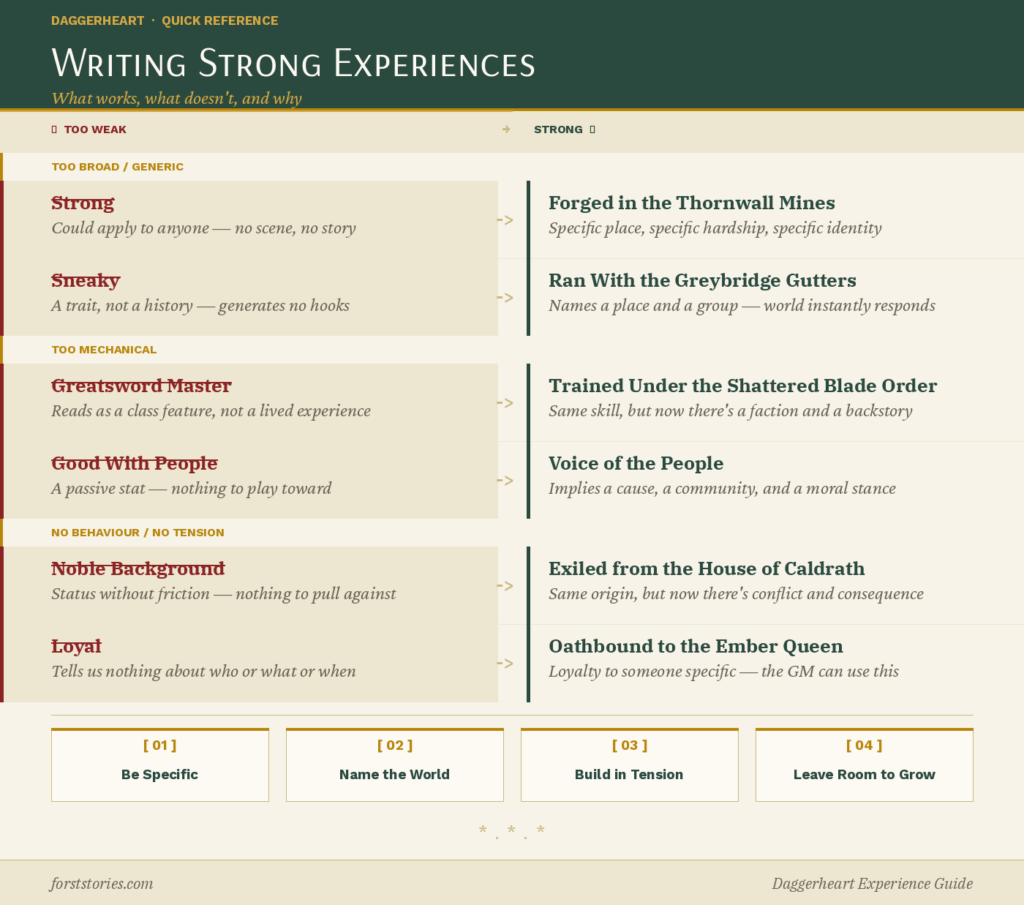
The rules are deliberate about what an Experience can’t be. Phrases like “Strong” or “Greatsword Master” are too broad or too mechanical. A good Experience has to be specific enough to conjure a scene. “Former Guild Accountant” tells you something. It raises questions. It creates complications. That’s exactly the point.
The question isn’t “what’s the optimal pick” — it’s “what did we go through?”
In Daggerheart, Experiences tie character advancement directly to story moments. Characters grow in ways that feel earned, not farmed — and each new Experience is a reflection of what the campaign has actually been about.
The Constraints That Make Them Work
There’s no master list of Experiences to choose from. Players and GMs create them together, and that collaborative authorship is part of what makes the system tick. It forces a conversation at the table: what shaped this character, and what kind of scenes do we want to see?
The other constraint worth noting is that Experiences can’t function as standalone mechanical boosts. They work because they’re narrative first — they need a story reason to be relevant before they do anything. That design choice keeps them honest.
Why This Feels Different From Traditional Advancement
In D&D 5e, you level up based on XP or milestones, then pick from a menu of class features. Your character gets more powerful in ways the system pre-determined. Daggerheart’s Experiences work in the opposite direction: the story shapes the character sheet, not the other way around.
If you’ve read our Daggerheart vs D&D 5e comparison, you’ll know that Daggerheart deliberately centres emotional and narrative play. The Experience system is where that philosophy becomes a mechanical reality. You start play with two Experiences at character creation, and you earn more as you level and move through the campaign. What you choose when you level is meant to reflect what actually happened — new scars, earned reputations, skills forged under pressure.
This shifts the question players ask when levelling up. Instead of “what’s the optimal pick,” the question becomes “what did we go through?” A Guardian who spent three sessions mediating a city under siege might take “Voice of the People” as their new Experience — not because it’s the strongest option, but because it’s true. That Experience then keeps pulling future scenes back toward negotiation and moral weight rather than faceless combat.
No More Grinding for the Right to Grow
The anti-grind design is worth sitting with, especially if your group comes from systems where advancement is a numbers game. When Experiences are tied to story beats, you can’t farm them. You can’t run the same encounter twelve times to hit a threshold. Growth happens when something meaningful happens to your character — and the table decides together what counts as meaningful.
For players who’ve spent years in crunchier systems, that shift can feel disorienting at first. For others, it’s a relief. The Pathfinder 2e vs D&D 5e conversation often centres on build depth and tactical optimization. Daggerheart is asking a genuinely different question about what advancement is for.
Experiences as Story Engines
Here’s what separates a good Experience from a great one: a great Experience generates story just by existing on the character sheet. “Haunted By The Siege of Althar” isn’t just a bonus — it’s an invitation. Every time it comes up at the table, the players add another detail about what Althar was. After a few sessions, it becomes a fully realized piece of shared history rather than a throwaway backstory line.
The official materials frame Experiences as narrative engines and plot hooks as much as mechanical tags. Each one suggests future complications. “Royal Mage” invites court politics, old rivals, and magical obligations. “Not On My Watch” practically begs for situations where someone is in immediate danger. The GM doesn’t have to invent plot from nothing when the character sheet is already full of hooks.
When a player invokes an Experience, the table benefits most when the player narrates how it applies — which memory is surfacing, which training kicks in, which relationship feels the weight of this moment. That description does more work than the +2 ever could.
The GM’s Perspective
As a GM, player Experience lists function as a menu of ready-made scene ideas. This pairs naturally with session prep approaches built around efficiency — you can spend less time generating plot from scratch when your players have already told you what they want their characters to be pulled toward.
A useful habit: before a session, scan the Experience lists and ask yourself what one scene could make each one feel relevant. You don’t have to engineer it mechanically. Just leave space for it. Players will recognize the invitation.
Another powerful GM move is to ask explicit permission when an Experience feels like it could become a recurring story thread. “If you write ‘Oathbound To The Ember Queen’ as an Experience, are you okay with me making that oath inconvenient later?” That question turns a line on the sheet into a shared agreement about future spotlight scenes — which is exactly how collaborative storytelling should work. This connects to everything good session zero planning is built on.
Writing Experiences That Do Real Work
Not all Experiences are created equal. The difference between one that generates story and one that just generates a bonus usually comes down to specificity. A strong Experience tends to do several things at once:
- Make it specific. “Street Rat of Greybridge” is better than “Sneaky.” The city name, the specific identity — those details open doors instead of closing them. Specificity invites the world to respond.
- Tie it to the world. Referencing factions, locations, or events you want to see again signals to the GM what you’re interested in and anchors the Experience in something real. “Veteran of the Azure Rebellion” promises that the Rebellion exists, that it mattered, and that your character was there.
- Build in a behavior. Experiences can be tendencies as much as skills or titles. “Runs Toward Trouble” and “Never Leaves a Friend” say something about how a character moves through the world — and behavioral tags create predictable friction, which is excellent for drama.
- Leave room for growth. An Experience is a starting point, not a closed description. “Loyal to the Crown” means something very different at level one than it does after three sessions of watching the Crown make terrible decisions.
Answer the four questions below and this tool will suggest Experience phrases you can bring straight to your Daggerheart character sheet. The best Experiences are specific, tied to the world, and carry a behaviour with them — not just a skill.
Prompts for Players Who Are Stuck
Sometimes players freeze up when trying to write Experiences from scratch. A few questions that tend to unlock things quickly:
- What’s the worst thing your character survived?
- Whose approval still matters to them, even if it shouldn’t?
- What job could they still do if they lost all their powers tomorrow?
- What do they do first when they’re scared?
Each answer naturally becomes a sharp Experience. The goal is to find the specific, lived detail — not the abstract personality trait.
Cross-System Takeaways
If you run systems beyond Daggerheart, the Experience model has ideas worth borrowing. Here’s how it maps onto mechanics you might already know:
- Fate Aspects — Experiences feel similar, but they’re fueled by Hope and sit inside a more traditional class chassis rather than a fully narrative framework.
- Burning Wheel Beliefs/Traits — Both reward playing to a stated concept, but Experiences are simpler to run in a high-fantasy dungeon-crawl context.
- PbtA Tags — Close cousins, but Daggerheart Experiences directly feed roll modifiers and advancement choices rather than staying purely fictional.
For groups who love indie systems and want to experiment, a light port into D&D 5e or a similar system is doable: let each character define two Experiences as narrative tags that grant a once-per-short-rest +2 bonus when invoked with a brief description of why that history is relevant right now. It mimics Daggerheart’s “spend Hope, lean into story” loop without a full system overhaul. The same creative energy that makes Blades in the Dark’s fictional positioning feel so rewarding applies here.
The deeper takeaway isn’t about the +2, though. It’s about what happens when you design advancement around the question “what changed you?” instead of “how much did you do?” Characters grow in ways that feel earned, and the story accumulates weight session by session. That’s a model worth stealing regardless of what system you’re running.
Bringing It All Together
Daggerheart’s Experience system is a small mechanic with large implications. It shifts character advancement from a reward for volume of play to a reflection of story — and in doing so, it makes every session matter more. Each Experience on the sheet is a promise the campaign will eventually keep.
Whether you’re running Daggerheart as a new system or looking for design ideas to fold back into your existing campaigns, the core principle holds: the best mechanical hooks are the ones that know what kind of scenes they want to create. Write Experiences that are specific, that tie to the world, and that build in behavior — and your character sheet will do half the GM’s job for them.
The story is already on the sheet. You just have to play toward it.
Continue Your Journey
Daggerheart Character Creation: A Step-by-Step Guide — Walk through building your first Daggerheart character from scratch, including how to write your starting Experiences.
Daggerheart vs D&D 5e: Which System Is Right for You? — A detailed comparison of both systems’ approaches to advancement, combat, and narrative play.
Daggerheart Classes for Beginners — Not sure which class to pair with your Experiences? This beginner-friendly breakdown has you covered.
Session Zero Strategies for New and Experienced GMs — How to use session zero to establish Experiences and story hooks collaboratively before the campaign begins.
Session Prep in 30 Minutes — A practical GM prep framework that pairs naturally with Experience-driven scene planning.
What Experience have you written that ended up generating the most story at your table? Drop it in the comments — I’d love to see what your tables have come up with.
Enjoying content like this? Subscribe to the Forst Stories newsletter for weekly RPG guides, GM tips, and system deep-dives delivered straight to your inbox.
RPG news, GM tips, and system deep dives — straight to your inbox, no filler.


