

Blades in the Dark: Crime, Consequences, and Collaborative Storytelling
Picture this: your crew of criminals huddles in a dimly lit hideout, planning your next score against the Lampblacks. The whisper suggests using ghost essence to bypass the ward, while the slide works their contacts for inside information. But here’s the twist – you don’t spend three hours planning every detail. Instead, you dive straight into the action, revealing your preparations through flashbacks as the heist unfolds. Welcome to Blades in the Dark, where the planning happens in the moment and every success comes with a price.
John Harper’s masterpiece, published by Evil Hat Productions in 2017, revolutionized how we think about heist games and consequence management. Built on the bones of Apocalypse World but heavily modified into something entirely its own, Blades drops players into Doskvol – a haunted industrial city where electricity flows through ghost blood and criminal crews carve out their territories in the shadows.
At $20 for the PDF or $40 for print plus PDF, Blades represents one of the best values in modern gaming. This isn’t just another fantasy heartbreaker or D&D alternative. It’s a complete reimagining of what collaborative storytelling can achieve, perfect for groups wanting narrative focus, morally complex characters, and consequences that matter beyond hit point damage.
Quick Facts
| Player Count: | 3-6 players (plus GM) |
| Time: | 3-4 hours per session |
| Complexity: | Medium (easy to learn, deep to master) |
| Similar to: | Leverage RPG, Shadowrun (thematically), PbtA games (mechanically) |
| Key Mechanics: | Position/Effect, Flashbacks, Crew Advancement, Stress/Trauma |
| Required Equipment: | 6d6, character sheets, crew sheet |
The Doskvol Setting: A City of Ghosts and Ambition
Doskvol isn’t just window dressing – it’s integral to how Blades in the Dark functions as a game. This industrial fantasy metropolis exists in a world shattered by a cataclysm that destroyed the sun and filled the world with vengeful ghosts. Massive lightning barriers powered by electroplasm keep the spectral hordes at bay, while inside the city walls, criminal organizations fight for territory, influence, and survival.

The city’s six districts each have distinct flavors and opportunities. Charterhall houses the city’s elite and their well-guarded mansions. The Docks bustle with smuggling opportunities and rough taverns. Crow’s Foot serves as neutral ground where deals get made and blood gets spilled. Each location comes with built-in conflicts, NPCs with agendas, and mechanical significance for your crew’s operations.
What makes this setting brilliant for RPG fans is how it supports the game’s central premise. You’re not heroes saving the world – you’re criminals trying to make a name for yourselves in a city that chews up the weak and spits them out. The faction relationships create natural story hooks, while the supernatural elements provide unique scoring opportunities that you won’t find in other crime games.
The 40+ factions operating in Doskvol each have clear goals, relationships, and resources. The Bluecoats maintain order through corruption and violence. The Spirit Wardens dispose of ghosts and guard the city’s spiritual health. Criminal organizations like the Lampblacks and Red Sashes fight bloody turf wars. These aren’t static elements – they react to your crew’s actions, creating a living ecosystem of consequence and opportunity.
Character Creation & The Revolutionary Crew Focus
Blades in the Dark offers eight distinct playbooks for individual characters, each representing a different criminal archetype:
- The Cutter brings muscle and intimidation to any situation
- The Hound excels at ranged violence and tracking targets
- The Leech combines alchemy with sabotage and technical expertise
- The Lurk specializes in infiltration and theft
- The Slide manipulates through social engineering and deception
- The Spider weaves plans and gathers crucial information
- The Whisper commands supernatural forces and ghostly powers
Each playbook provides unique abilities, advancement tracks, and ways to contribute to scores.
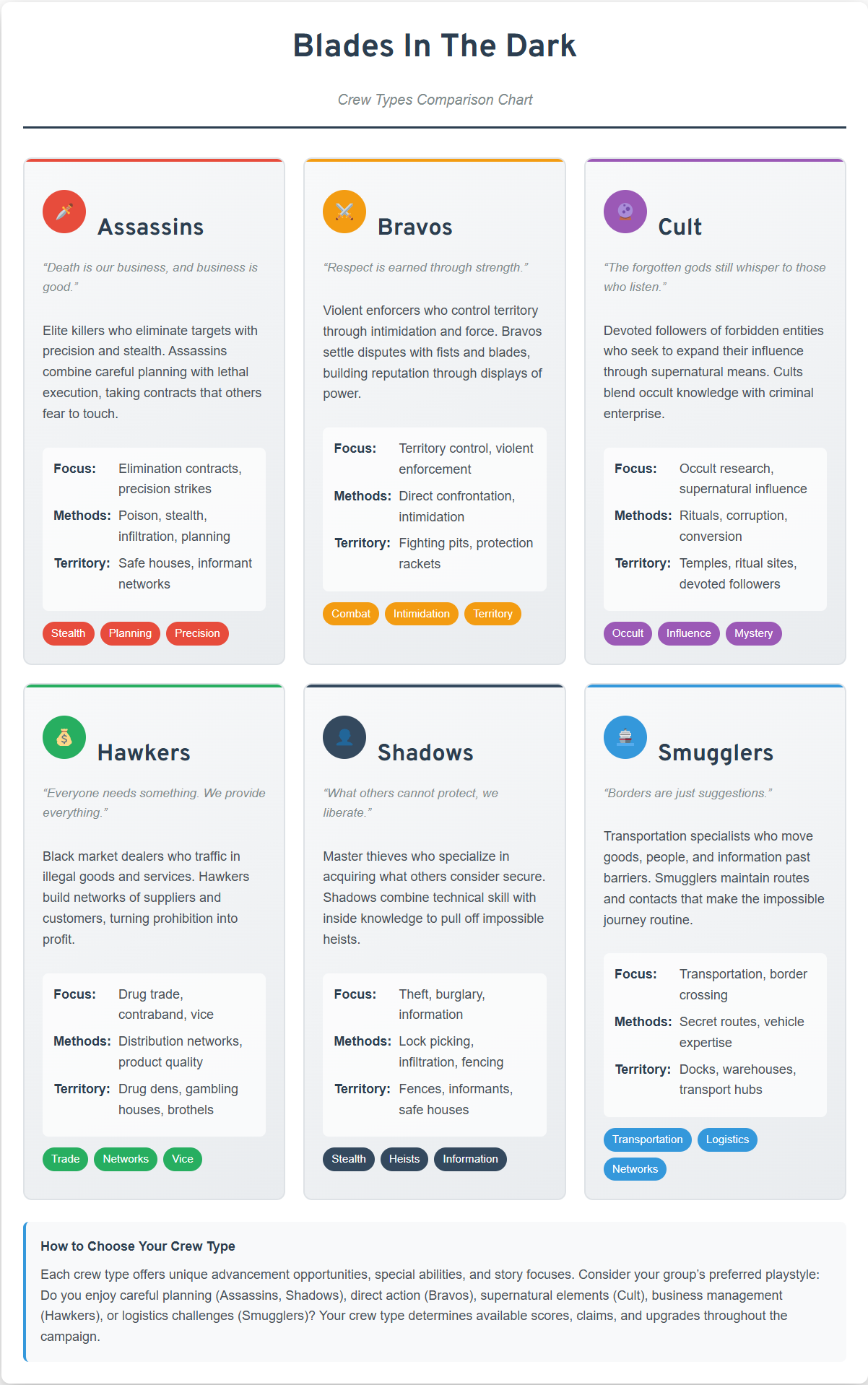
But here’s where Blades gets revolutionary – your individual character is only half the equation. The crew itself functions as a collective character with its own playbook, advancement, and mechanical identity. Choose from six crew types:
- Assassins eliminate targets with precision and stealth
- Bravos control territory through violence and intimidation
- Cults worship forgotten gods and pursue occult power
- Hawkers deal in contraband and black market goods
- Shadows steal what others can’t protect through expert thievery
- Smugglers move goods past barriers and borders
Your crew type determines available scores, special abilities, and advancement opportunities. Assassins unlock abilities like “Veteran” that grants access to other playbooks’ talents, while Shadows develop “Ghost Echoes” for supernatural infiltration. The crew accumulates coin, reputation, turf, and cohorts independently of individual character advancement.
This dual-layer character system creates investment beyond personal power growth. Players care about their organization’s reputation, worry about crew resources, and make decisions that benefit the group’s long-term goals. When the Spider gets arrested, the crew might sacrifice reputation to bail them out. When the Shadows need new turf, everyone contributes to planning the perfect heist to claim it.
The mechanical separation between crew and character advancement solves a common problem in campaign play – what happens when characters leave or die? In Blades, new characters can join an established crew and immediately participate in its accumulated resources and relationships. The crew’s story continues even as individual members change, creating natural opportunities for player turnover without breaking campaign continuity.
Core Mechanics: Position, Effect, and the Art of Consequence
Traditional RPGs often struggle with consequence management. Fail a stealth roll in D&D and nothing happens – you just don’t move forward. Blades in the Dark revolutionizes this through its Position and Effect system, where every roll carries transparent stakes and meaningful outcomes.
Before any action roll, the GM establishes Position (your risk level) and Effect (your potential impact):
Position levels:
- Controlled means limited risk with time to react to problems
- Risky threatens serious consequences for failure or complications
- Desperate promises severe outcomes regardless of success level
Effect levels:
- Limited produces minor impact toward your goal
- Standard creates solid progress on your objective
- Great represents major advancement or exceptional results
This transparency transforms the dice-rolling experience. Players understand exactly what they’re risking and what they might gain. A Controlled position with Great effect might represent the Lurk picking a simple lock with professional tools, while a Desperate position with Limited effect could be the same Lurk trying to pick that lock while hanging upside down from a rope as guards approach.
The action roll itself uses a dice pool system where you roll dice equal to your action rating (typically 1-4 dice). Roll 6s for full successes, 4-5s for partial successes with complications, and anything else triggers consequences without achieving your goal. Multiple 6s create critical successes with enhanced effects or reduced consequences.
When consequences threaten, players can make resistance rolls to reduce their impact. Spend stress equal to your relevant attribute (Insight, Prowess, or Resolve) and roll those dice. Each 4+ reduces the consequence level. This creates meaningful resource decisions – do you accept getting stabbed, or spend precious stress to turn it into a minor cut?
But the real genius lies in the flashback system. Instead of spending hours in planning sessions, players can declare retroactive preparations by spending stress. “Actually, I studied the guard rotations yesterday” costs 0 stress for something simple, 1 stress for complex preparation, or 2 stress for elaborate schemes. This maintains the pacing of heist movies while preserving the satisfaction of clever preparation.
Devil’s bargains add another layer of choice and tension. When facing a tough situation, the GM might offer an extra die in exchange for accepting a complication. “You can have an extra die, but someone will definitely notice you were here” or “Extra die, but this will definitely anger the Lampblacks.” Players control their own doom, creating investment in the consequences that follow.
Game Master Guidance: Running Scores and Managing Consequences
Running Blades in the Dark requires a different mindset from traditional RPGs. Instead of preparing elaborate scenarios, GMs learn to respond dynamically to player actions while maintaining the game’s consequence-heavy atmosphere.
Scores (the game’s term for heists and jobs) begin with an engagement roll that determines how the action starts. Rather than roleplaying the approach, you roll dice based on the plan’s type and quality, then jump directly into the action. A 6 means a smooth start with initiative, 4-5 creates a complication to overcome, and 1-3 drops you into serious trouble immediately.
The game identifies several score types, each with different challenges and approaches:
- Assault scores favor direct confrontation and violence
- Deception relies on misdirection and social engineering
- Stealth emphasizes avoiding detection entirely
- Occult scores involve supernatural elements and ghostly threats
- Social scores center on manipulation and relationship management
- Transport jobs focus on moving people or goods past obstacles
GMs use progress clocks to track complex situations. A four-segment clock might represent “Alert Guards” that fills as the crew makes noise, while an eight-segment “Steal the Painting” clock tracks their progress toward the objective. Multiple clocks can run simultaneously, creating dynamic situations where success in one area affects difficulty in others.
The faction game provides the campaign’s backbone. Every action creates ripples through Doskvol’s criminal ecosystem. Rob the Red Sashes and they’ll retaliate. Help the Bluecoats and other crews might target you as collaborators. Alliance with the Crows opens new opportunities but creates obligations. GMs track these relationships through faction clocks and status levels, letting consequences emerge naturally from the fiction.
Key GM Principles:
- Address the characters, not the players
- Make failure interesting rather than a dead end
- Ask questions and build on player answers
- Let consequences flow naturally from the fiction
- Use faction clocks for long-term developments
The game provides structured downtime between scores for character development and world evolution. Players can recover stress, work on long-term projects, acquire assets, or pursue personal goals. Meanwhile, faction clocks advance, rivals scheme, and opportunities emerge. This systematic approach ensures the world feels alive and reactive without requiring extensive prep work.
Unique Mechanical Innovations That Changed Gaming
Blades in the Dark introduced several mechanical innovations that have influenced the broader RPG community and spawned dozens of hacks and inspired games.
The stress system transforms resource management from mere hit points into meaningful psychological representation. Stress isn’t just damage – it represents the mental and physical toll of criminal life. Players can push themselves for extra dice, resist consequences, or use special abilities by taking stress. When stress fills your track, you gain trauma – permanent psychological conditions like “Cold,” “Reckless,” or “Unstable” that affect how you roleplay your character.
This creates genuine character development through mechanical consequences. A character who constantly resists physical harm might become “Haunted” by ghostly encounters, while someone who pushes themselves in social situations could develop a “Vicious” streak. Trauma makes characters more interesting rather than less effective.
The faction game operates through relationship levels and clocks that advance based on crew actions. Help someone and your status improves. Cross them and face retaliation. But relationships aren’t binary – you might have +2 status with the Bluecoats while they’re still actively investigating your crew’s activities. This nuanced approach creates realistic political complexity without overwhelming bookkeeping.
Crew advancement operates independently from character progression, creating group investment in organizational development. While characters gain experience and new abilities individually, the crew accumulates reputation, claims territory, and unlocks group capabilities. This mechanical separation ensures that players care about their organization’s success beyond personal power advancement.
Heat and wanted levels provide structured consequence escalation. Violent or public scores generate heat, representing increased attention from law enforcement and rivals. Accumulate too much heat and face entanglements – complications that create new story threads. Maybe the Bluecoats arrest a crew member, rival gangs target your territory, or your fence gets compromised. These aren’t punishments but story generators that create new opportunities and challenges.
The clock system has been adopted by numerous other games for tracking complex, ongoing situations. Whether representing “The ritual nears completion,” “The revolution gains momentum,” or “The detective closes in,” clocks provide clear visual representation of progress toward dramatic outcomes. They work equally well for threats, opportunities, and neutral developments.
GM Toolkit: Adapting Blades Elements to Other Games
Even if you never run Blades in the Dark directly, its mechanical innovations can enhance almost any RPG campaign.
Transferable Mechanics:
- The flashback system works brilliantly in any investigation or heist-focused game. Instead of requiring detailed planning sessions that bog down pacing, let players reveal their preparations retroactively. This technique works in everything from cyberpunk shadowruns to fantasy dungeon expeditions.
- Position and Effect provide transparent difficulty assessment for any system. Before any important roll, clearly establish what the character risks (position) and what they might achieve (effect). This eliminates arguments about difficulty and ensures everyone understands the stakes.
- Faction relationship mechanics work in any setting with multiple competing groups. Track relationships through simple numerical ratings and use progress clocks to represent ongoing developments. Political intrigue, corporate warfare, or supernatural conflicts all benefit from this systematic approach.
- Stress as a resource rather than simple health opens up interesting design space in other games. Consider allowing players to spend mental/emotional resources to enhance their capabilities, resist consequences, or activate special abilities.
- The clock system has already spread throughout the RPG community for tracking any ongoing situation with uncertain timing: “The dragon awakens,” “The peace talks progress,” “The plague spreads through the city.”
Story Inspiration Sources:
For story inspiration, Blades offers rich material even outside its specific setting. The focus on consequences, moral ambiguity, and organizational dynamics works well in any campaign where players operate outside traditional heroic archetypes. Consider how rival factions might react to player actions in your current campaign.
Digital Resources:
Digital tools for Blades include comprehensive Roll20 character sheets, excellent Foundry VTT modules, and several mobile apps for quick reference. The online community has created faction relationship trackers, score generators, and other helpful resources that demonstrate the game’s lasting appeal and utility.
Pros and Cons: The Complete Picture
Strengths:
- Eliminates planning paralysis – The flashback system means groups can’t spend entire sessions debating approaches because they dive straight into action and reveal preparations as needed
- Exceptional group dynamics support – The crew advancement system ensures everyone stays invested in collective success, while the faction game creates natural plot hooks
- Natural consequence management – Failure creates complications that drive the narrative forward instead of simply stopping progress. Even getting arrested becomes a gameplay opportunity
- Outstanding GM guidance – Clear principles and practical tools for running engaging sessions with systematic approaches to downtime, faction advancement, and consequence escalation
- Seamless setting integration – Doskvol isn’t just flavor text but mechanically relevant to gameplay. Every location, faction, and supernatural element connects to potential scores and relationships
Areas for Improvement:
- Learning curve for traditional RPG groups – Players expecting extensive character customization options may find the playbook system limiting initially, though most discover the depth through play
- Setting specificity – The focus on criminal protagonists in a supernatural-industrial environment may not appeal to all groups, though numerous hacks exist for different genres
- Limited character advancement – Characters grow in capability and narrative importance, but don’t gain the dramatic power increases some players expect from extended campaigns
- Requires collaborative buy-in – Groups preferring GM-driven narratives or those uncomfortable with significant player authority over world details may struggle with the system’s assumptions
- Different tactical focus – Combat is present but not the tactical mini-game found in D&D. Exploration and puzzle-solving work differently than in dungeon-focused games
Cross-System Comparisons: How Blades Stacks Up
Versus D&D 5E:
The differences run deep between these systems. D&D focuses on tactical combat encounters balanced against resource management, while Blades emphasizes narrative consequences and collaborative storytelling. In D&D, failure typically means taking damage or not progressing, while Blades makes failure into story complications that drive the narrative forward.
Character advancement follows different philosophies. D&D characters gain dramatic power increases through levels, eventually becoming legendary heroes capable of reshaping reality. Blades characters grow more competent and gain interesting abilities, but remain fundamentally human-scale criminals operating in a dangerous world.
Group dynamics vary significantly. D&D assumes individual heroes who cooperate when convenient, while Blades mechanically enforces crew investment through shared advancement and resources. A D&D party might split up to pursue individual goals, but a Blades crew succeeds or fails together.
Preparation approaches differ fundamentally. D&D rewards tactical planning and resource management, while Blades uses flashbacks to maintain pacing while still allowing clever solutions. A D&D heist might require hours of planning, while Blades jumps straight to the action.
Versus Shadowrun:
Both games explore criminal themes in urban fantasy settings, but their execution differs dramatically. Shadowrun combines extensive character customization with complex tactical combat, while Blades streamlines mechanics in service of narrative flow.
Shadowrun’s planning phase notoriously extends to multiple sessions as players research targets, acquire gear, and coordinate approaches. Blades eliminates this bottleneck through the engagement roll and flashback system, maintaining the satisfaction of preparation without the time investment.
The consequence systems operate differently. Shadowrun threatens character death, permanent injury, and lost resources through its lethal combat system. Blades uses stress, trauma, and faction relationships to create meaningful stakes that enhance rather than end characters’ stories.
Technology integration follows different approaches. Shadowrun’s cyberpunk elements create complex subsystems for hacking, augmentation, and matrix navigation. Blades’ electroplasm technology provides atmospheric flavor without requiring separate mechanical expertise.
Versus Other PbtA Games:
Within the Powered by the Apocalypse family, Blades stands out for its structured approach and clear GM guidance. While games like Apocalypse World or Monsterhearts rely heavily on GM improvisation and experience, Blades provides systematic tools for managing complex situations.
The dice mechanics vary from standard PbtA 2d6+stat systems. Blades uses dice pools that scale with character capability, creating different probability curves and success patterns. This allows for more granular difficulty adjustment through position and effect ratings.
Setting integration is more complete than many PbtA games. While some games in the family can adapt to various settings, Blades achieves mechanical reinforcement of its specific themes through every system element.
The faction game and advancement mechanics represent significant innovations within the PbtA framework. Most family members focus on individual character arcs and immediate situations, while Blades systematically tracks long-term consequences and organizational development.
Final Ratings & Recommendation
Rating Breakdown (1-5 scale):
RPG Adaptation Potential: 5/5
The mechanical innovations translate brilliantly to other genres and systems. Position/Effect, flashbacks, and clocks have already appeared in dozens of other games and hacks, proving their universal utility.
Accessibility: 4/5
The core mechanics are straightforward to learn, but the paradigm shift from traditional RPG thinking requires adjustment. New groups typically need 2-3 sessions to fully embrace the collaborative storytelling approach.
Value for Money: 5/5
At $20 for a complete game with excellent production values, comprehensive GM guidance, and innovative mechanics, Blades represents exceptional value. The included setting, factions, and adventure hooks provide months of gameplay.
Innovation: 5/5
Blades introduced genuinely revolutionary mechanics that have influenced the broader RPG community. The flashback system alone represents a significant breakthrough in heist game design.
Overall Experience: 5/5
This is modern RPG design at its finest. Every mechanical element serves the game’s core themes while solving common problems that plague other systems. It deserves its reputation as a modern classic.
Best For:
- Groups wanting narrative focus over tactical combat optimization
- Players interested in morally complex characters and difficult choices
- GMs who prefer reactive storytelling to detailed scenario preparation
- Anyone curious about innovative modern RPG design principles
- Fans of heist movies, crime fiction, or supernatural noir aesthetics
Not Ideal For:
- Groups preferring traditional dungeon exploration and monster fighting
- Players wanting extensive character customization and build optimization
- GMs who prefer running pre-written adventures with minimal modification
- Groups uncomfortable with criminal protagonists and moral ambiguity
- Players expecting dramatic power advancement and epic scope campaigns
Conclusion: A Modern Masterpiece
Blades in the Dark represents the pinnacle of modern RPG design innovation. Its mechanical solutions to common gaming problems – planning paralysis, consequence management, group investment, and narrative pacing – work so elegantly that they seem obvious in retrospect. The flashback system alone justifies experiencing this game, but every element contributes to a cohesive vision of collaborative storytelling at its finest.
For newcomers to the hobby, Blades offers an excellent introduction to narrative-focused gaming without overwhelming complexity. Veterans will appreciate how it solves problems they’ve encountered in other systems while opening new possibilities for campaign development. Game Masters will find the systematic approach to consequence management and faction relationships invaluable regardless of their preferred system.
The game’s influence continues spreading throughout the RPG community. Forged in the Dark hacks adapt its innovations to space opera, fantasy adventure, superhero stories, and countless other genres. Even games outside the family incorporate position/effect ratings, flashback mechanics, or clock-based progress tracking.
Next Steps for Interested Readers:
If you’re curious about Blades in the Dark, start with the free quickstart rules available from Evil Hat Productions. They include pre-generated characters and a complete introductory scenario that demonstrates the game’s core mechanics and atmosphere.
For experienced gaming groups looking for your next campaign, consider Blades for something completely different from traditional fantasy adventures. The shift in perspective from heroes to criminals creates fresh storytelling opportunities and challenges assumptions about character motivation.
Game Masters should study Blades’ consequence management techniques regardless of your preferred system. The principles of transparent stakes, meaningful failure, and systematic faction relationships enhance any campaign setting or genre.
Looking for more system reviews and GM advice? Check out our complete guide to running memorable one-shots and our monthly RPG roundups for the latest releases and community highlights.
What’s your experience with Blades in the Dark? Share your favorite crew type, memorable scores, or adaptation ideas in the comments below. And if you’re looking for more innovative RPG systems to explore, don’t forget to subscribe to our newsletter for reviews, tips, and community highlights delivered straight to your inbox.
RPG news, GM tips, and system deep dives — straight to your inbox, no filler.


