Sanity in Call of Cthulhu: How to Use It Without Destroying Your Players
Every Keeper remembers the first time a player’s eyes light up because their investigator just lost their mind. Done well, a Sanity roll is the best bit of theatre in the whole game. Done badly, it is a quiet countdown to a player sitting with their arms folded.
If you are comfortable running D&D 5e, Pathfinder or Daggerheart but new to Call of Cthulhu, Sanity is the one mechanic that has no real equivalent. Hit points tell you when a character falls over. Sanity tells you when the story changes shape.
This guide is written for the Keeper, not the rules-learner. We will look at how Sanity works in plain terms, how to decide when to call a roll, and how to keep a cracked investigator firmly in the spotlight. It assumes 7th Edition throughout.
🧠 How Sanity Works (The Short Version)
Each investigator has a SAN score. When they meet something horrific, they roll percentile dice against that score.
Success usually costs a small amount of SAN. Failure costs more. The loss is written as two values, such as 0/1D6, meaning nothing on a success and 1D6 on a failure.
That is the whole engine. Everything else is about what happens when the number drops.
Two thresholds matter most for a Keeper:
- Losing a big chunk at once. A single loss of 5 or more SAN prompts an Intelligence roll. Pass it, and the investigator truly grasps what they have seen. That means a spell of temporary insanity.
- Losing a lot over a session. Lose a significant fraction of your SAN in one day (the rulebook uses a fifth of current SAN) and the character is in indefinite insanity, which lasts far longer.
It sounds backwards, but passing the Intelligence roll is the bad outcome. The mind that understands is the mind that breaks.
Temporary insanity gives you a short bout of madness, then a return to something like normal once it has passed. Indefinite insanity is a longer-term state, often with a lasting phobia, mania or change to the investigator’s backstory.
Always check the exact thresholds and tables against your own copy of the Call of Cthulhu 7th Edition Keeper Rulebook. We have paraphrased here on purpose, and the book is where the final word lives.
As an Amazon Associate, we earn from qualifying purchases.
🎲 Think of Sanity as a Pacing Tool
The most useful shift you can make as a Keeper is to stop thinking of SAN as a health bar.
A health bar is a punishment for bad decisions. Sanity is a dial that controls how far into the Mythos your investigators have wandered. Every point lost is a record of what they now know that they cannot un-know.
Seen that way, your job is not to drain the pool. It is to make each loss mean something.
A campaign where everyone hits zero by session three has no middle. A campaign where nobody ever loses a point has no teeth. You are aiming for a slow, visible slide, with a few memorable drops along the way.
If you want help with the atmosphere side of things, our guide on how to build dread in CoC covers it. This post stays focused on the mechanic itself.
🕯️ When to Call a Roll (and When Not To)
New Keepers tend to over-roll. A grisly corpse, a creepy cellar, a suspicious cult robe, and suddenly the table is rolling dice every ten minutes.
The problem is numbness. If every scene costs SAN, none of them feel special. Players start treating the roll as a tax rather than a moment.
A useful test before calling for a roll:
- Is this genuinely beyond what the investigator has seen before?
- Does it challenge how they understand the world, not just their stomach?
- Would the scene lose something if I skipped the roll?
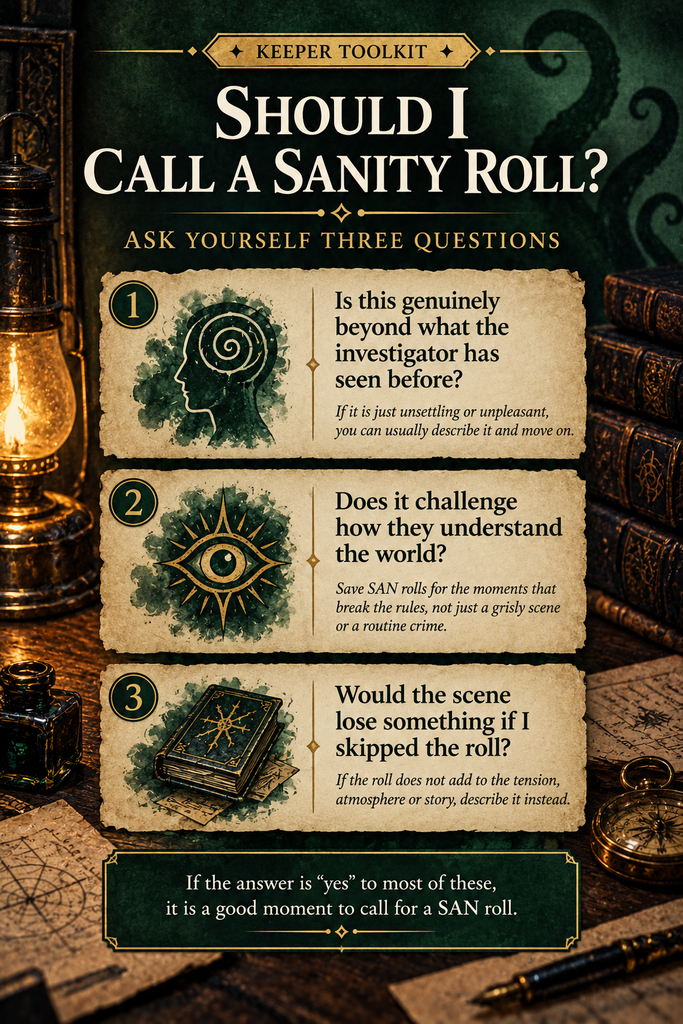
If the answer is no to most of those, describe it and move on. A gruesome murder scene might be unsettling, but ordinary investigators in this genre are expected to handle a crime scene.
Save the roll for the moments that break the rules. The thing that should not be moving. The face that is wrong in a way you cannot describe. The truth in the book that makes perfect sense.
A good habit is to decide, before the session, the two or three scenes you expect to cost real SAN. Everything else is texture.
⚖️ Matching the Cost to the Scene
Once you have decided to call a roll, the number matters.
A small cost, such as 0/1 or 1/1D3, says “that was unpleasant.” A bigger cost, such as 1D3/1D10, says “that changed you.”
Think about the scale of what the investigator has seen:
- A one-off shock, like a corpse in the wrong place, sits at the low end.
- Direct contact with something impossible sits in the middle.
- A true Mythos revelation belongs at the top.
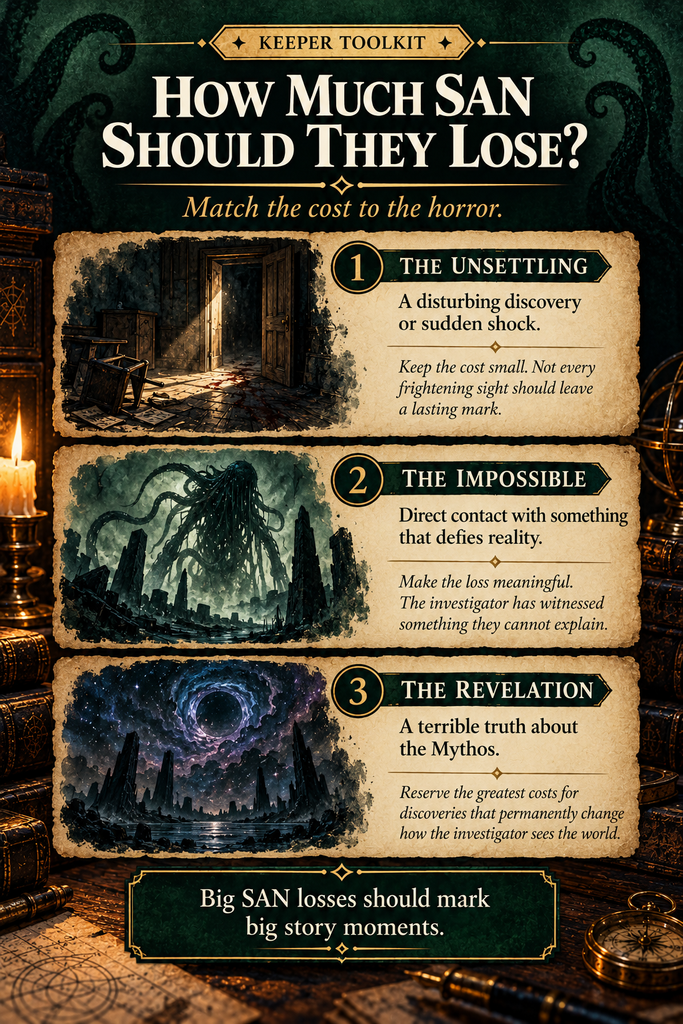
Resist the urge to put big numbers on small things because you want the table to feel scared. Big numbers on every scene lead straight to the spiral we will talk about shortly.
The rulebook gives example costs for typical creatures and events. Use those as a baseline and adjust for your own story, rather than inventing from scratch.
🎭 Keeping a Cracked Investigator in the Game
This is the part that separates a good Keeper from a great one.
The worst version of madness is “your character is insane, so sit this one out.” The player has lost agency, and agency is why they came.
Instead, treat a bout of madness as a prompt for the player. They are still in the scene. They are still making choices. The choices just come from a different place.
A few ways to do this:
- Hand over the role-play. Ask the player how their investigator reacts, within the shape of the bout. Most players will do something far better than anything you could script.
- Use the momentary action. When a roll fails, you can briefly steer the character’s next action. Make it a small, evocative beat rather than a hijack.
- Give the madness a job. A freezing, whimpering investigator is dull. One who cannot stop counting the stairs may notice something nobody else did.
- Keep other characters involved. A cracked investigator needs somebody to drag them out of the cellar. That is a scene in itself.
Phobias and manias are gifts to a Keeper. Rather than treating them as penalties, use them as story hooks that come back later in the campaign.
⚓ Backstory and Bonds as Anchors
Seventh Edition gives every investigator a backstory, including the people and things they care about. This is more than flavour. It is your best Sanity tool.
When an investigator is shattered, a connection to something real can pull them back. A sibling’s name. A promise made to a mentor. A lighthouse they grew up beside.
Encourage players to write backstory entries that you can actually use. Short, specific and personal beats long and vague.
It also works in the other direction. A madness episode can alter or damage a backstory entry, which means the Mythos does not only take SAN. It takes the things that make an investigator human.
If you are helping a new player build their character, our guide to creating an investigator in Call of Cthulhu 7th Edition is a good place to start. It is worth pointing them to the backstory step in particular.
🩹 Recovery and the Long Game
Sanity does not only go down. There are ways to recover, though they are slower and less reliable than players would like.
Recovery matters to you as a Keeper because it controls pacing across a whole campaign. If investigators recover quickly, you can afford harsher costs. If recovery is slow, you need to be gentler with the numbers.
Think about the shape of your campaign:
- A short, one-shot style scenario can run SAN right down, since nobody has to carry it into next week.
- A long campaign needs breathing room between horrors, or the party will be a row of broken wrecks by the midpoint.
It is also worth knowing that deeper knowledge of the Mythos comes at a price. The more an investigator learns about the cosmic truth, the lower the ceiling on how much sanity they can ever hold. That is a lovely, quiet mechanic for long campaigns. It rewards curiosity and punishes it at the same time.
Check the rulebook for the specifics of recovery options and for how the Mythos knowledge ceiling works.
🤝 Player Safety Without Killing the Mood
A dark game works best when everyone has agreed what kind of dark it is.
A session zero conversation takes ten minutes and saves hours of awkwardness. Ask what players want from the game and what they would rather not see.
Two simple tools are worth knowing:
- Lines are things that will not appear in the game at all.
- Veils are things that exist in the story but happen off-screen or are only hinted at.
You do not need to make a ceremony of it. A light touch works well. Say that you want everyone to have fun, that the game will get spooky, and that anybody can ask to adjust at any time.
This is not about making the game softer. It is about letting players commit fully to the scary parts because they trust the table. Horror lands harder when people feel safe enough to lean into it.
⚠️ Common Keeper Mistakes
Almost every Keeper makes at least one of these. Here is how to spot them early.
Over-rolling. We covered this above. If the table groans when you ask for a Sanity roll, you have probably called too many.
Lethal SAN spirals. Big costs early on drag investigators into insanity before the story has built up. The remaining sessions then become damage control. Keep early costs modest and let the drops grow with the story.
Ignoring a player’s reaction. Sometimes a player is visibly enjoying the descent. Sometimes they are quietly checking out. Watch the table, not just the character sheet. If somebody has gone silent, pause and check in.
Treating madness as a skip button. If the afflicted player is not doing anything for twenty minutes, something has gone wrong. Pull them back in.
Reciting rulebook tables. You do not need to read out every result. Use the tables for inspiration, then describe what happens in your own words.
If you are still finding your feet behind the screen, our Keeper’s survival guide to running Call of Cthulhu for the first time pairs nicely with this one.
🔦 Bringing It All Together
Sanity in Call of Cthulhu is not there to punish your players. It is there to tell a story about what it costs to look into the dark.
Call fewer rolls. Make each one count. Keep cracked investigators in the spotlight, anchor them with the things they love, and give the table room to recover between horrors.
If you do, you will find that the moments players remember are not the monsters. They are the moments somebody’s investigator stopped being the person they started as.
Looking for more to build on? A mixed party survives longer and breaks more interestingly, so our guide to building a balanced Call of Cthulhu party is a good next stop.
Deliverables
RPG news, GM tips, and system deep dives — straight to your inbox, no filler.