How to Create an Investigator in Call of Cthulhu 7th Edition
You’ve decided to stare into the void. Maybe a friend handed you the rulebook, maybe you’ve been watching actual play and wanted in, or maybe you’ve already read our guide to the Cthulhu Mythos and you’re ready to put a mortal face to that cosmic dread. Either way, you need an investigator—and Call of Cthulhu’s character creation process is one of the most flavourful in all of tabletop gaming.
This is a step-by-step walkthrough for Call of Cthulhu 7th Edition (7e), the current version published by Chaosium. Unlike many RPGs where you’re building a hero who grows into greatness, an investigator is an ordinary person—a professor, a journalist, a doctor—who stumbles into something they were never meant to find. That tension between mundane competence and creeping terror is baked right into how characters are built, and it makes the whole process feel different from anything else on the table.
We’ll move through each stage clearly, with tips on how to make choices that will serve you well when the screaming starts.
Before You Start: What You’ll Need
You need either the Keeper Rulebook or the Investigator Handbook—the latter is specifically the player-facing book and is worth having if you plan to run regular games. Chaosium also hosts downloadable character sheets on their official site, including editable PDF versions for different eras (1920s Classic, Modern, etc.), so grab one of those before you begin.
If you’d rather build digitally, Dholes House (dholes.house) is the go-to free web tool for Call of Cthulhu investigators. Chaosium links to it directly from their own sheet page, which tells you everything you need to know about its quality. It auto-calculates derived stats and lets you store characters online, which is handy if you’re not playing in person. That said, there’s something satisfying about working through the maths by hand at least once—you’ll understand your investigator far better for it.
The other thing you need before touching any numbers is a concept. Call of Cthulhu rewards investigators who feel like real people with real lives, not blank stat arrays waiting to be filled. Spend five minutes thinking about who this person is before you open the rulebook.
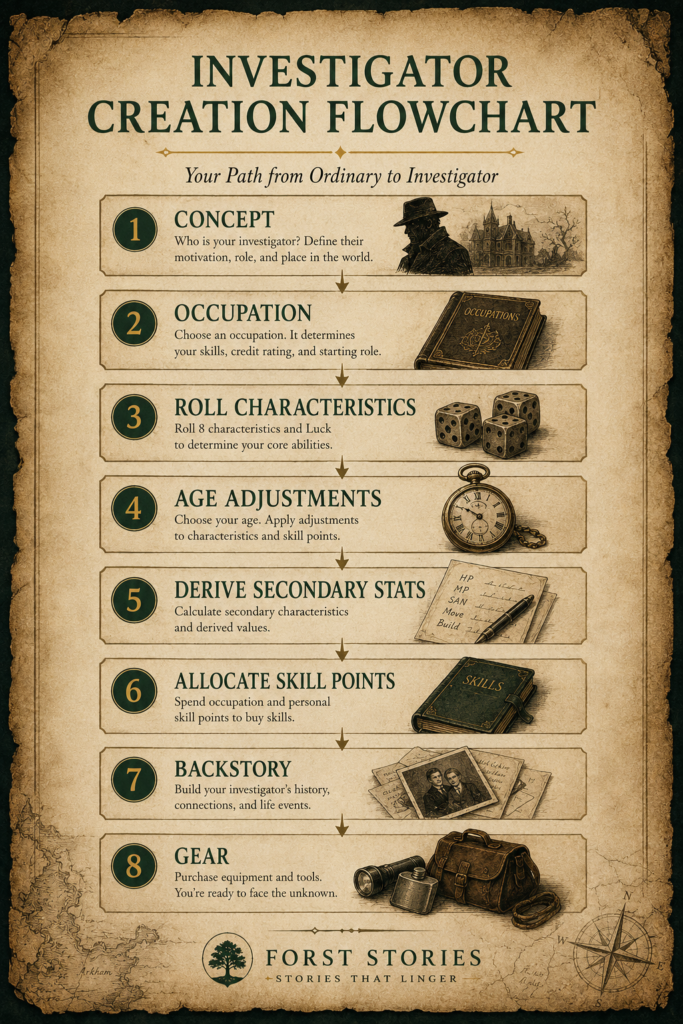
Step One: Concept and Occupation
Most guides tell you to roll dice first. Don’t. Start with concept and occupation—they shape everything that follows.
Your occupation is the backbone of your investigator’s identity. It determines which skills are considered “professional” for your character, sets the formula for calculating your occupation skill points, and establishes a Credit Rating range (how wealthy and socially connected your character appears). A Police Detective, an Antiquarian, a Nurse, a Journalist, a Dilettante—each brings a distinct flavour and a distinct toolkit to the table.
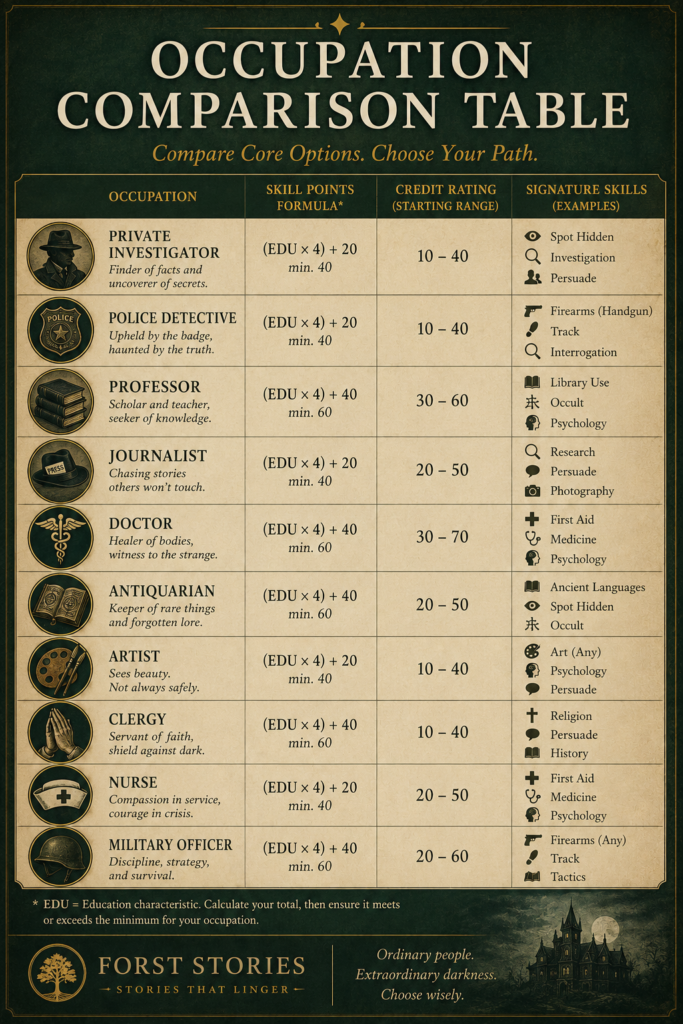
Think about what fits your campaign era and your Keeper’s scenario. The 1920s setting rewards period-appropriate choices: Private Investigators, Professors, Artists, and Clergy all feel at home in the pulp-horror aesthetic. A modern game might lean toward Paramedics, IT Consultants, or Military Personnel. If you’re playing with a group, consider what the party needs—someone good at research, someone who can handle a firearm, someone with social skills—and find an occupation that covers a gap without sacrificing character interest.
Making It Fit the Genre
One of Call of Cthulhu’s great strengths is how well occupation ties into tone. If you’ve read our overview of 10 Essential Things to Know About Call of Cthulhu, you’ll know this is a game about ordinary people facing extraordinary horror. That means the best investigators often have plausible reasons to be in the wrong place: a Librarian cataloguing an unusual estate, a Doctor treating a patient with no rational diagnosis, a Journalist chasing a story that turns out to be something worse.
Don’t optimise into a combat machine. Investigators who can fight tend to die just as fast as those who can’t—they just take more bullets doing it.
Step Two: Roll Characteristics and Luck
Now you get to touch the dice. Call of Cthulhu uses eight core characteristics, and the rolling method is elegantly simple once you know which pools go where.
STR, CON, DEX, APP, and POW: Roll 3d6 for each, sum the result, and multiply by 5. This gives you a percentage score between 15 and 90.
SIZ, INT, and EDU: Roll 2d6+6 for each, sum the result, and multiply by 5. The higher minimum reflects that all investigators are adults of reasonable intelligence and physical stature.
Luck: Roll 3d6 and multiply by 5 as normal. Luck is separate from the eight characteristics—it’s a pool you spend during play to modify rolls, and it doesn’t recover quickly, so its starting value matters a great deal.
Reading the Numbers
The results land between 15 and 90, with the average sitting around 50–55 for most stats. A characteristic of 50 represents a competent, unremarkable adult. Higher scores (70+) are genuinely exceptional; lower scores (30 and below) represent meaningful weaknesses that will come up in play. Don’t be tempted to reroll everything that isn’t 60+—low stats create the texture that makes investigator play memorable.
Some Keepers allow a “point-buy adjacent” approach where you roll the full pool and assign scores to characteristics as you see fit. If that option is on the table, prioritise EDU (it drives your occupation skill points) and the stat most relevant to your chosen occupation.
Step Three: Age and Derived Statistics
Your investigator’s age modifies their characteristics and affects how many personal skill points they have. The Investigator Handbook contains the full table, but here’s the broad shape:
Younger investigators (under 30) have more personal interest skill points to spend but may take small reductions to EDU. Older investigators have often lived enough to boost EDU further—roll 1d10 and add it to EDU for each decade past 20, up to a limit. Physical stats (STR, CON, DEX, APP) typically take small penalties as age increases. Check with your Keeper which version of the table they’re using, as there are minor variations between printings.
Calculating Secondary Stats
Once characteristics are set, several secondary statistics calculate directly from them:
Hit Points are derived from (CON + SIZ) divided by 10, rounded down. This is a small number—most investigators start with 10–12 HP. That number will feel very small the first time something hits you.
Sanity starts equal to your POW score. It represents your investigator’s psychological resilience, and it will go down. Planning for how your investigator loses their mind is almost as important as planning their skills.
Damage Bonus and Build derive from combining STR and SIZ, using a table in the rulebook that returns a modifier (from -2 to +2) and a Build score. Sheets and digital tools auto-calculate these—if you’re working by hand, the table is on the same page as the characteristic descriptions.
Move Rate defaults to 8 for most adult investigators and is modified slightly by relative STR, DEX, and SIZ values.
Step Four: Allocate Skill Points
This is where your investigator really takes shape. You have two pools of points to spend on skills.
Occupation skill points are calculated from your EDU and (depending on your occupation) one or two other characteristics. The most common formula is EDU × 4, but many occupations use a blend—EDU × 2 + DEX × 2 for an Athlete, EDU × 2 + APP × 2 for a Performer, and so on. These points can only go into your occupation’s listed skills and into Credit Rating.
Personal interest skill points equal INT × 2 and can go into any skills except Cthulhu Mythos. These represent everything your character learned outside their professional life—hobbies, obsessions, formative experiences.
How Skills Work
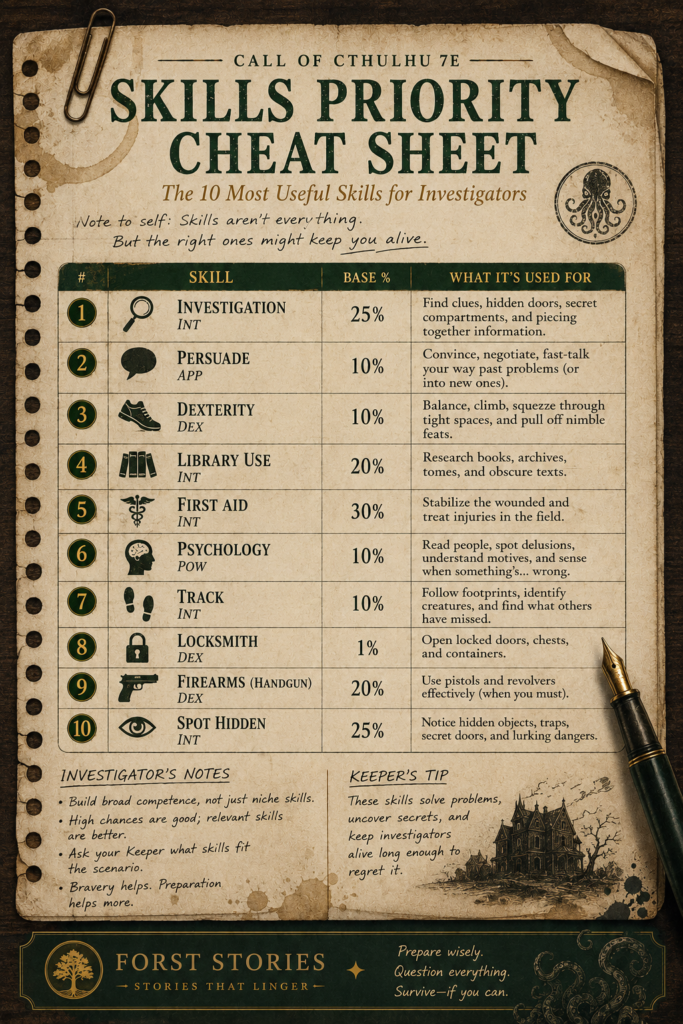
Each skill has a base percentage printed in the rulebook—Spot Hidden starts at 25%, Library Use at 20%, Firearms (Handgun) at 20%. You add your skill points on top of that base, not instead of it. A character who dumps 50 points into Library Use starts at 70%—that’s a professional-grade researcher who will find things other investigators miss.
Two important housekeeping rules: Credit Rating must be funded from your occupation skill points, and it should land within your occupation’s specified range. Own Language (usually English for most campaigns) automatically equals your EDU score—you don’t spend points on it.
The instinct to spread points thinly across many skills is understandable but counterproductive. A skill below 50% will fail often enough to frustrate you. Aim for a handful of skills in the 60–80% range that define what your investigator is actually good at, and let the others sit at base. Specialisation is survival.
Skills Worth Prioritising
Spot Hidden (default 25%) is universally useful—it’s the skill that tells you something is wrong before something is wrong with you. Library Use (20%) drives the investigative backbone of most scenarios. Psychology (10%) lets you read NPCs and know when someone is lying, which happens constantly. Beyond those three, build toward your occupation and your concept.
If your occupation or concept involves social interaction, Persuade (25%), Fast Talk (5%), or Charm (15%) all serve different conversational contexts. Combat skills are worth modest investment—enough to function, not so much that you’re treating Call of Cthulhu like an action game. As noted in our Call of Cthulhu vs. Delta Green comparison, these are games where fighting is usually a losing strategy.
Step Five: Backstory and Motivations
This is the step many players rush through, and it’s the one that matters most for actually playing the game.
Call of Cthulhu uses a structured backstory system with ten entry slots, which the Investigator Handbook lays out as: Personal Description, Ideology/Beliefs, Significant People, Meaningful Locations, Treasured Possessions, Traits, and a few additional slots for quirks and relationships. You don’t have to fill all ten with elaborate prose—a few vivid specifics are worth more than comprehensive vagueness.
One of these entries should be designated as your Key Backstory Connection: a relationship, belief, or place that serves as your investigator’s emotional anchor. In mechanical terms, connecting with this anchor between adventures can restore Sanity. In narrative terms, it’s the reason your investigator keeps going back into the dark. Make it something that matters, and make it something that Lovecraftian horror can threaten.
Making Backstory Work at the Table
The best backstory entries are ones that create obvious hooks. A Significant Person who is a sibling currently working as a nurse at Arkham Sanatorium is far more useful than “my mother, who I love.” A Treasured Possession that’s an heirloom pocket watch from a grandfather who disappeared under mysterious circumstances is better than “a gold watch.” Give your Keeper material to work with.
If your campaign involves props and player handouts—which it often does in Call of Cthulhu—the backstory can also inform what physical items your character carries. Our Props and Handouts guide has ideas for turning investigator details into table props, which works especially well for the personal items and letters that appear in so many classic scenarios.
Step Six: Gear, Cash, and Finishing Touches
With Credit Rating established, you can determine your investigator’s starting cash on hand and assets using the table in the rulebook. A Professor with a Credit Rating of 35 carries moderate savings and a reasonable lifestyle; a Dilettante at 70 has access to serious money and social connections but may be less trusted in certain circles.
Buy equipment that fits the era and your occupation. A 1920s Antiquarian might carry a walking stick, a magnifying glass, and a flask. A Military Officer might have a service revolver and a campaign medal. A Journalist carries a notebook, a camera, and press credentials. These details don’t just provide practical tools—they tell the other players who you are before you’ve said a word.
Finish with a name, physical description, and a mannerism or two. The physical description can be surprisingly important in Call of Cthulhu, where aging, trauma, and Sanity loss leave visible marks. Decide what your investigator looks like before the horror finds them—it makes the contrast all the more effective when something changes.
Character Sheet Downloads
Chaosium hosts official character sheets at their website, including editable PDF versions for the Classic 1920s era, the Modern era, and Pulp Cthulhu. These are updated regularly and are the cleanest versions available.
For digital creation and storage, Dholes House remains the community’s preferred tool. It handles the maths automatically, supports multiple eras, and lets you save and share investigators. If you’re playing on a virtual tabletop, Roll20 and Foundry VTT both have Call of Cthulhu character sheet integrations that can speed up your first session.
What to Expect at Your First Session
A freshly created investigator is a competent adult with specific professional skills and meaningful personal connections—and that’s exactly as prepared as they should be. Call of Cthulhu is a game about discovery, and the best sessions often begin with investigators who feel like they know what they’re doing, right up until they don’t.
Before your first session, talk to your Keeper about how the backstory slots will be used and whether there’s a Session Zero planned to establish safety tools and tone. Call of Cthulhu can go to dark places, and setting expectations early makes the game better for everyone. Our Essential Guide to Call of Cthulhu Expansion Books is also worth a read once you’ve played a session or two—there’s a lot of excellent supplemental material that builds on the base experience.
If horror isn’t quite your flavour but you’re interested in investigation-focused play, Beyond the Mythos rounds up some excellent alternatives. And if you want to try a different character creation approach entirely, our Daggerheart character creation guide covers how one of Call of Cthulhu’s tonal opposites handles building a character from scratch.
Your investigator is ready. They just don’t know what they’re walking into yet.
Continue Your Journey
- 10 Essential Things to Know About Call of Cthulhu RPG — Everything you need before your first session
- A Beginner’s Guide to the Cthulhu Mythos: Who Are the Great Old Ones? — The lore your investigator will spend sessions trying to understand
- Call of Cthulhu vs. Delta Green: Same Universe, Very Different Tone — For when you’re ready to explore what else the Mythos has to offer
- The Essential Guide to Call of Cthulhu Expansion Books — Ready to go deeper? Start here
- Session Zero Strategies: Setting Your Campaign Up for Success — Get your table on the same page before the madness begins
Have you built a Call of Cthulhu investigator before? What occupation did you choose, and did it survive long enough to matter? Share your investigator stories in the comments below — we’d love to hear who you brought to the table.
Want more TTRPG guides and gaming resources delivered straight to your inbox? Sign up for The Scriptorium Newsletter and never miss a post.
RPG news, GM tips, and system deep dives — straight to your inbox, no filler.