
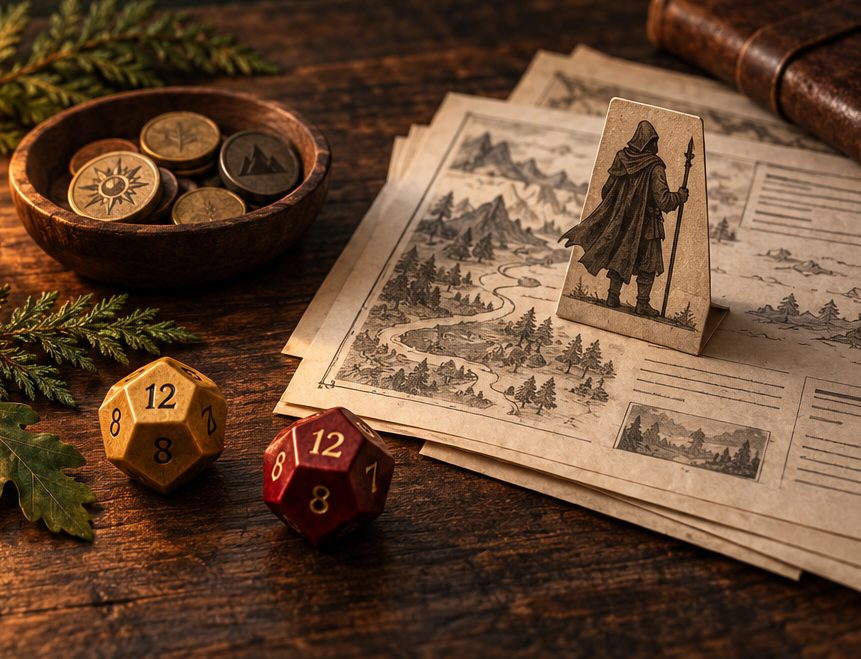
Running the Official Daggerheart Quickstart Adventure: Prep Guide and Pitfalls
The first time you run Daggerheart, the game itself is rarely the problem. The problem is the gap between “I have read the rules” and “I have five people staring at me, waiting for the first scene.”
That gap is exactly what the official quickstart adventure is built to close. It is also easy to underestimate. Here is how to prepare for it, where new GMs tend to trip up, and how to keep the session moving.
GM spoiler note: This guide is for the person running the game. It covers the adventure’s overall shape and general pitfalls, not a scene-by-scene walkthrough, but if you are planning to play rather than run, stop here and send your GM the link instead.
🌲 What the Quickstart Actually Is (and Isn’t)
The Sablewood Messengers is the free quickstart adventure from Darrington Press. You can download it from the official Daggerheart downloads page, and the version I checked while writing this is the PDF dated 20 May 2025.
It is written for three to six people in total: one GM and two to five players. It comes with five pre-generated characters, so nobody needs to build anything before they sit down.
It also includes step-by-step guidance for the GM, including notes on teaching the game as you go. That is what makes it a proper “learn by playing” product rather than a plain one-shot.
What it is not is a full rulebook. The quickstart teaches enough to run this adventure, but it does not cover every rule you might need if players start improvising. Keep the Daggerheart core rulebook within reach for those moments. [AFFILIATE LINK NEEDED: Daggerheart Core Rulebook]
The adventure follows a five-act shape. It mixes a roadside encounter, an ambush, a stretch of social exploration and a final defence, which gives you a nice spread of combat, conversation and discovery in one sitting.
📖 Read the Whole Thing First, Properly
The guide itself tells you to read the entire adventure before your players arrive, and that is the single best piece of advice in it. It is tempting to skim the first act and trust yourself to wing the rest.
Don’t. This adventure leans on information that is revealed gradually, and you will want to know where each thread is heading before you start dropping hints.
A good first pass takes about an hour. Read it once for the story, then once with a pen, noting where you will pause to teach a rule and where you expect the table to slow down.
If you have never run a narrative-first game, it helps to read the Daggerheart GM guidance alongside it. Our plain-language walkthrough of the core principles in the Daggerheart GM guide is a quick way to get into the right headspace.
Keep your own notes short. One page with the five act names, the NPCs you want to voice well and the two or three rules you plan to teach is far more useful at the table than a stack of highlighted pages.
🎲 The Prep Checklist
Most of the work is practical rather than creative. Get these sorted a day or two ahead and the evening itself becomes much calmer.
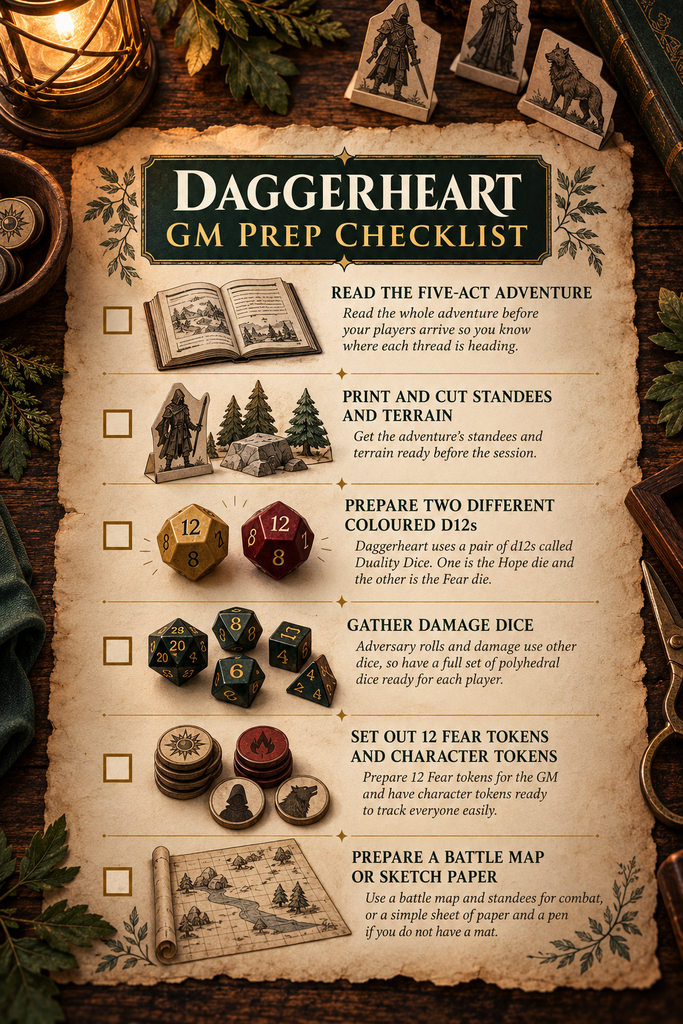
- Print and cut your materials. The adventure comes with standees and terrain, and you will want them folded or cut before anyone sits down. Doing it during the session eats ten minutes you do not have.
- Gather your dice. Daggerheart uses a pair of d12s called Duality Dice, and they need to be two different colours. One is the Hope die and the other is the Fear die, so you must be able to tell them apart at a glance.
- Bring the rest of the polyhedral set. Damage and adversary rolls use other dice, so a standard set each is ideal. A shared pool in the middle of the table works if people are short.
- Prepare Fear tokens. The guide lists 12 Fear tokens for the GM. Coins, glass beads or anything similar will do.
- Have character tokens ready. The guide also mentions tokens for characters, which makes tracking much easier.
- Decide how you will show the action. The guide suggests a battle map and standees for combat. A sheet of paper and a pen is enough if you do not own a mat.
If your group will be playing online, the same prep applies in digital form. The GM behind the Delve With Hope blog printed the guide and GM sheets even for an online game, so they could flip between pages without losing screen space.
For online tools and character sheets, see our rundown of Demiplane, VTTs and character tools for online Daggerheart.
🧑🤝🧑 Handing Out Characters
The five pre-generated characters are one of the quickstart’s best features. They remove the biggest barrier for a mixed table, because nobody has to make decisions about a system they have not played yet.
Let people choose by vibe rather than by mechanics. Ask who they would like to be for an evening and let them read their own sheet breakdown aloud.
One of the characters, Marlowe Fairwind, is written into the adventure’s story. The guide treats her as a character who needs to be played, so someone at the table will want to take her on. If you only have two players, or a table that does not want that role, some GMs run her as an NPC instead. It works, but you will need to give her a bit more life yourself.
Players are also asked to link their characters through Connections. This step can feel awkward when people are still shy, so let them roleplay for a few minutes first and the answers tend to come more naturally.
If anyone at your table wants to go further after the one-shot, point them towards our guide to step-by-step character creation in Daggerheart. That is where the real choices begin.
🧠 Teach the Dice as You Go
The most common mistake with any new system is front-loading the rules. Resist the urge to explain Hope, Fear and Duality Dice for twenty minutes before a single scene begins.
The quickstart is designed to avoid this. It walks players through their sheets, then introduces action rolls in context, so each rule arrives at the moment it matters.
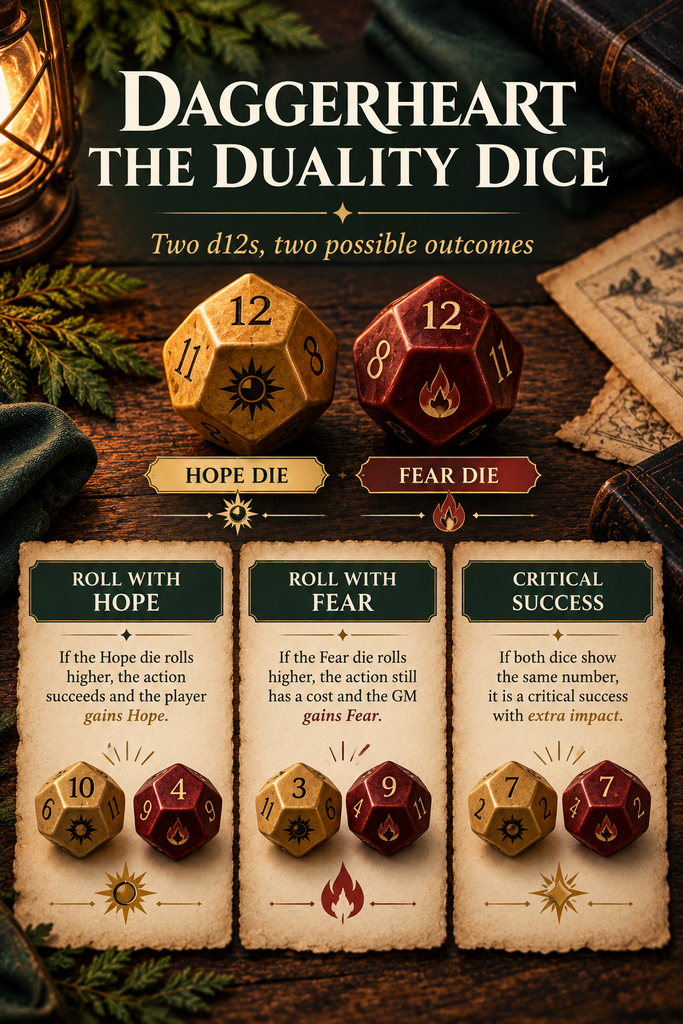
The core idea is simple enough to teach in a sentence or two. A player rolls two d12s, adds a trait modifier and compares the total to a difficulty. The higher die also tells you whether the roll was made with Hope or with Fear.
Roll with Hope and the player gains a Hope. Roll with Fear and you gain a Fear to spend on complications. Matching dice are a critical success, which gives you a reliable moment of celebration at the table.
Encourage players to say their total and which die was higher every time. After four or five rolls, most people do it without being asked.
If you want a deeper look at using that tension well, our piece on Hope and Fear as GM tools explains how to keep Fear fair rather than arbitrary.
⏱️ Pacing Pitfalls to Watch For
Most first-time quickstart sessions go wrong in the same few ways. None of them are fatal, and all are easy to fix once you know what to look for.
Early dice maths. In the first scenes, players are still working out which trait to add and what the difficulty means. Rolls feel slow. Do the sums for them at first, then hand the job back as they gain confidence.
Uneven spotlight. Daggerheart does not use a fixed turn order. Players act in whatever order feels natural, which is brilliant for flow and risky for quieter people. Keep an eye on who has not spoken lately and invite them in directly.
Treating every fight as a fight to the death. One experienced GM, writing in Piotr Sordyl’s GM advice, points out that players often assume they must defeat every enemy. Remind them that escaping, bargaining or moving on can also be valid outcomes.
Forgetting Hope. Players frequently forget that Hope can be spent. Ask “do you want to use a Hope for that?” a few times and it will stick.
Not using Fear. New GMs hoard Fear tokens. The guide is clear that you can spend them to make a move even when the players have not failed, so use them to keep the pressure on.
🕯️ Letting the Social Scenes Breathe
The middle of the adventure is where roleplay-loving groups will shine, and where a nervous GM is most tempted to hurry. Do not rush it.
The guide encourages you to let players roleplay before the first roll and to ask them questions about the world. Ask what they have noticed about the trees, or what the village feels like, and then build your description around their answers.
This does two things. It gives players ownership, and it takes pressure off you to invent everything.
If you want to add a little extra colour, create one or two NPCs of your own. A tavern keeper with a strong opinion is often enough to make a place feel real. Keep them minor, so they never pull focus from the story the adventure is telling.
You also do not need to cover everything. The Delve With Hope GM did not push players through every open-ended moment and felt the table did not miss much by skipping some.
⚔️ The Final Fight
The last act is where most groups hit a snag, and it is also where I would be most cautious about trusting any advice, including mine.
At the time of writing I could only read part of the official PDF, so I could not confirm the final encounter’s exact setup from the source. Check the final act in your own copy before the session and make your own adjustments.
What I can tell you comes from other GMs. The Piotr Sordyl write-up describes the finale as using a progress counter that drops as enemies fall, and reports a real risk of a total party kill with a small group. His suggestion for two or three players is to reduce the starting number or make tougher enemies count for more.
That is a sensible principle for any table. If you have fewer players than the adventure assumes, soften the finale before you start rather than after the party is already struggling.
There are a few general habits that help in any final fight:
- Reintroduce Hope combos and tag-team options before the big fight, not during it.
- Take a short break before the finale if the group is flagging.
- Use Fear to move the spotlight between adversaries, so enemies feel like a threat without piling onto a single player.
- Call out when something has gone well. Daggerheart rewards enthusiasm.
For a wider look at running fights smoothly, read our guide to Daggerheart encounters without a grid.
🕰️ Setting Session Length Expectations
Tell your players how long you expect to be playing, and be honest about it. Published listings for this adventure generally put it somewhere between two and four hours.
The Delve With Hope GM reported around two and a half hours, not counting chat and reflection afterwards. A group that loves roleplay, or one that is learning the rules for the first time, will naturally run longer.
Plan for four hours and be delighted if you finish sooner. If time is tight, decide in advance which social scenes you are happy to compress, so you never have to rush the ending.
A short pause between acts is a good habit, especially if people are juggling dice and tokens for the first time. It also gives you a moment to check how everyone is feeling.
🚪 Where to Go Next
Once the session is over, ask your players what they liked. The answers will tell you whether you are heading for a longer campaign or another one-shot.
If they want more of the same, the official downloads page also offers a Sablewood location download. It is designed to follow the quickstart and adds landmarks, settlements, factions and adversaries, so you can keep exploring the forest without writing everything from scratch.
If they want their own heroes, it is time for character creation. Sit down together and build characters properly, now that everyone has felt how the dice behave.
Running the quickstart is a gentle way to find your feet as a Daggerheart GM. Read it through, prepare your table, teach as you go and give yourself permission to adapt the finale. If it goes a little wobbly in places, that is part of learning the game.
RPG news, GM tips, and system deep dives — straight to your inbox, no filler.


