How to Read the Daggerheart GM Guide: Core Principles in Plain Language
If you’ve run D&D for years and recently picked up Daggerheart, the GM Guide PDF probably felt a little strange. It’s short. It’s terse. It looks like a reference sheet, not a rulebook, and there’s a reason for that — it genuinely is one. The Daggerheart GM Guide is designed to sit behind your screen as a reminder of how to run a conversation, not as a dense technical manual you read end-to-end before your first session.
This article breaks down what the guide is actually for, what each section is trying to tell you, and how to translate the core principles into something you can act on at the table — particularly if your GM instincts have been shaped by D&D 5e.
What the GM Guide Actually Is (and Isn’t)
The official Daggerheart GM Guide PDF is a condensed, printable cheat sheet of moves, Hope and Fear uses, difficulty benchmarks, and encounter guidance. It doesn’t contain the full rules. It’s not trying to. It’s a prompt sheet for the GM’s half of the conversation that happens every time your players look up from their character sheets and ask “what do we see?”
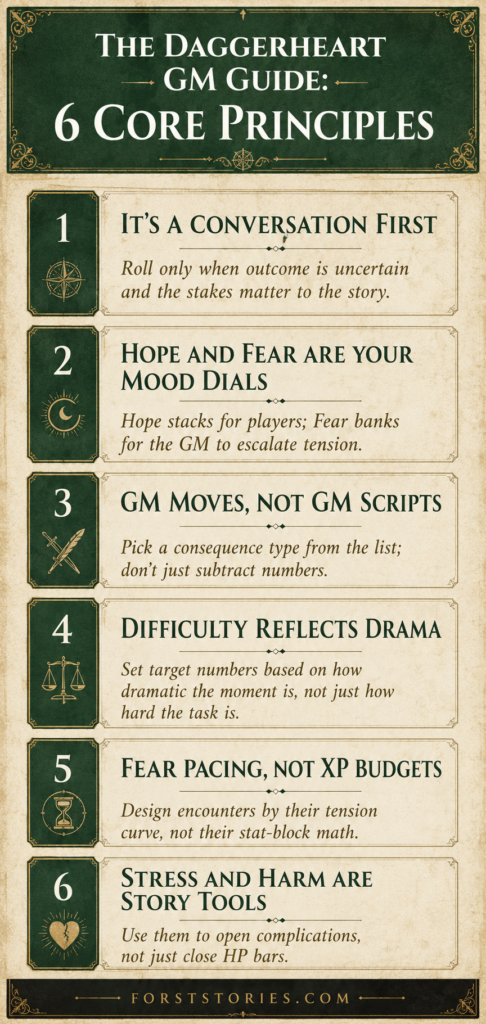
Think of it less like a rulebook and more like a flowchart for how to respond to your players. When you’re unsure what to do next, the guide gives you a small menu of options, not a wall of text to parse. If that sounds unfamiliar after years of the 5e DMG, that’s intentional — Daggerheart comes from a different design tradition, one that prioritises narrative momentum over procedural completeness.
A useful first pass: skim the section headings only. GM moves list. Hope and Fear uses. Difficulty table. Fear per encounter suggestions. Stress and damage boxes. Once you can name what each section is for in your own words, the detail in each section becomes much easier to use.
Core Principle 1: It’s a Conversation First
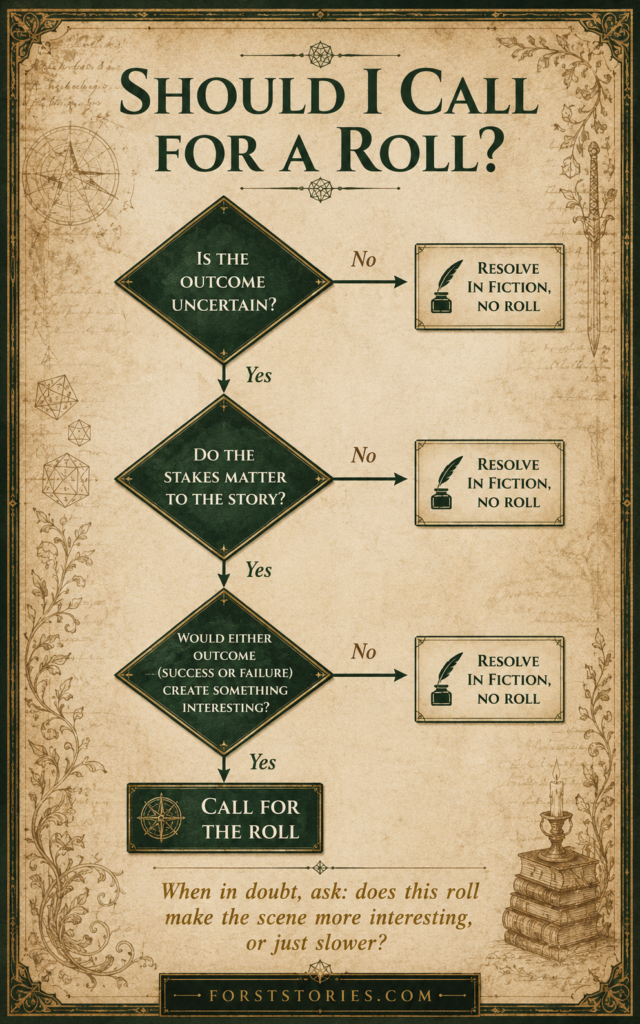
Daggerheart frames play as a conversation. The GM describes a situation, players say what they do, and only then do you ask whether a roll is needed. Where D&D 5e often starts with “what skill do I roll?”, Daggerheart asks you to resolve as much as you can in the fiction first — dice come in only when the outcome is genuinely uncertain and the stakes of that uncertainty matter to the story.
GM Guide · Self-Assessment
What kind of Daggerheart GM are you?
Question 1 of 4
Your focus for next session
Read next on Forst Stories
This is the same rhythm as Powered by the Apocalypse and Forged in the Dark games: fiction generates a move or roll, and the result generates new fiction. If you’ve played Blades in the Dark or Monster of the Week, you’ll find it immediately familiar. If you haven’t, the shift feels strange at first because 5e tends to go “skill list → DC → narration,” which is almost the reverse order.
The GM Guide’s action roll summary puts this plainly: call for a roll when the stakes and outcome matter. Not when a player attempts something difficult, but when what happens next depends on the roll in a way the story cares about. That’s a small distinction that changes a lot in practice.
When Not to Roll
Experienced 5e GMs often reach for the dice out of habit. Daggerheart asks you to pause before calling for a roll and ask whether anything interesting would change depending on the result. If the answer is no — if success is certain, or if failure would just be “you don’t do the thing” with no consequences — resolve it in fiction and move on. Saving dice for genuinely pivotal moments makes them land harder when they do hit the table.
Core Principle 2: Hope and Fear as Your Mood Dials
Daggerheart’s signature mechanic is the Hope and Fear duality. When players roll the Duality Dice (two d12s, one marked Hope, one Fear), one side will be higher. If the Hope die wins, the player earns a point of Hope to spend later. If the Fear die wins, the GM earns a point of Fear to bank.
For 5e GMs, the most useful shorthand is this: Hope works like Inspiration that stacks and is meant to be spent constantly, and Fear works like a pool of “hard move points” you earn when the dice go dark and can cash in to make fights scarier or complications nastier.
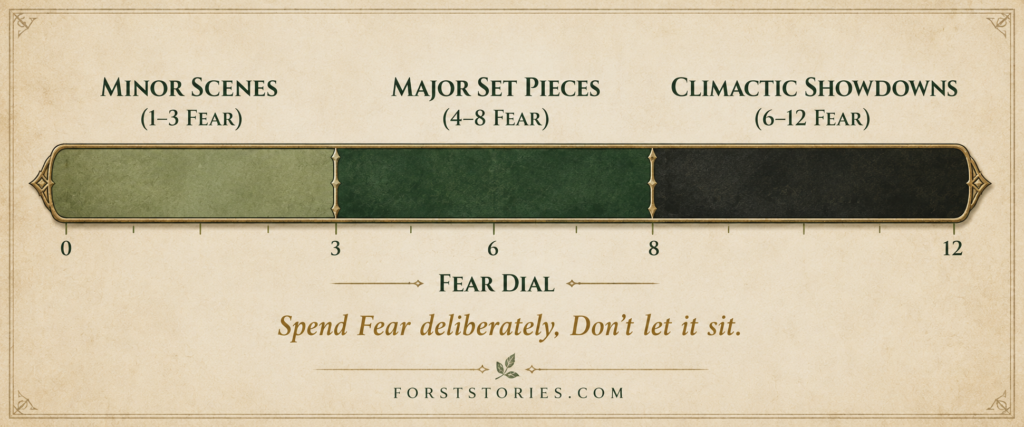
The GM Guide lists what you can spend Fear on — making extra GM moves, activating adversary or environment Fear features, escalating tension in and between scenes. It also gives you suggested Fear ranges per encounter type as a pacing guide: minor scenes generate 1–3 Fear, major set pieces 4–8, and climactic showdowns 6–12. These ranges aren’t rules so much as calibration — they help you understand how hard to push and when you’re sitting on more Fear than a scene naturally supports.
Spending Versus Holding Fear
The guide implicitly teaches you that hoarding Fear is a mistake. Fear held too long makes individual encounters feel flat; Fear spent at the right moment shifts the texture of a whole scene. Think of it as the GM’s version of dramatic timing — save enough for the moment that needs to hit hard, but don’t let it accumulate into dead weight.
Core Principle 3: GM Moves, Not GM Scripts
The GM Guide provides a list of GM moves — things like revealing an unwelcome truth, showing future badness, spotlighting an adversary, shifting the environment, or making a player character mark Stress. These moves are prompts for how the world hits back, not mandatory scripts you must follow in a specific order.
In D&D 5e, the instinct when a roll fails is often “subtract hit points” or “say nothing happens.” Daggerheart’s move list is designed to break that habit. When a player rolls with Fear, when they fail, or when the fiction calls for consequences, you pick a move from the guide and narrate a consequence that changes the fiction — not just the numbers on the sheet.
A failed stealth roll, for example, might trigger “signal an imminent off-screen threat” or “force the group to split up” rather than simply “you don’t sneak in.” The outcome still makes sense, but it opens new complications rather than closing off a failed attempt with a flat no.
Moves as Vocabulary
One of the more underappreciated things the move list does is give you a shared vocabulary with your players. When you announce “I’m going to make a GM move” before narrating a consequence, it signals that what’s about to happen is the world responding to the fiction, not the GM making a punitive decision. That small transparency builds trust at the table, especially with players coming from games where GM authority can feel opaque.
Core Principle 4: Difficulty and Consequences Together
The GM Guide includes difficulty benchmarks — target numbers for action rolls, similar to DCs in D&D 5e — but it explicitly ties them to narrative stakes rather than just task hardness. The question isn’t only “how physically difficult is this?” but “how dramatically important is this moment, and how much should difficulty reflect that weight?”
Outcomes are tiered: critical success, success with Hope, success with Fear, and outright failure. Each tier comes with guidance on what to add or take away from the scene. The most important tier for recovering 5e GMs to absorb is success with Fear — on a roll like this, you still give the player what they wanted, but you also take the chance to earn Fear and add trouble. It’s a partial success in the PbtA sense, not a failure in disguise.
The guide’s plain-language framing is worth quoting here: don’t set difficulty to punish; set it to spotlight how risky or dramatic this moment is. That reframes the DC equivalent away from “obstacle to overcome” and toward “opportunity to tell an interesting story,” which changes how you prep and how you respond when players take unexpected routes.
Core Principle 5: Fear Pacing Instead of XP Budgets
Daggerheart replaces the CR math and XP budget system from D&D 5e with a Fear-focused pacing approach. Rather than calculating encounter difficulty based on monster statistics and player levels, the guide asks you to think in scenes and spotlight moments — how much Fear will this encounter generate, when should it be spent, and what does each encounter contribute to the emotional arc of the session?
The environment and adversary “Fear features” listed in the guide are the mechanical expression of this. Each encounter should feel distinct not because enemies have different stat blocks, but because the Fear features attached to them create different dramatic textures. One fight might involve enemies that trigger Fear features when players take Stress; another might shift the environment underneath them. The variety comes from the kind of trouble, not just the quantity of it.
For anyone used to thinking in “monsters per day,” the translation is roughly: a short travel scene might only ever generate 1–2 Fear and one colourful complication, while a climactic duel is where you deliberately cash out Fear to trigger multiple hard moves in sequence. Pacing becomes about the shape of a session’s tension curve, not its numerical balance.
Core Principle 6: Stress, Harm, and Death as Story Tools
The GM Guide’s references to damage thresholds (minor, major, severe), Stress, armour, and death moves are all pointed toward the same goal: keeping you focused on what these costs mean in the fiction, not just what they subtract from a stat block.
Stress is the pressure valve. Rather than going straight to hit point damage every time the world hits back, Stress lets you make a player’s situation feel more desperate in a way that’s recoverable — for now. It’s narrative breathing room built into the system. The guide nudges you to mark Stress as a consequence when the fiction calls for mounting pressure rather than outright injury.
The death and scar rules are framed similarly. When a death move triggers, the guide treats it as an invitation to pivot the story rather than a punitive end state. Characters can sustain permanent changes, take on new vulnerabilities, or make desperate final choices. The scene doesn’t just subtract a character — it generates something the remaining party has to reckon with.
How to Actually Read the GM PDF
If you’re sitting down with the guide for the first time, a two-pass approach works well. On the first pass, just skim the headings and give yourself one sentence in plain language for each section — “this is how I make trouble,” “this is my danger dial,” “this is my how-hard-is-it ruler.” Don’t stop to memorise anything. You’re building a mental map, not learning rules by heart.
On the second pass, pick a scene type you know well from D&D — a bar fight, a social intrigue scene, a trap corridor — and rewrite how you’d run it using only the guide. When does Fear get earned? Which GM moves would you use? When would you cash out Fear? If you’ve been GMing systems with deeper rules literacy for years, this exercise bridges your existing instincts into Daggerheart’s vocabulary faster than any amount of passive reading will.
The guide is short enough that both passes together take maybe twenty minutes. Most of the learning happens at the table in your first two sessions.
Building from Your Existing Experience
If you’ve already read our piece on running your first Daggerheart session or looked at how experience prompts shape your Daggerheart story, you’ll find the GM Guide slots naturally into the framework those articles describe. The moves list is the mechanical spine connecting session prep to in-the-moment decisions.
Cross-System Potential: Borrowing from Daggerheart
The “conversation plus GM moves” structure in Daggerheart sits in the same design family as PbtA and Forged in the Dark games. If you’ve run Blades in the Dark before, the rhythm will feel immediately familiar. If you haven’t, it’s worth knowing that Daggerheart’s approach represents a well-developed tradition of design, not an experiment.
More interestingly, several elements of the GM Guide lift cleanly into other systems. A Hope/Fear meta-currency layer dropped into D&D 5e — as a house rule alongside normal mechanics — can add the kind of ebb-and-flow tension Daggerheart builds in natively. Similarly, importing a Daggerheart-style GM moves list into your existing game (whatever system that is) encourages more narrative consequences and breaks the habit of “nothing happens on a miss.”
The move list is system-neutral enough that GMs running Call of Cthulhu, Triangle Agency, or almost anything else can adapt it with minimal translation. The principle — have a small vocabulary of consequence types and pick from it intentionally — applies everywhere.
If you want to compare how Daggerheart sits relative to 5e as a whole before committing to the GM side of things, the Daggerheart vs D&D 5e overview covers the player-facing differences in depth.
GM Guide · Side by Side
Daggerheart GM vs D&D 5e: Key Differences
| D&D 5e habit | Daggerheart approach |
|---|---|
|
5e What skill do I roll? Dice check comes first; fiction fills in around the result. |
Daggerheart Resolve in fiction first. Roll only when the outcome is uncertain and the stakes genuinely matter to the story. |
|
5e Subtract HP on a failed roll. Or say nothing happens — the action simply didn’t succeed. |
Daggerheart Pick a GM move; change the fiction. Consequences open new complications rather than closing off failed attempts. |
|
5e CR math for encounter balance. XP budgets, monster CR, and action economy calculations. |
Daggerheart Fear ranges per scene type. Minor scenes 1–3 Fear · Major set pieces 4–8 · Climactic showdowns 6–12. |
|
5e Inspiration (single use). One token, awarded by GM, spent for advantage. |
Daggerheart Hope (stackable, spent often). Earned on Hope die results; players hold multiples and spend freely for narrative impact. |
|
5e GM chooses consequences silently. Players rarely know if a GM decision is a rule call or a narrative choice. |
Daggerheart “I’m making a GM move” — named and transparent. Signals that the world is responding to fiction, not the GM punishing a player. |
|
5e DC = task difficulty. How physically or socially hard is this action to pull off? |
Daggerheart Difficulty = dramatic weight. How important is this moment? Set numbers to spotlight risk, not to punish. |
What This Means for Your First Session
The GM Guide is designed to be useful the moment you open it at the table, not before. The most valuable thing you can do before your first Daggerheart session as GM isn’t to memorise it — it’s to be comfortable enough with the six principles above that you can make instinctive decisions when something unexpected happens.
Fear will get spent at the wrong moments. You’ll call for rolls when fiction would have done the job. You’ll forget which tier of success you’re on. All of that is normal and correctable. Daggerheart is designed for a GM who’s trying to stay in the conversation with their players, not one who’s consulting a manual mid-sentence.
If your players are new to the system, point them toward how Daggerheart’s cards work and the best beginner classes to handle the player-side learning curve independently. That frees you to focus on the GM side — the moves, the Fear economy, and the conversation — without having to hold both halves of the table at once.
Run the first session. Use the guide as a prompt sheet. See which parts of it you never looked at and which you reached for every ten minutes. That’s your real map for what to study before session two.
Continue Your Journey
New to Daggerheart? These articles cover the essentials before your first session:
- What Is Daggerheart? 10 Things to Know Before Your First Session — the big-picture overview of the system
- Your First Daggerheart Session: What to Expect at the Table — what the session rhythm feels like from a player’s perspective
- Step-by-Step Character Creation in Daggerheart — walks your players through building their first character
- Daggerheart vs D&D 5e: Which Fantasy RPG Should You Start With? — a full comparison for GMs and players deciding between systems
- Online Daggerheart for Beginners: Demiplane, VTTs, and Character Tools — everything you need if you’re running Daggerheart online
What’s the GM move you’re most likely to forget in the heat of a session — and what’s your plan for remembering it? Drop it in the comments.
Want more GM resources, system guides, and RPG news in your inbox each week? The Scriptorium newsletter lands every Wednesday — one email, no filler.
RPG news, GM tips, and system deep dives — straight to your inbox, no filler.