
Running Triangle Agency for the First Time: A Handler’s Guide
You have read the book, you have strong opinions about the Agency’s cheerful corporate language, and you have a table of friends waiting for a briefing. Then it hits you: what does the person running this game actually do on the night?
Triangle Agency is a joy to read and a slightly different beast to run. This guide walks you through the Handler’s chair, from prep to pacing to the moment a session wobbles, so your first mission feels confident rather than chaotic (well, the good kind of chaotic).
🗂️ What a Handler Actually Does
The Handler is the Triangle Agency version of a GM. You frame scenes, play the Agency and everyone in the world, and adjudicate what happens when the Agents act.
The main difference from many fantasy games is where your energy goes. You are not mostly there to say no and set obstacles. The dice lean heavily towards success, so your real job is steering the consequences that pile up around those successes.
Think of yourself as a slightly too-friendly manager running a very strange workplace. You keep the briefings smooth, the paperwork absurd and the dread quietly building underneath.
If you want the premise before you go further, the Triangle Agency introduction covers it in full. For this guide, all you need to hold onto is this: the players are Agents, the Agency is not quite what it claims to be, and you are the voice of both.
🎲 What You Control and What You Hand Over
Many new Handlers assume they must hold every lever. In practice, a lot of the game’s spark comes from sharing them.
Here is a useful way to divide the table:
- You control the Agency, its staff, the world outside, the Anomalies in play and the pressure that builds as the mission goes on.
- The players control what their Agents attempt, how they describe their abilities and how they react to the strangeness around them.
- The dice and the Chaos system decide how much pressure lands, and when.
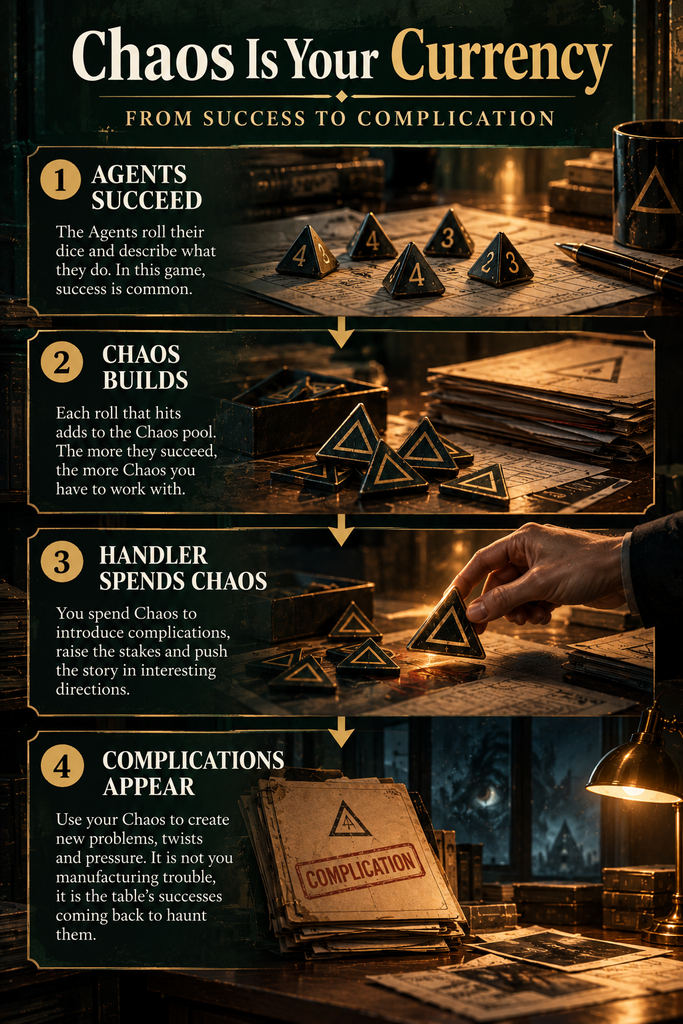
That last point matters. As the Agents roll, Chaos accumulates, and it becomes a resource you spend to complicate things. You are not inventing trouble out of thin air. You are cashing in what the table has already generated.
This takes real weight off your shoulders. If you ever feel you have to manufacture a problem, look at the Chaos you are holding and ask what it should buy.
📖 Prep Before Session One
Good news: Triangle Agency does not reward heroic amounts of prep. It rewards the right prep.
Start by reading the Handler-facing sections of the core book properly, not skimming them. Pay particular attention to how the Anomalies work, because you need to understand what each of your players’ Agents can do. A player who has to explain their own powers to you every turn will stall the pace.
If you want a copy of your own, the Triangle Agency core rulebook is the place to begin.
Then do a short, practical checklist:
- Read the character sheets before the session, or have players send them ahead
- Make a one-page cheat sheet of your Agents’ Anomalies and the Chaos rules you will lean on most
- Gather six four-sided dice per player if you can, since the game resolves actions with a pool of d4s
If your group has not built Agents yet, send them to the character creation guide before the session, or do it together in a dedicated session zero. If you want to understand the shape of the table first, the guides on agent roles and building a balanced team will help you read what you are about to run.
✂️ How Much to Plan, and What Not to Over-Plan
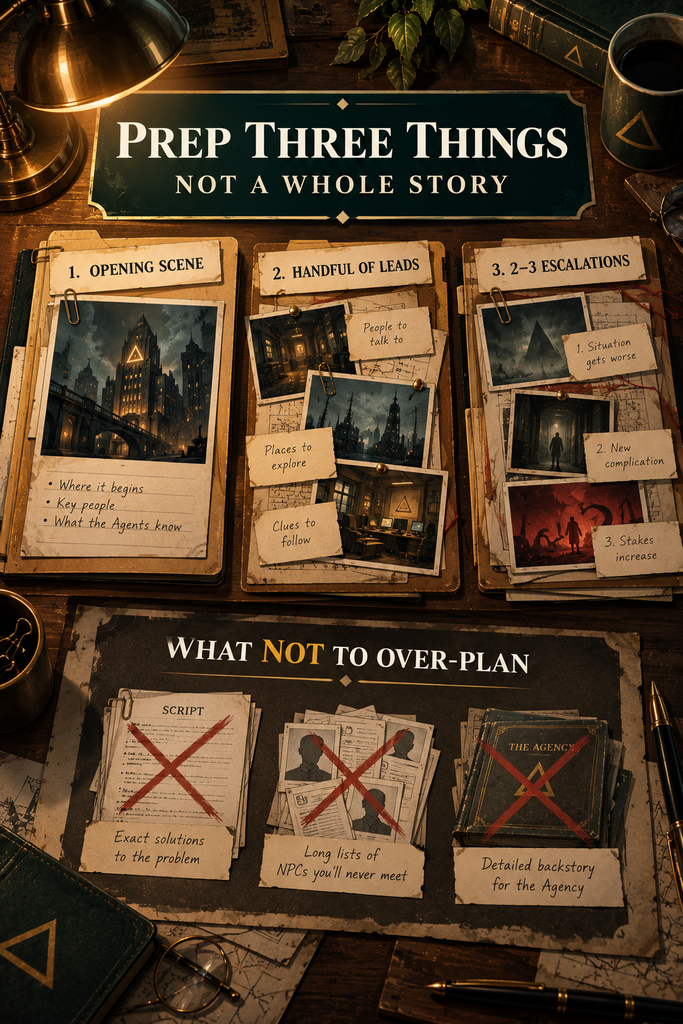
Plan the situation, not the story. A good first mission needs a clear problem, a handful of interesting people or places, and a sense of what the Anomaly at the heart of it wants.
You do not need a script, a fixed ending or an answer to every question your players might ask. The Agency’s structure will carry a lot of the pacing for you.
What you should avoid over-planning:
- Exact solutions to the problem, because your Agents will surprise you
- Long lists of non-player characters you will never meet
- Detailed backstory for the Agency itself, which works best when it stays slightly out of focus
A tidy rule of thumb is to prep three things: an opening scene, a handful of leads and two or three ways things could escalate. Everything else you can improvise from the Chaos in your hand.
If you are choosing a mission to run, pick a published one or a short prepared scenario designed for a first outing, and keep it away from your players’ eyes until play. This guide will not spoil any, and neither should you in your prep notes, which is a good reason to keep them short.
🧭 Structuring Your First Mission
The simplest shape to hold in your head is a loop that the game itself leans on: debrief, investigate, confront. Then repeat as the situation deepens.
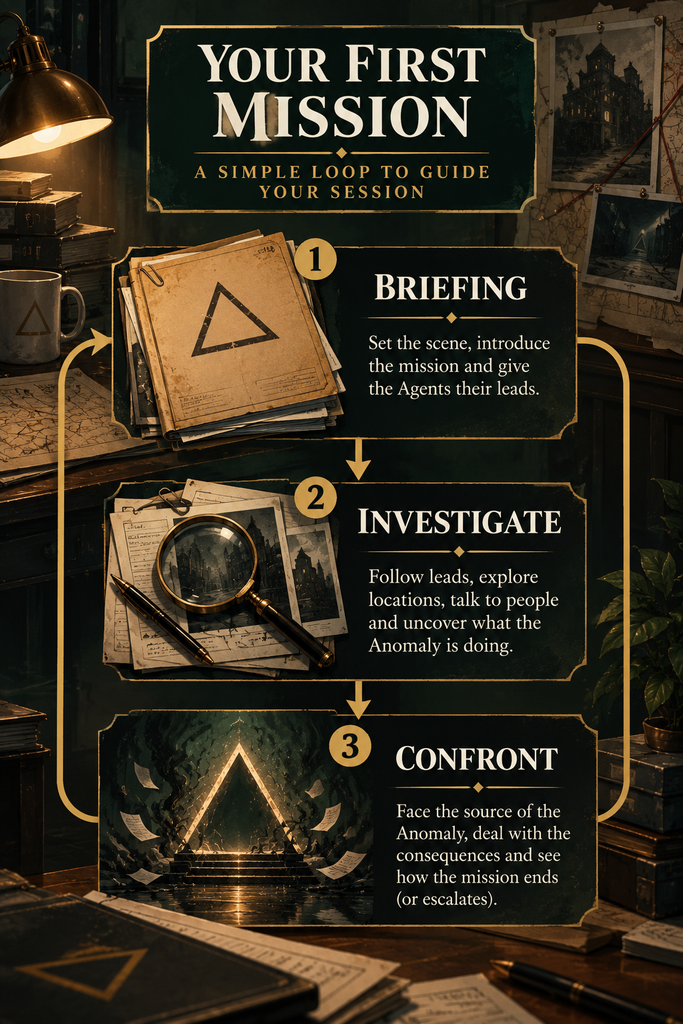
Debrief. Open with a briefing scene. This is where the Agency’s voice shines, so lean into the tone. Present the task as mundane, bureaucratic and a little too cheerful. Give the Agents just enough to start, not everything they need.
Investigate. Let the Agents go to the place, talk to the people and poke at the oddness. Ask what they do, call for rolls when things are uncertain or risky, and let their successes open doors.
Confront. Bring them face to face with the Anomaly or the consequence of what they have uncovered. This is the pressure point of the mission, and by now you should have Chaos to spend.
For a single first session, aim for one pass through this loop, with a clear moment where the Agents have to make a choice. If you finish with time to spare, that is a lovely problem to have.
⏱️ Pacing a Single Session
New Handlers tend to run too slowly, because they are enjoying the atmosphere. The cure is to give yourself soft time markers.
A workable shape for a three to four hour session looks like this:
- Opening and briefing: about 20 minutes
- Investigation: the bulk of the session, roughly half of your time
- Confrontation and fallout: around the last third, leaving a few minutes for a closing beat
Use scene framing as your throttle. If the Agents are circling, cut to the next meaningful moment. If a scene has done its job, end it. Nobody ever complained that a scene finished too crisply.
A good habit is to glance at the clock at the end of each scene rather than during it. That way you stay in the fiction while still keeping an eye on where you are.
🎯 Calling for Rolls and Handling Consequences
Because the dice pool is generous, you will find yourself calling for rolls often. Do not be shy about it.
Ask for a roll when the outcome is genuinely uncertain, when something is at stake, or when the fiction would be more interesting with a complication. Skip the roll when success is simply what would happen.
When Agents succeed, say so, clearly and with enthusiasm. When their rolls build Chaos, make a note, because that is your currency for the next complication.
The skill here is spending Chaos in ways that feel like consequences of the story, not punishment. Say a clean success lets the Agent grab the file, but the person watching from across the office now knows what they took. That is the flavour of trouble the game does well.
If your players are unsure how their Agents’ numbers interact with the dice, the skills and stats guide is a useful companion to keep open at the table.
Remember too that Anomalies matter. Know what your players’ Anomalies can do, and let those powers be the star of the scene. This is often where the game’s most memorable moments come from.
🎭 Tone: Bureaucratic Horror With a Straight Face
Triangle Agency blends dark comedy, office satire and horror, and the secret to the tone is commitment. The more calmly and cheerfully you present the Agency, the stranger and sharper everything underneath will feel.
Treat forms, targets and policies as completely serious. Let the dread arrive slowly, as the cracks in the routine start to show. A well-timed corporate platitude over something unsettling is worth more than a dozen jump scares.
You do not need to be a comedian. Aim for a deadpan, helpful voice, and let your players supply the laughter and the unease.
If you want a primer on what to expect before you commit, 10 things to know before playing Triangle Agency is a handy read for both you and your group.
🛡️ Setting Expectations and Running Dark Themes Well
This is a game for adults, and it deals with horror and unsettling themes that some players may not want at the table. Being a good Handler means making space for that conversation.
Before the first session, talk to your group about what they want from the game. Cover the tone you are aiming for, the kinds of content that are welcome, and anything players would prefer to leave out of the story.
Some practical steps:
- Hold a short session zero and agree on lines and veils, meaning topics to avoid entirely and topics to handle off screen
- Offer a simple way for anyone to pause or change direction mid-scene
- Check in briefly after tense scenes, and again at the end of the session
None of this dampens the atmosphere. Players who feel safe are far more willing to lean into the creepy parts, which makes for a better game for everyone.
🛠️ Common First-Time Handler Mistakes and How to Recover
Every Handler makes a few of these. Here is how to spot them and fix them without stopping the game.
Mistake: Trying to make every roll a threat. Because success is common, rolls are not mostly about pass or fail. If a scene feels flat, ask what the success costs or reveals, and use your Chaos accordingly.
Mistake: Forgetting to spend Chaos. If you finish the session sitting on a pile, the pressure never landed. Next time, spend it earlier and more often. Small complications add up.
Mistake: Over-explaining the Agency. The Agency works best slightly out of focus. If you are explaining it too much, stop and let the players discover it through play.
Mistake: Losing track of Anomalies. If a player’s powers confuse you mid-scene, pause and ask them to remind you. Doing so is perfectly normal and keeps the pace moving.
Mistake: Running too long on one scene. Cut it. Move to the next moment that matters.
If a session really goes sideways, take a short break. Reset with a quick recap of where the Agents are and what they want, then pick the next scene from your leads. A confident restart usually saves the evening.
✨ Your First Mission Awaits
Running Triangle Agency for the first time is less about mastering a complicated system and more about trusting a few core habits. Understand your players’ Anomalies, keep your prep light, frame crisp scenes and spend Chaos with intent.
Keep the tone sincere, keep the table safe, and let the strangeness do the work. Your first session will not be perfect, and the Agency would probably tell you that is a feature.
If you are building up your group, the full series is a good place to circle back to, starting with the introduction and working through the character and team guides. Then sit down, clear your throat and welcome your Agents to their first briefing.
RPG news, GM tips, and system deep dives — straight to your inbox, no filler.