What Is Triangle Agency? A Complete Introduction to the TTRPG
Triangle Agency is a paranormal investigation and corporate horror TTRPG set in a modern world where emotions can become dangerous Anomalies, and players work as Field Agents for a powerful corporation that wants to contain them. With its in-universe handbook presentation, episodic mission structure, and a blend of horror, satire, and character drama, it’s one of the most distinctive tabletop RPGs to land in recent years. If you’ve been hearing the name float around and wondering whether it belongs on your shelf, this is your full introduction.
Published by Haunted Table Games in 2024 after a successful Kickstarter campaign, Triangle Agency was designed by Caleb Zane Huett and Sean Ireland. The core rulebook is a 300-page hardcover, and it’s already carved out a reputation as something genuinely different from the systems that dominate most gaming tables. That reputation is well earned.
The Setting: A World Where Feelings Become Monsters
The world of Triangle Agency looks a lot like ours at first glance. It’s the present day, ordinary life, ordinary people. But underneath that surface, something strange is happening. Anomalies exist, things shaped and twisted by human thoughts and feelings, and left unchecked they can become monstrous, dangerous, and reality-warping.
Enter the Triangle Agency itself: a powerful, secretive corporation with the resources and reach to find these Anomalies and contain them. The Agency employs Field Agents to go out into the world, track down whatever strange thing has surfaced this week, and manage the situation before it spirals. That’s the job. That’s what players do every session.
Corporate Horror as a Feature, Not a Bug
What makes Triangle Agency genuinely interesting is that it doesn’t let players off the hook with a clean “monster hunters doing good” premise. The Agency is morally ambiguous. It’s bureaucratic, it’s powerful, and it may not have your best interests at heart. Players have to decide, session after session, how they feel about working inside a massive system that is almost certainly using them.
This corporate horror angle is baked into every layer of the game. The rulebook itself is written as an in-universe company handbook, which is a genuinely clever piece of design. It makes the tone immediately clear and gives the whole experience a meta-textual texture that most TTRPGs don’t attempt. If you’ve ever played a game and thought the rulebook read like it was written by the people who made the world, rather than people describing it from the outside, that’s what Triangle Agency is going for.
What Players Actually Do
A session of Triangle Agency plays out like an episode of a paranormal procedural show. The structure is episodic: each mission centres on an Anomaly problem, the Agents deal with it, and then real life continues alongside it. The comparison to shows like The X-Files or Fringe is frequently made by people who’ve played it, and it’s apt. There’s a case-of-the-week rhythm that makes the game very accessible for groups who prefer defined session structures over sprawling open-world sandboxes.
But here’s the part that tends to surprise new players: you’re not just playing your Field Agent. You also portray ordinary people connected to the other Agents at the table. Family members, partners, colleagues, the regular humans in their lives. This creates an ensemble feel closer to a drama series than a traditional RPG, and it’s one of the things that makes Triangle Agency stand apart from investigation games that focus purely on the mystery or the action.
Balancing the Job and the Life
That dual-character structure is the heart of what Triangle Agency is really about. The Agents are capable and powerful, but they’re still workers. They have personal lives. They have people they care about who have no idea what they actually do for a living. The game asks players to weigh those two things constantly, and it’s in that tension where the best sessions live.
If you’ve found that most investigation TTRPGs leave you wanting more character texture and less pure puzzle-solving, this game was built for exactly that feeling. For a GM perspective on structuring that kind of session, our session prep guide has some useful starting points, and the principles in our session zero guide apply particularly well here, since getting player expectations aligned before the first mission is genuinely important.
The Mechanics: Clean, Purposeful Design
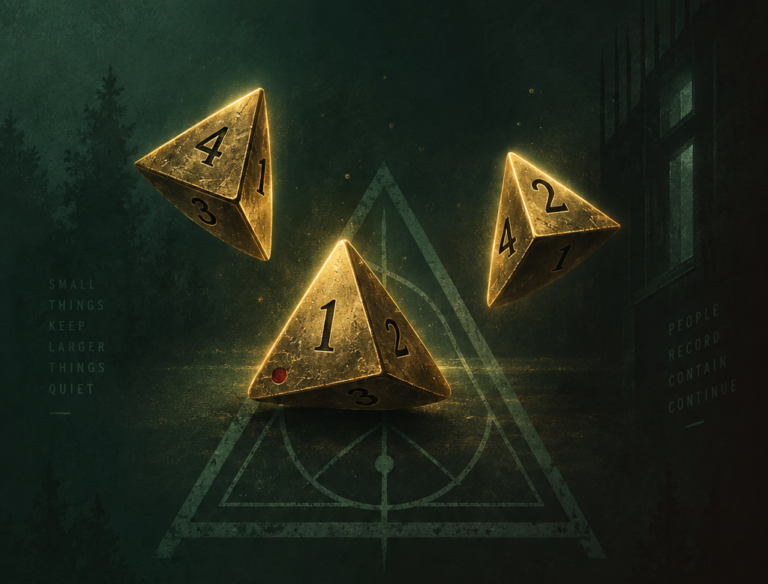
Triangle Agency uses a dice pool of six d4s. Success is generally based on rolling at least one 3. That’s the core of it, and it’s deliberately simple to explain and learn. The design philosophy here is that the system should support the tone and the story without getting in the way of either.
If you’re coming from D&D 5e or a heavier crunch system like Pathfinder 2e, the shift to d4s might feel counterintuitive at first. But the pool-based resolution creates a specific rhythm, one where outcomes feel genuinely uncertain without requiring extensive modifiers or table lookups. It keeps momentum in the room, which matters for an episodic, character-driven game where you want the drama to stay in focus.
Triangle Agency — 6d4 pool
You’re asking “did anything go right?” A single good result carries the roll. More dice in the pool = more chances — not a bigger number to beat.
Result feels like a team effort, not a lone hero’s stat check.
D&D 5e — 1d20 + modifier
You roll once and add your stat. The target number shifts with difficulty. High modifiers raise your floor; low ones punish you hard.
Result feels personal — it’s about how capable your character is.
Advancement as Meaningful Tradeoff
Character progression in Triangle Agency uses a limited resource called Time. Rather than an open-ended advancement path where you just accumulate improvements session after session, players choose how to invest their Time across different tracks. That makes every advancement decision a tradeoff, and tradeoffs are interesting. They reveal character priorities, they create story, and they make you feel the cost of the choices in a way that pure accumulation never does.
This is one of those design choices that’s easy to overlook in a summary but becomes central to play. When advancement is limited and meaningful, players naturally develop stronger attachments to their characters’ specific shape and trajectory. It’s worth flagging for anyone building from one of the fantasy RPG systems that treat character growth as essentially open-ended.
Tone and Themes: What Kind of Game Is This?
Triangle Agency is best described as a blend of paranormal investigation, satire, emotional drama, and horror. The tone can shift between creepy, funny, and sincere, sometimes within the same session, and that flexibility is genuinely one of its strengths. You’re not locked into grimdark, and you’re not forced to keep things light. The GM and players can calibrate based on what the group wants from any given session.
The satire runs throughout. The corporate structure, the mundane bureaucracy of filing Anomaly reports, the way the Agency communicates in corporate-speak about genuinely terrifying things: all of it lands as darkly funny, deliberately. If your group enjoys games that can laugh at themselves while also taking the horror seriously, this is fertile ground.
Investigation and Horror Done Differently
There’s a growing category of investigation-focused TTRPGs that aren’t trying to replicate the Call of Cthulhu experience. We’ve covered Call of Cthulhu alternatives before, and Triangle Agency belongs in that conversation, though it sits in its own lane. Where CoC often leans into futility and existential dread, Triangle Agency is more interested in the moral and personal costs of the work. The horror is real, but so is the possibility of handling it and going home to your family afterwards.
The episodic structure also makes it more sustainable for long-term play than a lot of horror games, which can become emotionally exhausting if the tone never lifts.
Who Should Play Triangle Agency?
This game is likely going to click for players who enjoy modern supernatural settings and want a system that takes the mundane and the weird equally seriously. If your group has ever watched The X-Files and thought “I want to play that,” or if you’ve played investigation games but wanted more personal drama alongside the cases, Triangle Agency is built for you.
It’s also a strong choice for groups who enjoy morally complicated organisations. The Agency as an employer raises questions that don’t resolve neatly, and that’s intentional. If your table likes to debate whether they’re actually the good guys, you’ll find a lot to chew on here.
Groups coming from indie RPG systems will probably find the learning curve comfortable. The system is clean and the structure is clear. Groups coming from D&D specifically may need a session or two to adjust to the episodic format and the expectation that character drama is as central as the mission, but most groups get there quickly.
| System | Complexity | Tone | Character focus | Session structure | Best for |
|---|---|---|---|---|---|
| Triangle Agency Haunted Table Games |
|
Horror Satire Drama | Dual character (Agent + others’ NPCs) | Episodic missions with personal life B-plot | Story-driven groups who want workplace drama alongside the weird |
| Call of Cthulhu Chaosium |
|
Horror Mystery | Single investigator; sanity as core arc | Scenario-based; characters often die or crack | Fans of Lovecraftian dread and pulp investigation |
| Blades in the Dark One Seven Design |
|
Gritty Crime | Crew + individual scoundrels; vice & trauma | Score-based heists with downtime between | Groups who like mechanical elegance and criminal intrigue |
| City of Mist Son of Oak |
|
Neo-noir Myth | Dual identity (mortal self vs mythic power) | Case-based with personal identity arc | Players who enjoy mythology and identity themes in a modern city |
| Delta Green Arc Dream Publishing |
|
Horror Conspiracy | Government agents; sanity & moral cost | Mission-based; high lethality and moral weight | Players who want government conspiracy with brutal consequences |
Is It Good for Beginners?
Triangle Agency is accessible in terms of mechanical complexity. The d4 pool is easy to understand, and the episodic structure means new players don’t have to hold a lot of ongoing lore in their heads from session one. The trickier part for genuine beginners is the tone: corporate horror and dual character play require a certain comfort with collaborative storytelling that pure dungeon-crawl games don’t demand as much. If your players already have some TTRPG basics under their belts and are ready to step into something more thematically rich, this is an excellent next game.
Why Triangle Agency Stands Out Right Now
The TTRPG market is genuinely crowded, and standing out requires more than a good premise. Triangle Agency earns its reputation because the design is coherent from premise to mechanics to presentation. The in-universe handbook format, the dual-character structure, the morally ambiguous corporation, the limited advancement system: these aren’t separate features bolted together. They’re expressions of the same set of ideas about what kind of story the game wants to tell.
There’s also a practical reason to pay attention now. Coverage and community resources for Triangle Agency are still relatively sparse compared to games that have been around for years. Getting into it early means you’re part of shaping how it grows, which is one of the better things about finding a game before it becomes ubiquitous. Our indie RPG systems spotlight is a good companion read if you want to explore more of what’s happening in this space beyond the dominant systems.
Getting Started with Triangle Agency
The core rulebook is your starting point, and at 300 pages it’s substantial without being overwhelming. The in-universe presentation means the GM should read it with an eye toward how the style reinforces the tone, since that carries through to how you run the game. For players, understanding the dual-character structure before session zero will save a lot of confusion at the table.
From a GM perspective, Triangle Agency rewards the kind of prep that focuses on people and situations rather than elaborate dungeon layouts. Think about the Anomaly and the human context around it. Think about which ordinary people in the Agents’ lives might show up this session. The session setup guide covers some of the broader principles, and the advice in our running your first game session article applies well for GMs coming to this system fresh.
If Triangle Agency sounds like your kind of game, it’s available from Haunted Table Games and through most major tabletop retailers.
Have you played Triangle Agency, or is it on your list? Drop a comment below and let us know what drew you to it, or if you’ve run it, what your group made of the Agency.
Want more coverage of standout indie TTRPGs and what’s new in the tabletop space? Sign up to the Forst Stories newsletter for weekly roundups and new guides straight to your inbox.
Continue Your Journey
What Is a TTRPG? Exploring Tabletop RPG Basics — New to tabletop RPGs altogether? Start here for a grounding in the hobby before picking your first system.
Beyond D&D: Indie RPG Systems Spotlight — A broader look at the indie systems worth your time, with Triangle Agency’s neighbours in the space.
Fantasy RPG Systems Ranked: From Beginner to Expert — See how different systems stack up for complexity and play style.
Session Zero Strategies: Setting Your Campaign Up for Success — Essential reading before your first session of any new game, Triangle Agency included.
Beyond the Mythos: Alternative Horror TTRPGs for Call of Cthulhu Fans — If you’re drawn to Triangle Agency for the investigation and horror angle, these systems deserve a look too.
RPG news, GM tips, and system deep dives — straight to your inbox, no filler.