
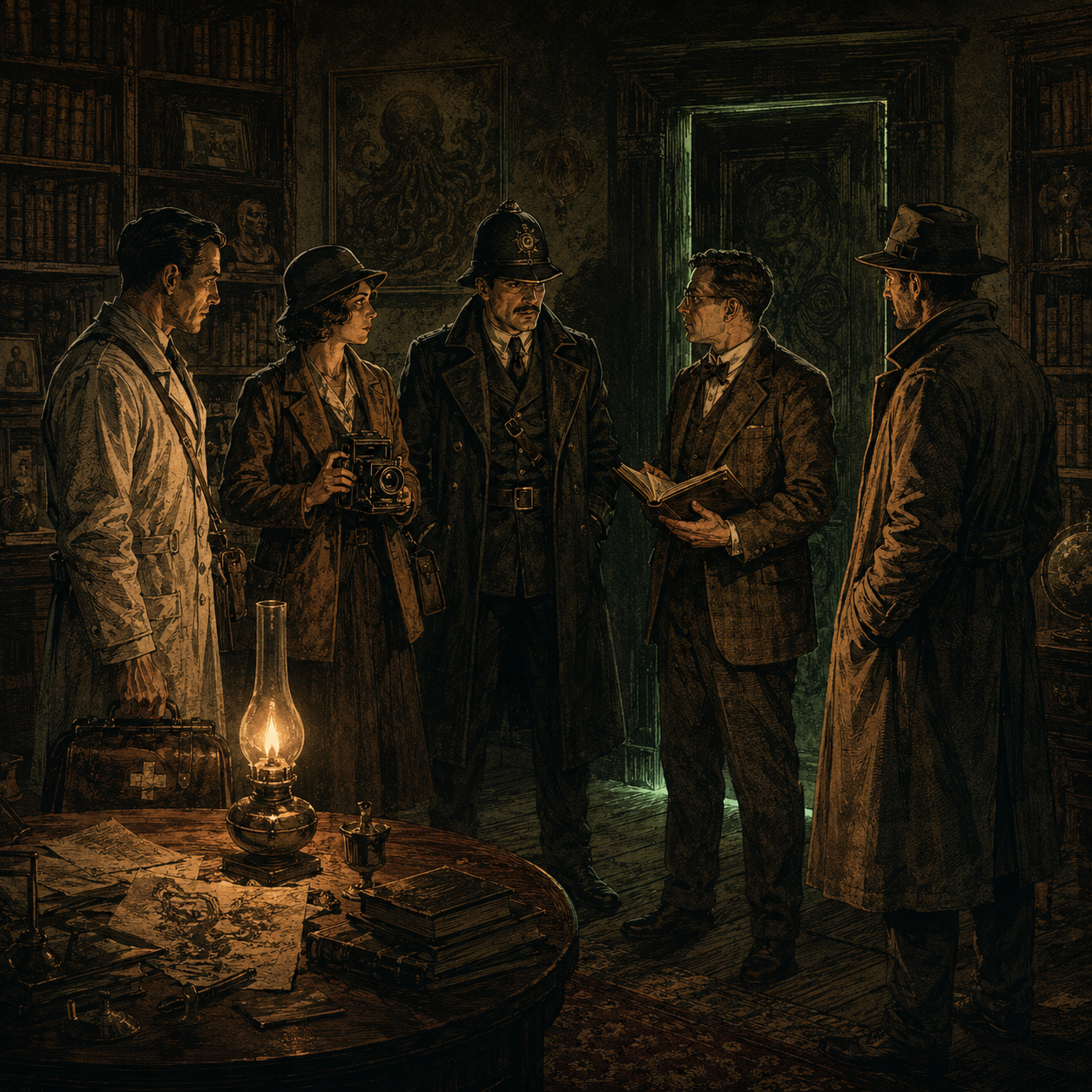
Building a Balanced Call of Cthulhu Party: Why Diversity Keeps Investigators Alive Longer
Call of Cthulhu has a reputation for killing investigators. Characters die, lose their minds, or retire in broken-down sanatoriums. But most tables that consistently lose investigators aren’t running into unwinnable scenarios — they’re paying for a character creation session that went wrong before a single clue was found.
The single biggest factor in party survival isn’t luck or player skill. It’s whether the group built investigators that actually cover different ground. When five players all drift toward the same broad archetype, the gaps get brutal fast. A session zero conversation about who’s doing what changes the odds more than any amount of combat optimisation.
This guide breaks down how to think about party roles in Call of Cthulhu 7th edition, why spread matters more than depth, and what a well-rounded group actually looks like at the table.
Why Call of Cthulhu Isn’t About Combat
Most TTRPGs have a combat system at their centre. Call of Cthulhu technically has one too, but Chaosium built this game around a very different assumption: the investigators are ordinary people, and the things they’re hunting are either unkillable or going to make them wish they hadn’t tried.
Scenarios mix clue-hunting, social scenes, physical danger, and psychological strain. No single skill set answers all of these. A retired army sergeant who can punch through a wall is going to be genuinely useless when the evidence is locked inside a university archive or when the only way forward is charming the suspicious local magistrate.
The game’s own fiction tells you something important here. In most published scenarios, finding the answer and choosing a clever exit matters more than standing your ground. Investigators who win fights with mythos creatures rarely survive them — the numbers simply don’t work. What keeps a party alive is having options at every decision point, which means having someone whose skills open each door the scenario puts in front of you.
The Five Roles Worth Covering
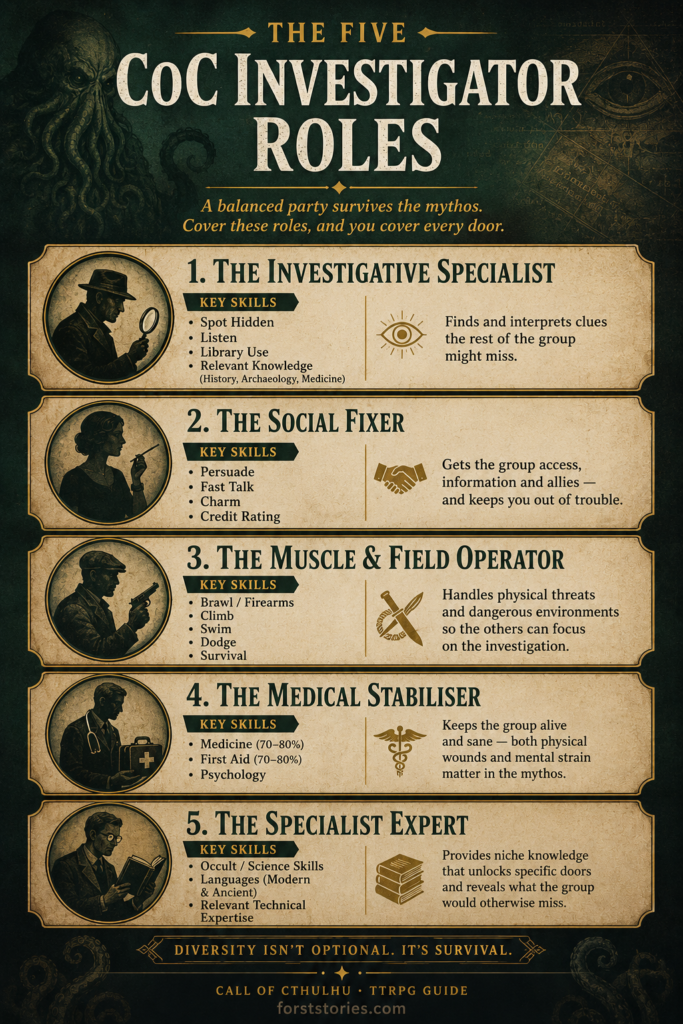
These aren’t rigid classes. Think of them as pressure points in most scenarios — areas where having no coverage creates a bottleneck that forces risky improvisation.
The Investigative Specialist
This is the person who finds things. Skills like Spot Hidden, Listen, Library Use, and relevant knowledge skills (History, Archaeology, Medicine depending on the campaign’s era and focus) sit in the 60-70% range for this investigator, sometimes higher. Their job is to actually locate and interpret clues rather than bumbling past them.
Without this role, groups miss crucial information and blunder into danger. Spot Hidden is deceptively important — it catches the thing in the corner, the detail on the photograph, the wrong note in an otherwise ordinary room. Library Use is slow but indispensable in any scenario that involves research, which is most of them. A Private Eye, Journalist, or Researcher is the natural fit here, though the skills matter more than the occupation.
The Social Fixer
Persuade, Fast Talk, Charm, and Credit Rating keep this investigator busy. Their value isn’t just talking people down — it’s preventing the situations that cost time, resources, and sanity in the first place. The Social Fixer keeps the party out of jail. They secure funding and access. They convince the hostile witness to share what they actually saw.
A table without a social specialist tends to brute-force past people, which accumulates heat with authorities, burns bridges with potential allies, and occasionally kicks off physical altercations the group can’t afford. A Lawyer, Diplomat, or Entertainer works well, but what you’re really after is someone with Persuade in the 60s and Credit Rating high enough to open doors.
The Muscle and Field Operator
Combat skills aren’t the point here, though they matter. The field operator has high Brawl or Firearms ratings, yes, but they also have Climb, Swim, Dodge, and Survival. They’re the person who takes point in basements, old buildings, and other environments where the physical risks are real.
Call of Cthulhu does have moments where someone has to take a swing or take a fall, and having one investigator built to absorb and deal with those moments protects everyone else. Soldiers, police detectives, and explorers fill this role naturally. The key is investing in physical skills that cover movement and hazards, not just the ability to fire a gun.
The Medical Stabiliser
Medicine and First Aid at 70-80% is the target. Psychology rounds this out because mental damage in Call of Cthulhu is as dangerous as physical damage, and the ability to talk someone down from the edge of an indefinite insanity is genuinely valuable.
This role is often the difference between a temporary setback and losing an investigator permanently. First Aid can be attempted immediately after an injury; Medicine requires more time but handles serious wounds. A doctor or nurse brings both plus the medical knowledge skills that occasionally turn out to matter for identifying causes of death or strange symptoms. Don’t underestimate this role. Groups that skip it spend a lot of late-session time watching investigators deteriorate.
The Specialist Expert
Professors, occultists, and scientists bring niche knowledge that opens specific doors. Occult knowledge helps the party understand what they’re dealing with earlier. Science skills unlock technical evidence. Languages (both modern and ancient) make certain handouts readable when they’d otherwise be useless.
This role reinforces other roles rather than replacing them. The specialist isn’t investigating instead of the investigative specialist — they’re adding an angle the group wouldn’t otherwise have. Their value is highest in scenarios built around a particular subject matter, which most good Call of Cthulhu adventures are.
How Occupation Diversity Helps Beyond Skills
Here’s something that doesn’t get enough attention: Call of Cthulhu ties Credit Rating, assumed equipment, and social network to occupation. When all five investigators are working-class or all five are wealthy professionals, the group’s access to the scenario narrows.
When you have one investigator who’s wealthy, another who’s working-class, and another who’s a professional with academic connections, the party can approach different social strata without crime being the default solution. The wealthy investigator can open a door the poor one can’t. The working-class one gets access to a community the wealthy one would never earn trust from. Neither replaces the other.
This matters practically. Scenario design often assumes that investigators will find routes into different parts of the story world. Occupation diversity expands those routes. It also creates more interesting roleplay — a table where the Lawyer and the Sailor have to figure out how to work together is more interesting than five people with identical class assumptions.
The Party Composition Maths
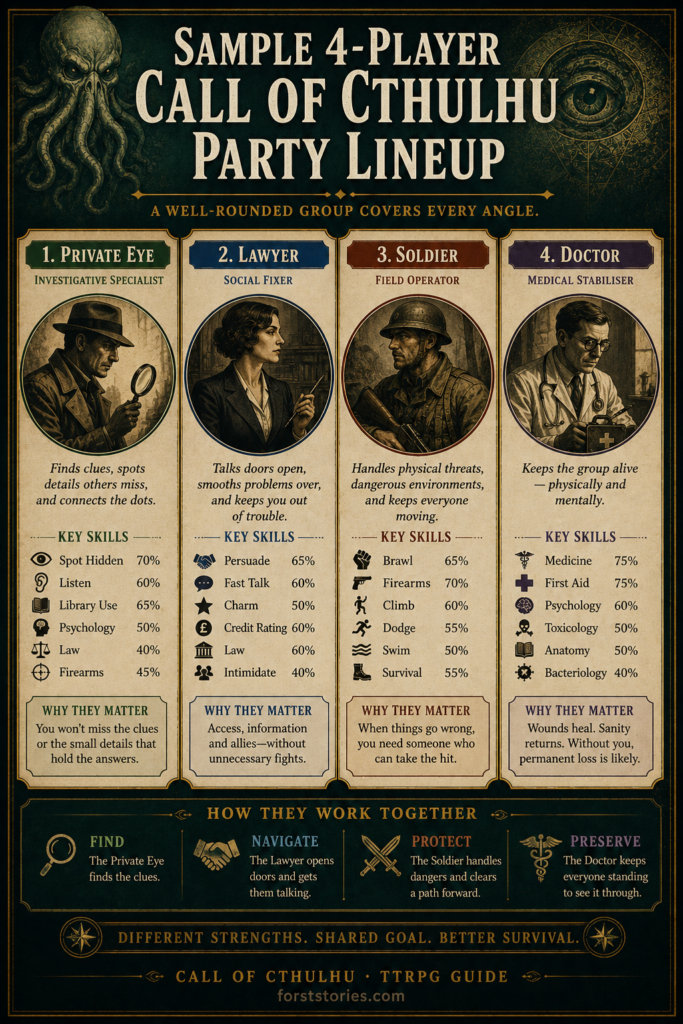
For a four-player group, aim for: investigative specialist, social fixer, field operator, and either medical stabiliser or specialist expert depending on the campaign’s focus. The medical role is more universally useful for one-shots and short campaigns; the specialist role pays off in longer campaigns with consistent themes.
For five players, you can cover all five roles cleanly, or double up slightly on the investigative and social functions since those get used most. For three players, someone will need to run a hybrid character — investigative and medical together is workable, or social and specialist.
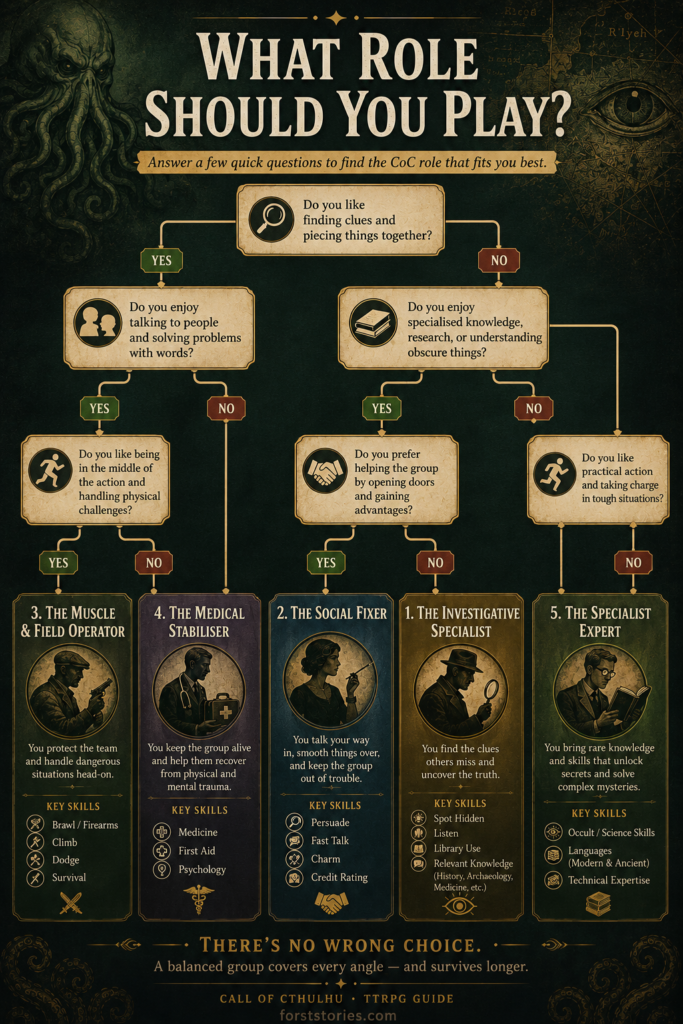
The key constraint is this: if no one in the group has Spot Hidden above 40%, the party is going to miss things. If no one has any social skills worth using, the party is going to have to fight their way past people. Either gap is punishing in most scenarios.
Practical Character Building Advice
CoC character creation is built around a clean math structure. You roll characteristics, choose an occupation, then distribute occupation skill points (usually EDU×4) and interest skill points (INT×2). The party balance conversation should happen before anyone touches the character sheet.
Call of Cthulhu · Session Zero
Party Role Planner
Assign roles by player
Or tick roles to check coverage
Coverage at a glance
Agree in broad strokes who’s owning which role. Then individual players can decide exactly which occupation and which specific skills get them there, rather than accidentally choosing the same thing. It’s also worth thinking about who’s not doing what — an investigator should probably have a couple of backup skills across categories, but their main investment goes into their role.
One thing that catches new players: don’t over-optimise for gear and combat. The Keeper’s usual expectation is that investigators are relying on their skills, their wits, and their connections rather than their equipment load-out. Focusing on skills you’ll enjoy using naturally leads to characters who are interesting as well as mechanically useful.
For Keepers Running the Session Zero
If you’re the Keeper, you can structure the session zero to gently guide players toward a diverse group without it feeling like an assignment. A few approaches that work:
Ask players what kind of problems they want to solve. Someone who says “I want to find hidden clues” and someone who says “I want to know how the pieces fit together historically” are actually filling two different functions. Let them realise that naturally rather than handing out role cards.
Ask how the investigators know each other. A group with a doctor, a journalist, a retired soldier, and a local lawyer feels more credible than five strangers who happen to all be Private Eyes. The backstory question often steers players toward more varied occupations without any explicit direction.
If you see a gap after character creation, mention it gently. “I notice we have nobody with strong social skills” is useful information, and most players would rather know than be surprised when the magistrate scene goes sideways.
And if the group goes in with a gap regardless, design around it slightly. Not by removing the challenge, but by making sure there are multiple routes through the scenario that can accommodate their particular strengths and weaknesses. Good Call of Cthulhu design expects investigators to be human-shaped rather than optimised.
Putting It Together
A diverse Call of Cthulhu party survives longer because weaknesses aren’t shared. If your social fixer botches a Persuade push, the investigative specialist can pursue another lead. If the field operator takes a bad hit, the medical stabiliser can keep them functional. The group routes around failure rather than being stopped by it.
Skill coverage also reduces the need for desperate, high-risk actions — pushing dangerous rolls, fighting things that shouldn’t be fought, making calls the party isn’t equipped to handle. The investigators who walk out of a scenario aren’t usually the ones who fought hardest. They’re the ones who read the situation, found a way through that didn’t require them to be something they weren’t, and knew when to run.
Build the party to cover multiple kinds of problems and the game becomes much more interesting to play. The horror hits harder when the investigators are competent enough to understand what they’re facing.
Continue Your Journey
How to Create an Investigator in Call of Cthulhu 7th Edition — A step-by-step walkthrough of character creation from scratch.
Best Investigator Occupations in Call of Cthulhu (and How to Play Them) — Which occupations hold up in play, and how to get the most out of your chosen role.
A Beginner’s Guide to the Cthulhu Mythos: Who Are the Great Old Ones? — What your investigators are up against.
Call of Cthulhu vs. Delta Green: Same Universe, Very Different Tone — If you’re weighing up which system fits your group better.
The Essential Guide to Call of Cthulhu Expansion Books — Where to go once you have the core rulebook handled.
Session Zero Strategies: Setting Your Campaign Up for Success — How to run a session zero that actually does what it’s supposed to.
What role do you usually end up playing in a CoC group — and what’s the gap your table most often leaves unfilled? Drop it in the comments.
Want more GM tips, system guides, and RPG news every Wednesday? Sign up for The Scriptorium newsletter — free, and one email a week.
RPG news, GM tips, and system deep dives — straight to your inbox, no filler.


