Hope and Fear as GM Tools: Keeping Tension Fair, Not Arbitrary
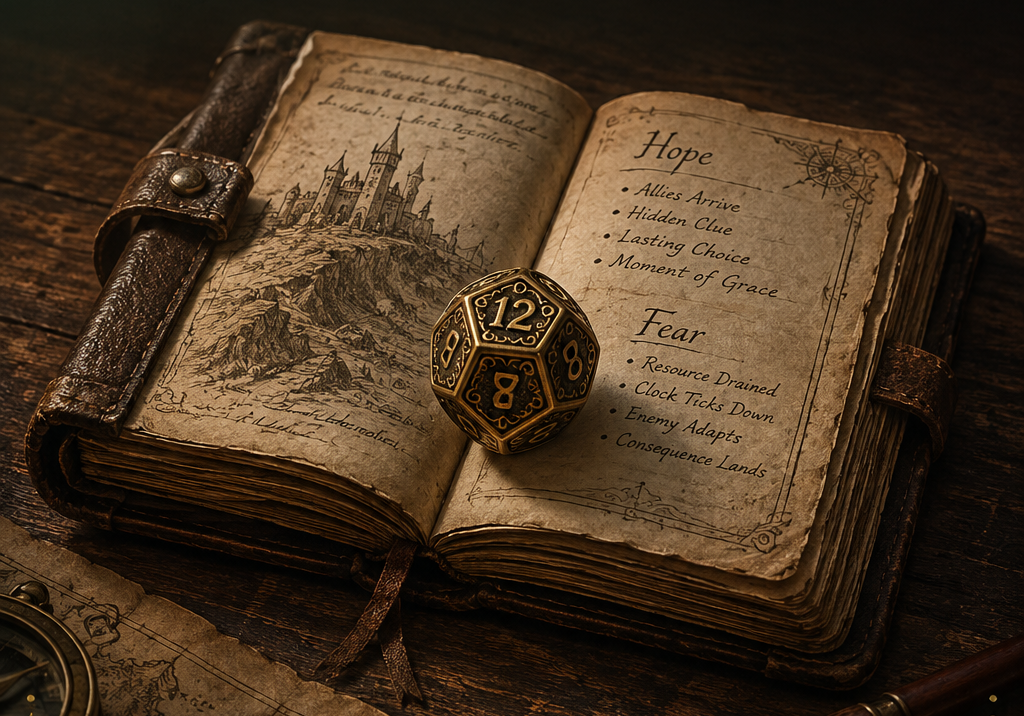
You already know what Fear is. You have read the rulebook, maybe run a session or two, and you understand the mechanical shape of it: the Fear die comes up higher than the Hope die, you gain a Fear point, and you can spend it later to complicate things for the party.
What is harder to pin down is the judgement call sitting underneath that mechanic. When does spending Fear read as earned tension, and when does it just feel like the GM decided to punish someone? This post is about that call, not the base rules behind it. If you want the rules refresher first, How to Read the Daggerheart GM Guide and our Daggerheart Review both cover Hope and Fear from the ground up.
🎲 Fear as a Pacing Tool, Not Just Flavour
It helps to think of Fear less as a villain’s toolkit and more as a pacing dial. Every point you spend should be doing one of two jobs: raising the stakes at a real decision point, or keeping momentum moving when a scene has gone slack.
Fear spent outside of those two jobs tends to land badly. A Fear-fuelled attack that lands on a random player mid-conversation, with no build-up and no connection to anything the table cares about, reads as arbitrary even if it is mechanically legal.
🚦 Reading the Signals: Serve the Story or Interrupt It
Before spending a point, it is worth pausing for a beat and asking what the spend is actually doing to the scene.
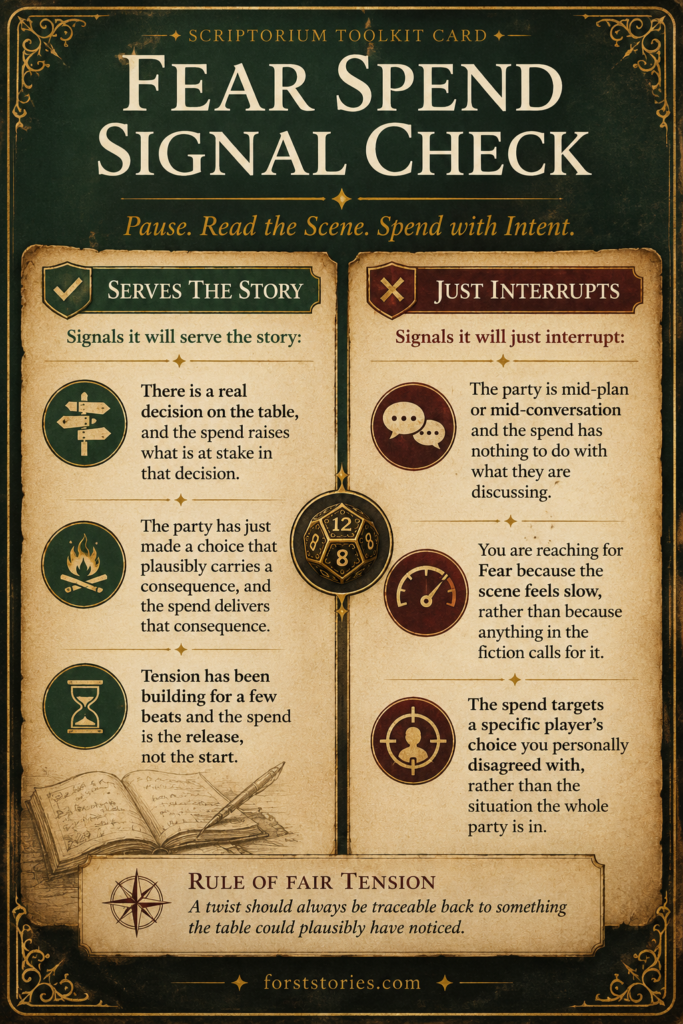
Signals it will serve the story:
- There is a real decision on the table, and the spend raises what is at stake in that decision.
- The party has just made a choice that plausibly carries a consequence, and the spend delivers that consequence.
- Tension has been building for a few beats and the spend is the release, not the start.
Signals it will just interrupt:
- The party is mid-plan or mid-conversation and the spend has nothing to do with what they are discussing.
- You are reaching for Fear because the scene feels slow, rather than because anything in the fiction calls for it.
- The spend targets a specific player’s choice you personally disagreed with, rather than the situation the whole party is in.
🃏 Framing a Fear-Fuelled Twist So It Feels Earned
A twist funded by Fear does not need to be predictable, but it does need to feel fair after the fact. Three habits do most of the work here.
Telegraph before you spend. A detail dropped a scene or two earlier, an NPC’s nervous glance, a sound in the wrong direction, gives the twist somewhere to land instead of appearing from nowhere.
Tie the consequence to stakes already on the table. If the party is trying to reach the gate before it closes, a Fear spend that costs them time on that exact goal will always land better than one that introduces an unrelated problem.
Avoid the gotcha reveal. A twist that exists purely to catch the table off guard, with no earlier thread to trace it back to, tends to read as the GM overriding the story rather than the story turning on the party.
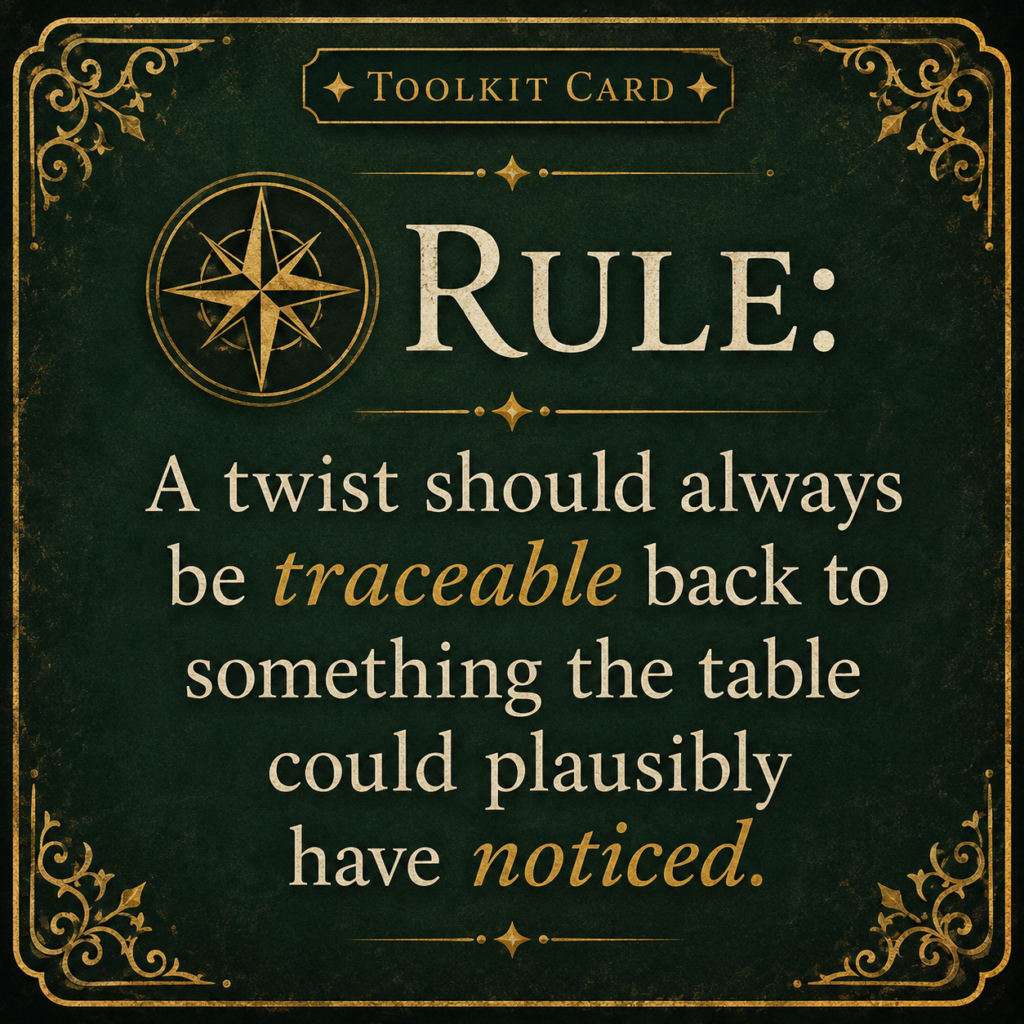
Rule: A twist should always be traceable back to something the table could plausibly have noticed. If a player asks “wait, where did that come from?” and you cannot point to an earlier beat, the twist needed more setup before you spent the Fear.
⏳ Pacing Fear Spends Across a Session
Tension that spikes once and then disappears rarely feels satisfying. Tension that builds in stages, small complication, bigger complication, release, tends to hold a table’s attention far better across a full session.
A rough pattern worth trying: spend a small point early to plant a seed, hold through the middle of the session while the party works the problem, and save a larger spend for the point where the scene is naturally heading toward a climax. This is not a rigid formula, sessions do not always cooperate, but it gives you a target to aim for instead of spending reactively every time the pool allows it.
⚠️ Common Pitfalls
Hoarding Fear too long. Saving every point for a hypothetical bigger moment often means it never gets spent at all, and the table loses the tension Fear is meant to create in the meantime.
Spending as punishment. If a Fear spend is really about a player choice you disagreed with rather than a genuine complication for the party’s situation, it will usually read as punitive, even if you do not intend it that way.
Overruling instead of complicating. Fear is built to make things harder, not to take a decision away from the players. A spend that erases a choice the party just made tends to feel worse at the table than one that makes the consequences of that choice more interesting.
✅ A Mid-Session Decision Checklist
Keep this nearby for the moments where you are on the fence about a spend:
- Does this raise the stakes of a decision the party is already making, or interrupt something unrelated?
- Can I point to an earlier beat that makes this twist traceable?
- Is this complicating the party’s situation, or undoing their choice?
- Have I let tension build toward this, or is it landing out of nowhere?
- Am I spending this because the fiction calls for it, or because I am frustrated with a player?
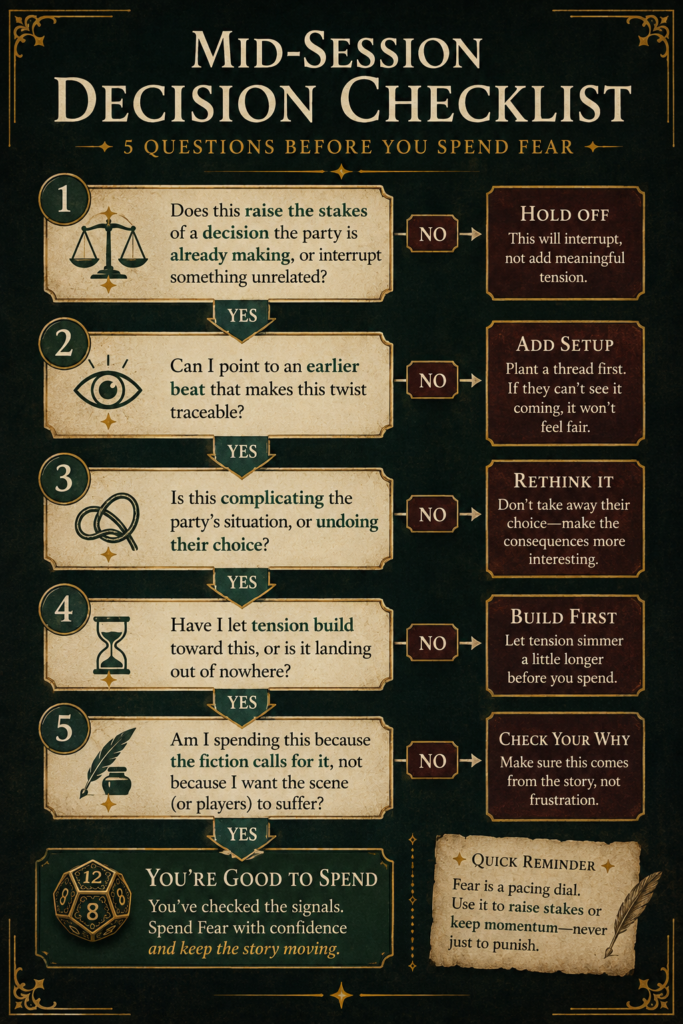
If the honest answer to that last question is the second one, it is worth holding the point a little longer.
This is one read on how to use Fear well, not a correction to the official rules; different tables and different GMs will land on their own rhythm. For more on running the moment-to-moment side of the table, Game Mastering in Daggerheart: Agenda, Principles, and GM Moves is a good next stop.
Worth noting if you are looking to expand your table’s options: the official Daggerheart: Hope & Fear expansion rulebook is due out on 25th August 2026, with new adversaries, environments, and campaign frames that give GMs more raw material to build these moments from.
Continue Your Journey
RPG news, GM tips, and system deep dives — straight to your inbox, no filler.