Session Prep in 30 Minutes: Quick GM Preparation Guide
Sunday night, 10 PM. Your gaming group expects another session tomorrow, and you’ve spent the weekend binge-watching Netflix instead of preparing. Sound familiar? You’re staring at blank pages, feeling that familiar panic creep in as you realize you have exactly zero ideas for tomorrow’s adventure.
This scenario plays out in gaming groups worldwide every week. Between work, family, and life’s endless demands, finding time for thorough session preparation feels impossible. But here’s the truth: great sessions don’t require hours of prep work. They require smart preparation.
The 30-Minute Framework
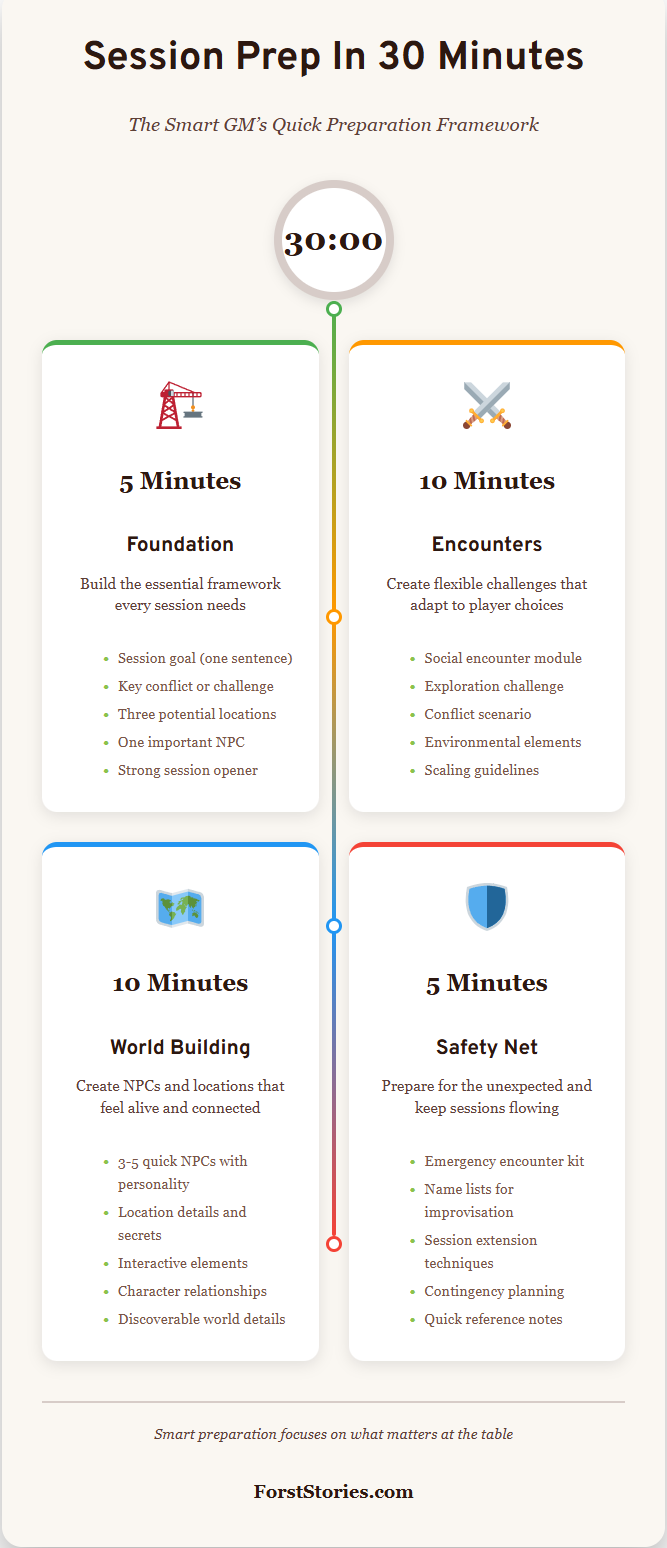
The secret isn’t cutting corners – it’s focusing your limited time on what actually matters at the table. This system breaks down into four focused segments:
- 5 minutes: Session foundation
- 10 minutes: Encounter preparation
- 10 minutes: NPCs and locations
- 5 minutes: Contingency planning
Each segment tackles specific elements your session needs to succeed. No fluff, no perfect battle maps, just the core components that create memorable gaming experiences.
The 5-Minute Foundation (Minutes 1-5)
Every great session needs solid bones. These five elements form your session’s skeleton:
Session Goal (30 seconds)
Write one sentence describing what you want players to accomplish or discover. Examples:
- “The party investigates the missing merchant caravan.”
- “Players negotiate with the rebel faction for safe passage.”
- “The group explores the haunted lighthouse for clues.”
Key Conflict (1 minute)
What’s the main obstacle or challenge? This doesn’t mean combat – conflicts can be social, environmental, or puzzle-based. The merchant caravan was attacked by bandits, but the real conflict might be convincing traumatized survivors to share information.
Three Scene Locations (2 minutes)
List three places the session might visit. Keep descriptions to single sentences:
- The burned caravan site with scattered goods
- The Rusty Anchor tavern where survivors are recovering
- The bandit camp hidden in Thornwood Forest
One Important NPC (1 minute)
Choose one character who drives the story forward. Give them a simple want, a personality flaw, and one memorable trait. Mira the caravan guard wants revenge against the bandits, tends to interrupt others, and unconsciously touches her bandaged arm when lying.
Session Opener (30 seconds)
How will you start? “You arrive at the smoking remains of three wagons” beats “Um, so, you’re walking along the road and…”
Quick Foundation Template
Session Goal: _________________________________
Key Conflict: _________________________________
Scene 1: _____________________________________
Scene 2: _____________________________________
Scene 3: _____________________________________
Important NPC: _______________________________
- Wants: ___________________________________
- Flaw: ____________________________________
- Trait: ___________________________________
Opener: _____________________________________
The 10-Minute Encounter Prep (Minutes 6-15)
Encounters are more than combat. They’re any scene where players face meaningful choices with consequences. Smart GMs prepare flexible encounters that work regardless of where players go.
The Modular Encounter System (3 minutes)
Create three encounter “modules” you can drop anywhere:
Social Module: Someone needs convincing, bribing, or outsmarting. This works whether it’s a tavern keeper, bandit leader, or city guard.
Exploration Module: Something hidden needs finding. Clues, secret doors, or environmental puzzles fit anywhere.
Conflict Module: Opposition that could be physical, but doesn’t have to be. Bandits can become angry survivors or suspicious townspeople.
Reskinning for Speed (2 minutes)
Don’t create new stat blocks. Take existing ones and change the description. Bandits become cultists become corrupt guards with identical statistics. A wolf becomes a dire rat becomes an animated statue – same mechanics, different narrative.
For different systems:
- D&D 5E: Use stat blocks from the Basic Rules online
- Pathfinder 2E: Grab creatures from the free bestiary on Archive of Nethys
- Call of Cthulhu: Modify human stats for most situations
- Indie Systems: Most provide simple guidelines for improvising difficulties
Environmental Spice (3 minutes)
Add one environmental element to each potential scene:
- Unstable wooden bridges over the ravine
- Thick smoke making visibility difficult
- Rain making tracking easier but conversation harder
These elements create tactical options and memorable moments without complex rules.
Scaling on the Fly (2 minutes)
Prepare simple scaling rules:
- Too Easy: Add reinforcements or complications
- Too Hard: Reduce enemy health by half or introduce helpful NPCs
- Perfect: Change nothing
For more detailed encounter balance tips, check out our guide on balancing combat and roleplay which covers advanced encounter design principles.
The 10-Minute World Building (Minutes 16-25)
Living worlds need characters and places that feel real. You don’t need extensive histories – you need details that matter in the moment.
The Three-Detail NPC Rule (4 minutes)
Every NPC gets exactly three details:
Want: What do they need from the players? Flaw: What makes them difficult or interesting?
Memorable Trait: What will players remember?
Examples:
- Barkeep Tomas: Wants information about strangers, doesn’t trust authority figures, always cleaning the same mug
- Guard Captain Vale: Wants to maintain order, quick to anger when questioned, speaks in military jargon
- Merchant Elara: Wants protection for her remaining goods, greedy to a fault, counts coins while talking
Create 3-5 NPCs using this method. They work in any scene because their details are flexible.
Quick Location Building (4 minutes)
For each potential location, note:
One Obvious Detail: What players notice immediately One Hidden Detail: What they find if they investigate
One Interactive Element: Something they can use or manipulate
The Rusty Anchor tavern:
- Obvious: Crowded with nervous caravan survivors
- Hidden: Bloodstained clothes hidden behind the bar
- Interactive: A loose floorboard hiding the barkeep’s emergency coin stash
This system works for dungeons, cities, or wilderness areas. The details create discovery opportunities without requiring extensive maps.
NPC Relationship Web (2 minutes)
Connect your NPCs with simple relationships:
- The barkeep owes money to the merchant
- The guard captain is the merchant’s brother
- Two survivors are secretly lovers
These connections create roleplay opportunities and make your world feel interconnected. When players ask unexpected questions, these relationships provide instant answers.
Cross-System Inspiration
Our indie RPG systems guide showcases games with excellent NPC creation tools you can borrow for any system. City of Mist’s identity-based character creation and Lancer’s pilot relationships work great for quick NPC development.
The 5-Minute Safety Net (Minutes 26-30)
Players will surprise you. This final segment prepares you for chaos.
The Emergency Encounter Kit (2 minutes)
Keep these ready for any situation:
The Helpful Stranger: An NPC who provides information or assistance when players are stuck The Urgent Message: News that creates immediate action and direction The Unexpected Obstacle: A problem that forces creative problem-solving
These encounters buy you time to think while keeping the session moving.
Name Generation (1 minute)
Create quick lists:
People Names: Grab 10 names from any source – fantasy name generators, phone books, or random RPG resources Place Names: 5 taverns, 5 shops, 5 geographical features Object Names: 5 magical items, 5 important documents, 5 organizations
When players ask “What’s the innkeeper’s name?” you have instant answers instead of awkward pauses.
Session Extension Techniques (1 minute)
Sometimes sessions run short. Prepare these backup options:
The Red Herring: A false clue that creates investigation opportunities The Complication: A problem that makes simple tasks more complex The Revelation: A twist that reframes everything players thought they knew
The “Yes, And…” Safety Net (1 minute)
When players suggest something you didn’t prepare, consider saying yes. That random suggestion about the blacksmith being involved in the conspiracy? Roll with it. The best sessions often emerge from collaborative storytelling.
Your prep provides the framework, but player creativity fills in the details. Embrace the unexpected – it makes your job easier and games more memorable.
System-Specific Adaptations
D&D 5E Quick Prep
- Use Challenge Rating guidelines for encounter balance
- Keep spell save DCs handy: 8 + proficiency + ability modifier
- Modify existing monsters rather than creating new ones
- Check out our first TTRPG campaign guide for beginner-friendly prep tips
Call of Cthulhu Efficiency
- Focus on atmosphere over complex mechanics
- Prepare sanity loss triggers for key scenes
- Keep skill difficulty numbers simple: 50% normal, 25% hard, 5% extreme
- Learn more about Call of Cthulhu alternatives for different horror approaches
Indie System Flexibility
Most indie games prioritize narrative over complex mechanics. Focus on:
- Player-driven story elements
- Collaborative world-building opportunities
- Emotional stakes over tactical challenges
- Simple conflict resolution
Our indie RPG systems overview covers systems designed for minimal prep.
Free GM Resource
Get the 30-Minute GM Prep Kit — Free
Sign up for the Forst Stories newsletter and we’ll send you this 13-page fillable PDF straight to your inbox — no faff, just a free resource.
- Printable & digital prep worksheet
- d6, d8 & d10 random tables
- 3 emergency encounter templates
- Guides for D&D 5e, Daggerheart & CoC
- Weekly RPG news every Wednesday
No spam. Unsubscribe any time.
Cross-Platform Inspiration
Board Game Pacing
RPG board games like Gloomhaven teach excellent pacing lessons. Each scenario has clear objectives, escalating challenges, and satisfying conclusions. Apply these principles:
- Start sessions with clear, achievable goals
- Escalate tension through obstacles and complications
- End with resolution and forward momentum
Check our best RPG board games guide for more inspiration.
Computer RPG Structure
CRPGs excel at quest design that works for 30-minute prep:
- Main objective with multiple solution paths
- Side objectives that add complexity without derailing focus
- Environmental storytelling through visual details
- Consequences that matter for future sessions
Our computer RPG coverage explores how digital games inform tabletop design.
LitRPG Pacing Techniques
Popular LitRPG novels maintain engagement through:
- Clear short-term goals within larger objectives
- Character growth opportunities in every scene
- World-building details that enhance rather than overwhelm
- Cliffhangers that connect sessions
For more on how LitRPG informs gaming, see our LitRPG books overview.
Advanced Quick-Prep Techniques
The Relationship Map Method
Draw quick diagrams showing how NPCs connect. These visual aids help you:
- Remember who knows what information
- Create believable social dynamics
- Generate plot complications organically
- Maintain consistency across sessions
For comprehensive relationship-building techniques, our session zero strategies guide covers establishing character connections before play begins.
Modular Scene Building
Create scenes that work anywhere:
The Negotiation: Someone wants something players have The Investigation: Clues lead to important discoveries
The Chase: Someone or something must be caught The Defense: Players must protect someone or something
These templates adapt to any setting or story. A negotiation works equally well in a tavern, throne room, or bandit camp.
Improvisation Triggers
Prepare specific prompts that help you improvise:
- “This person reminds you of…”
- “The obvious solution won’t work because…”
- “Someone here isn’t who they appear to be…”
- “The real problem is actually…”
These triggers help you adapt when players go unexpected directions.
Building Long-Term Efficiency
Template Development
After running several sessions with this method, you’ll notice patterns. Create templates for:
- Your most common scene types
- NPC archetypes your players enjoy
- Environmental challenges that work in your setting
- Plot complications that generate interesting choices
Note-Taking Systems
Develop consistent methods for recording what happens:
- Key decisions players made
- NPCs they connected with
- Plot threads they pursued
- Details they added to the world
These notes become prep material for future sessions. Player-generated content often provides the best story material.
Session Feedback Loops
After each session, spend 5 minutes noting:
- What worked well with minimal prep
- Where you needed more detail
- Player reactions to different scene types
- Unexpected directions that created good stories
This reflection improves your prep efficiency over time.
Managing Player Expectations
Communicate Your Approach
Let players know you’re using focused prep methods. Most groups appreciate:
- Shorter delay between deciding to play and actually playing
- More collaborative storytelling opportunities
- Faster response to player suggestions
- Less rigid adherence to pre-planned plots
Encourage Player Investment
Quick prep works better when players contribute:
- Ask for character backgrounds that suggest plot hooks
- Request player input on world details during play
- Use character relationships as story drivers
- Let players help create NPCs and locations
For more on managing player expectations, our campaign setup guide covers establishing group agreements and collaborative world-building.
Common Pitfalls and Solutions
Over-Preparation Trap
Some GMs try to prep everything possible in 30 minutes. Focus on:
- Quality over quantity
- Flexible details over rigid specifics
- Player-facing elements over background lore
- Immediate needs over long-term planning
Under-Preparation Anxiety
Other GMs worry 30 minutes isn’t enough. Remember:
- Players don’t see your prep notes
- Good improvisation beats perfect preparation
- Player creativity fills gaps in your planning
- Memorable moments often emerge spontaneously
The Perfectionism Problem
Don’t let perfect become the enemy of good. Your session won’t be flawless, but it will be:
- Engaging for players
- Manageable for you
- Focused on what matters
- Ready to evolve based on player choices
Building Your Quick-Prep Toolkit
Essential Resources
Keep these readily available:
- Random Name Generators: Online tools or pre-made lists
- Stat Block Collections: Basic monster/NPC statistics for your system
- Location Templates: Reusable descriptions for common places
- Plot Hooks Database: Situations that generate player interest
Digital Tools
Leverage technology for efficiency:
- Note-Taking Apps: OneNote, Notion, or simple Google Docs
- Random Generators: Donjon, Kobold Fight Club, or system-specific tools
- Timer Apps: Keep yourself honest about prep time
- Voice Recording: Capture ideas while commuting or exercising
Physical Tools
Sometimes analog works better:
- Index Cards: Perfect for NPCs and scene notes
- Notebooks: Dedicated prep books you can reference quickly
- Dice: For generating random elements during prep
- Whiteboard: Visual planning and relationship mapping
The Psychology of Quick Prep
Embracing Constraints
Limited time forces better decisions. When you can’t plan everything, you focus on what matters most. This constraint-driven approach often produces:
- More focused sessions
- Better player engagement
- Increased GM confidence
- Sustainable preparation habits
Managing GM Anxiety
Many GMs fear quick prep means poor sessions. Combat this by:
- Starting with low-stakes sessions to build confidence
- Recognizing that players rarely notice preparation gaps
- Focusing on player reactions rather than your perceived shortcomings
- Building skills gradually rather than expecting perfection
The Preparation Paradox
Counter-intuitively, less prep time often leads to better sessions because:
- You stay flexible when players surprise you
- You rely more on player creativity and investment
- You focus on immediate engagement over perfect world-building
- You develop stronger improvisation skills
Seasonal and Campaign Considerations
One-Shot Optimization
For single-session games, focus heavily on:
- Clear, achievable objectives
- Memorable NPCs with strong personalities
- Satisfying resolution opportunities
- Immediate player engagement
Our comedy one-shots guide provides specific techniques for light-hearted single-session games.
Campaign Integration
For ongoing campaigns, use quick prep to:
- Maintain momentum between major story arcs
- Explore character backgrounds and relationships
- Build world details organically through play
- Respond to player interests and decisions
Convention and Event Gaming
When running games at conventions or special events:
- Prepare for diverse player experience levels
- Focus on immediately engaging scenarios
- Keep rules explanations minimal
- Emphasize fun over mechanical complexity
Measuring Success
Player Engagement Indicators
Watch for signs your quick prep is working:
- Players ask questions about NPCs and locations
- They remember details from previous sessions
- They make plans based on world elements you’ve introduced
- They contribute their own ideas to the developing story
GM Satisfaction Metrics
Track your own experience:
- Do you feel prepared and confident when sessions start?
- Are you enjoying the preparation process?
- Do you feel creative and engaged during play?
- Are you maintaining consistent game scheduling?
Long-Term Campaign Health
Over multiple sessions, assess:
- Are story threads developing naturally?
- Do players feel invested in ongoing plots?
- Is the world growing in interesting directions?
- Are you maintaining enthusiasm for the campaign?
Conclusion
Thirty-minute session prep isn’t about taking shortcuts – it’s about working smarter. By focusing on the elements that actually matter at the table, you create more time for gaming and less stress around preparation.
The framework gives you structure while preserving flexibility. Your session foundation ensures direction without rigidity. Encounter modules adapt to player choices. Quick NPCs feel real without extensive backstories. Your safety net handles surprises without panic.
Most importantly, this approach is sustainable. You can maintain it week after week without burning out. Your sessions will be engaging, your players will be happy, and you’ll rediscover the joy of game mastering.
The next time you face Sunday night panic, remember: you don’t need hours of preparation to run great games. You just need thirty focused minutes and the confidence to let the story unfold collaboratively.
Start your timer, grab your worksheet, and discover how much great gaming you can create in just half an hour.
Free GM Resource
Get the 30-Minute GM Prep Kit — Free
Sign up for the Forst Stories newsletter and we’ll send you this 13-page fillable PDF straight to your inbox — no faff, just a free resource.
- Printable & digital prep worksheet
- d6, d8 & d10 random tables
- 3 emergency encounter templates
- Guides for D&D 5e, Daggerheart & CoC
- Weekly RPG news every Wednesday
No spam. Unsubscribe any time.
What’s your biggest time-saver for session prep? Share your quick-prep strategies in the comments below!
Ready to dive deeper into GM techniques? Check out our guides on session zero strategies
RPG news, GM tips, and system deep dives — straight to your inbox, no filler.