The Agent Roles in Triangle Agency Explained
There is a moment in every Triangle Agency session when you realise your character is not the hero of a thriller. They are the product of a corporation. They have a lanyard, a department, a set of sanctioned behaviours, and a supernatural bond that their employer technically owns.
That tension is baked into every decision the game asks you to make, and it starts long before you roll a single die. It starts when you build your Agent.
Understanding how agent roles work in Triangle Agency means understanding the ARC system: the three-piece framework of Anomaly, Reality, and Competency that sits at the heart of every character. These are not three separate choices you make and then forget about. They are three lenses through which the game constantly reads your Agent. If you have read our complete introduction to Triangle Agency and want to go deeper on what makes characters tick, this is the place to start.
What Is ARC and Why Does It Matter?
ARC is an acronym for Anomaly, Reality, and Competency. It is also a useful metaphor, because every Agent has an arc in the narrative sense: a trajectory shaped by the power they carry, the life they are trying to hold onto, and the job they are expected to do.
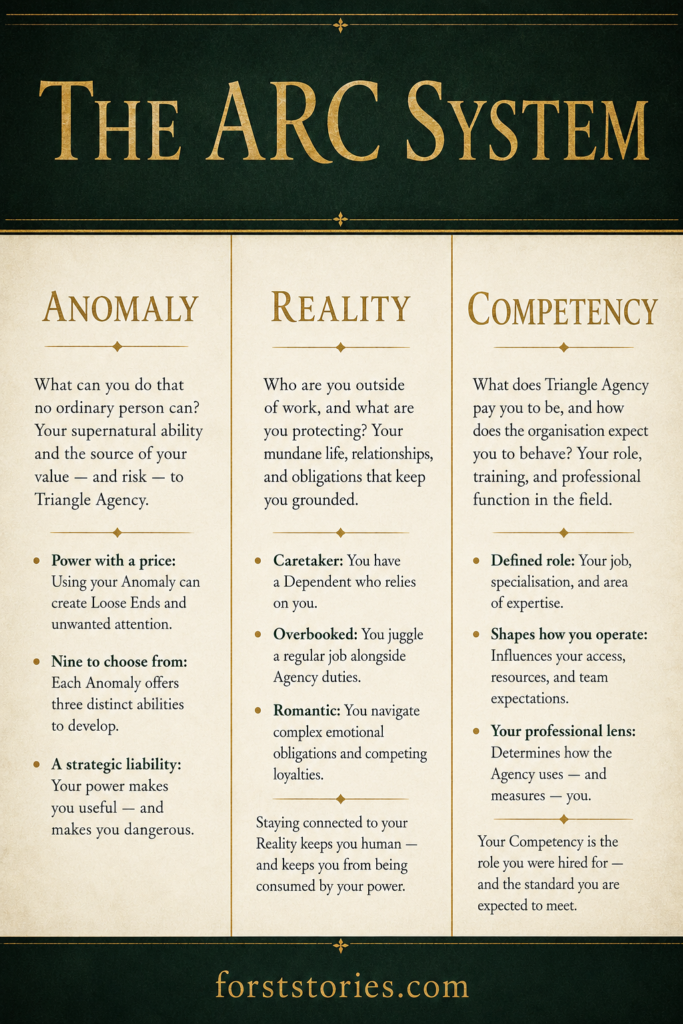
The genius of the system is that all three elements have mechanical weight, not just flavour. They are not background details. They are the engine the game runs on.
Each ARC piece is chosen from a list of options during character creation, and the combination of your three choices produces a character who is genuinely distinct. With nine Anomalies, multiple Reality types, and a range of Competencies to choose from, there are up to 729 different starting combinations available. If you want the full walkthrough of how these choices are made in sequence, our complete ARC guide to character creation covers that step by step.
The Three Questions ARC Is Answering
The easiest way to think about ARC is as three different answers to three different questions:
- Anomaly answers: what can you do that no ordinary person can?
- Reality answers: who are you outside of work, and what are you protecting?
- Competency answers: what does Triangle Agency pay you to be, and how does the organisation expect you to behave?
None of these questions is optional. The game is not interested in Agents who are only their powers, or only their job. The pressure between all three is where Triangle Agency lives as a game, and resolving that pressure, or failing to, is the story.
Anomaly: The Power That Is Also a Problem
Your Anomaly is your supernatural ability. It is the reality-warping entity you are bonded to, the source of everything that makes you useful to Triangle Agency in the first place.
Agents are Resonants: humans who have formed a bond with an Anomaly and, as a result, can do things that should not be possible. The Agency recruits Resonants because those abilities are genuinely valuable. It also monitors them closely, because those abilities are genuinely dangerous.
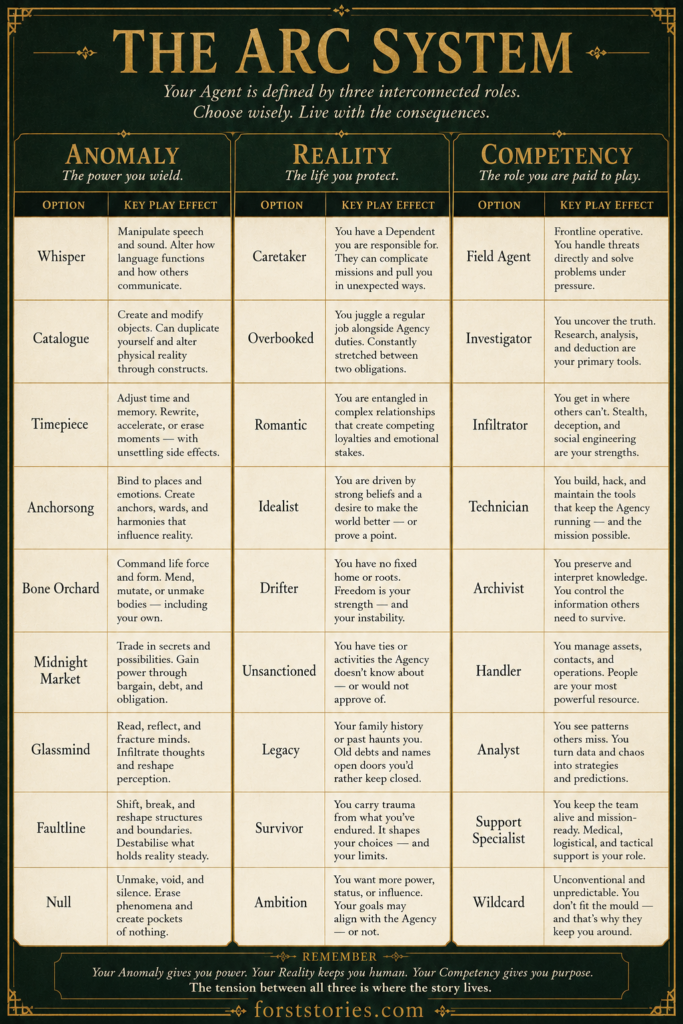
There are nine Anomaly options in the core book, each split into three distinct abilities that can be developed over a campaign. The range is striking:
- Whisper lets you manipulate speech and sound, not just what people say but how language itself functions around you.
- Catalogue opens up the creation and modification of objects, including the unsettling option to duplicate yourself.
- Timepiece works on time and memory, letting you adjust both in ways that tend to unsettle everyone in the room, including your teammates.
The Risk That Comes With the Power
Using your Anomaly in the field is powerful, but it comes with a cost that matters mechanically. If you use your abilities in front of ordinary people, you risk creating Loose Ends.
Loose Ends are unresolved complications: witnesses who saw something they should not have, traces of anomalous activity that could destabilise reality further, threads that Triangle Agency will expect you to clean up. Managing them is part of the job, and handling them badly can spiral into serious problems for the whole team.
This is why the Anomaly is not just a power fantasy. It is a liability you have agreed to carry on behalf of your employer, and the game reminds you of that at every opportunity.
Reality: The Life You Are Still Living
If Anomaly defines what you can do, Reality defines who you are when the work is done. It represents the Agent’s mundane life: their relationships, obligations, and personal history outside Triangle Agency.
The game places genuine mechanical importance on this. Staying connected to ordinary life is what keeps an Agent from being consumed by their Anomaly, and the Reality options each give that a specific shape.
- A Caretaker has a Dependent they are responsible for, someone who may turn up at inconvenient moments and complicate mission work significantly.
- An Overbooked Agent is juggling the demands of a regular job alongside their Agency duties, never quite managing either cleanly.
- A Romantic is tangled in complex emotional obligations, with all the competing loyalties that implies.
Why Relationships Have Mechanical Weight
It would be easy to read the Reality piece as pure flavour, a character-sheet note you reference during downtime and otherwise ignore. Triangle Agency is specifically designed not to work that way.
Maintaining your mundane connections is mechanically important. It is what keeps your Agent grounded and, in the game’s terms, genuinely themselves. An Agent who neglects their Reality in favour of mission efficiency is slowly becoming something the Agency prefers not to examine too closely.
This is the corporate horror element working at its most subtle. The Reality piece also drives the downtime scenes between missions, moments that are not optional padding but structurally important to how the game builds pressure over a campaign.
Competency: Your Department, Your Duties, Your Tools
Competency is the piece that most directly answers the question of what kind of agent you are. It defines your department within Triangle Agency, the specific role the organisation employs you to fill, the code of conduct attached to that role, and the equipment you are authorised to use.
In the most literal sense, it is your job description.
The Competency options each come with a distinct identity and a very different feel at the table:
- R&D agents are creative problem-solvers, the people who make what others “really want,” which in a Triangle Agency context can mean anything from experimental containment tools to solutions that were never officially approved.
- Gravedigger agents handle the work no one else wants, in places no one else wants to go. If there is a problem that is unpleasant, dangerous, and invisible, a Gravedigger is probably already there.
- Hotline agents are listeners and guides, the customer-service professionals of anomalous reality. That sounds gentle until you realise what the calls are usually about.
Quality Assurances: The Mechanical Backbone of Competency
The most important mechanical element attached to your Competency is the Quality Assurances system. These are specific tools that let your Agent guarantee certain outcomes in the field, or sidestep particular types of harm, based on their professional expertise.
They are not general bonuses. They are narrow, specialised abilities that reflect exactly what your department has trained you to do. A Hotline agent’s Assurances reflect their ability to manage communication and information. A Gravedigger’s reflect their capacity to operate in hostile, degraded environments.
Quality Assurances are how Competency reaches into the actual mechanics of play rather than sitting purely as flavour. They reinforce the sense that your department is not just a label. It is a perspective on how problems get solved.
How All Three Work Together at the Table
The ARC system is not designed to be experienced one piece at a time. At the table, Anomaly, Reality, and Competency are constantly in conversation with each other, and the tension between them is where the most interesting play happens.
Triangle Agency
What Is Your ARC?
Seven questions to find your Anomaly, Reality, and Competency.
Your ARC
A typical Triangle Agency mission moves through several phases: a Morning Meeting where the team receives their briefing, an anomalous investigation in the field, and a post-mission report where outcomes are assessed. Your Competency shapes how your Agent approaches problems and who leads on which elements of the work. Your Anomaly provides options that are potent but come with consequences. Your Reality is waiting at the end of the day.
Dice, Assurances, and Triscendence
The core dice resolution involves rolling six d4s and looking for dice showing 3s, a result that reflects the triangular, triplicate nature of the game’s design. Quality Assurances from your Competency let you guarantee certain results or avoid certain consequences, giving you a layer of reliable expertise on top of the dice.
When three or more dice all show 3s simultaneously, you achieve Triscendence: a near-miraculous effect that goes beyond what normal success looks like. Agents can also solve problems by “Asking the Agency,” invoking a kind of corporate coincidence where the organisation’s resources create a convenient solution. Both approaches have their uses, and both have their costs.
Spending Time: The Long Game
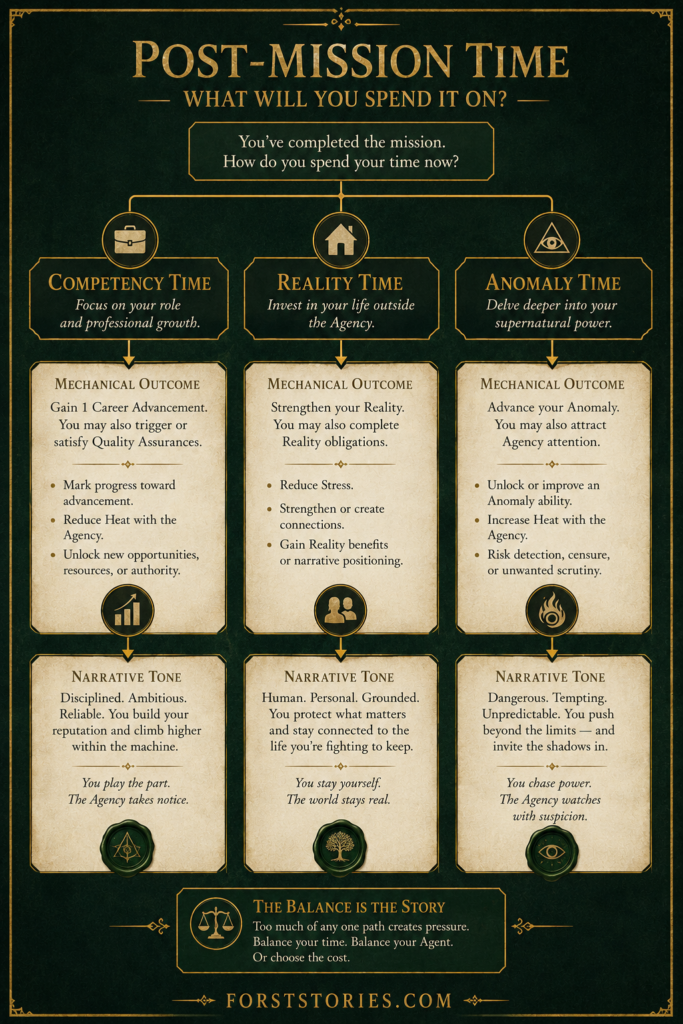
After missions, Agents spend Time, the game’s resource for advancement and recovery. Where you spend it matters enormously because each option shapes a different part of your Agent’s development.
- Competency Time advances your career: promotions, new Quality Assurances, greater standing within your department.
- Reality Time means tending to your relationships and personal life, essential for staying grounded, but not something the organisation rewards.
- Anomaly Time is where it gets complicated. The Agency strongly discourages it, because developing your Anomaly outside official channels produces abilities that have not been sanctioned or contained.
The rules on Anomaly Time are clear. The temptation is also clear. What your Agent chooses to do with that tension is, ultimately, the shape of their campaign arc. If you want a fuller look at the broader game before diving into character specifics, 10 Things to Know Before Playing Triangle Agency is a solid place to start.
Building Your Own Agent: Where to Start
The practical question, once you understand what ARC is doing, is how to approach your own choices. The most useful frame is to think about the kind of story you want to tell rather than the kind of character you want to optimise.
Triangle Agency is not a game where mechanical efficiency is the primary goal. It is a game about pressure, identity, and what it costs to do an unusual job for an employer who does not have your best interests at heart.
Start with the tension that interests you most. If you are drawn to the horror of supernatural ability and the risk of losing yourself to it, build outward from your Anomaly. If the workplace drama and corporate-horror elements appeal most, let your Competency lead. If you want a character whose personal life is the emotional engine of their story, anchor yourself in a Reality piece that creates specific complications to explore at the table.
Whatever you choose, remember that the three pieces are designed to complicate each other. The most interesting Agents are not the ones where all three choices point in the same direction. They are the ones where Anomaly, Reality, and Competency create genuine friction, because that friction is the game.
Conclusion
Triangle Agency builds its characters from three pieces that are each, individually, interesting, and then asks what happens when you have to be all three at once. The Anomaly gives you power and risk. The Reality gives you stakes and grounding. The Competency gives you a role, a toolkit, and an employer’s expectations to live up to or disappoint.
Understanding how these elements work, and how they push against each other in play, is the key to getting the most out of any session. The 729 combinations are not just a selling point. They are a genuine design space, and each one plays differently.
Continue Your Journey
What Is Triangle Agency? A Complete Introduction to the TTRPG — Everything you need to know about the setting, tone, and core concepts before your first session.
How to Create a Character in Triangle Agency: Your Complete ARC Guide — The step-by-step walkthrough for building your Agent from scratch.
10 Things to Know Before Playing Triangle Agency — Essential context for new players heading to their first session.
Fantasy RPG Systems Ranked: From Beginner to Expert — See where Triangle Agency sits in the wider landscape of TTRPG design.
Beyond D&D: Indie RPG Systems Spotlight — More indie systems worth exploring if Triangle Agency has caught your attention.
What does your Agent look like? Drop your ARC combination in the comments below. We would love to see the range of characters people are building.
Want more TTRPG deep dives, guides, and news delivered straight to your inbox? Subscribe to Forst Stories and never miss a post.
RPG news, GM tips, and system deep dives — straight to your inbox, no filler.