Best Investigator Occupations in Call of Cthulhu (and How to Play Them)
Call of Cthulhu doesn’t have classes in the D&D sense. There’s no Fighter selecting combat manoeuvres or Wizard memorising spells. Instead, your investigator’s identity comes from their occupation — the job they held before Mythos horrors decided to ruin their week. And while no occupation is mechanically “broken,” some consistently shine at the table in ways that others simply don’t.
This guide ranks the best occupations for new and experienced players alike, based on three things that actually matter: how often your skills will be useful in a typical adventure, how much the occupation helps you contribute across different scene types, and how easy it is to roleplay convincingly without prior CoC experience. Raw stat efficiency isn’t the point here. The best investigators are the ones who stay useful, stay interesting, and stay just sane enough to get through the scenario.
If you’re brand new to building your first character, the Call of Cthulhu investigator creation guide is a good starting point before diving into occupation specifics.
What Makes an Occupation “Best” in CoC
Before getting into the list, it’s worth being clear about what “best” actually means in a system where combat will get you killed and sanity is the real resource to manage.
Spotlight frequency is the biggest factor. Any occupation that naturally invests in Library Use, Spot Hidden, or strong interpersonal skills will see constant use in published scenarios, because those skills appear in virtually every investigation. If you’re rolling dice regularly, you’re contributing. If your key skills only matter in specific scenes, you’re waiting a lot.
Hook density matters almost as much. Occupations like journalist, private investigator, and police detective come with a built-in reason to ask questions, go places, and get tangled in strange cases. A dilettante attending a creepy gala makes narrative sense. A professor called in to examine an unusual artefact makes sense. An accountant stumbling into a Mythos horror needs more work from the Keeper to justify. The best occupations do some of that justification work for you.
Player friendliness rounds out the list. For players who haven’t spent a decade reading Call of Cthulhu supplements, some occupations are just easier to inhabit. A journalist knows instinctively to ask questions, take notes, and push past “no comment.” A private investigator has an obvious reason to follow people and break into buildings. Starting with an occupation that feels intuitive frees up mental energy for the actual roleplaying.
How Occupations Work
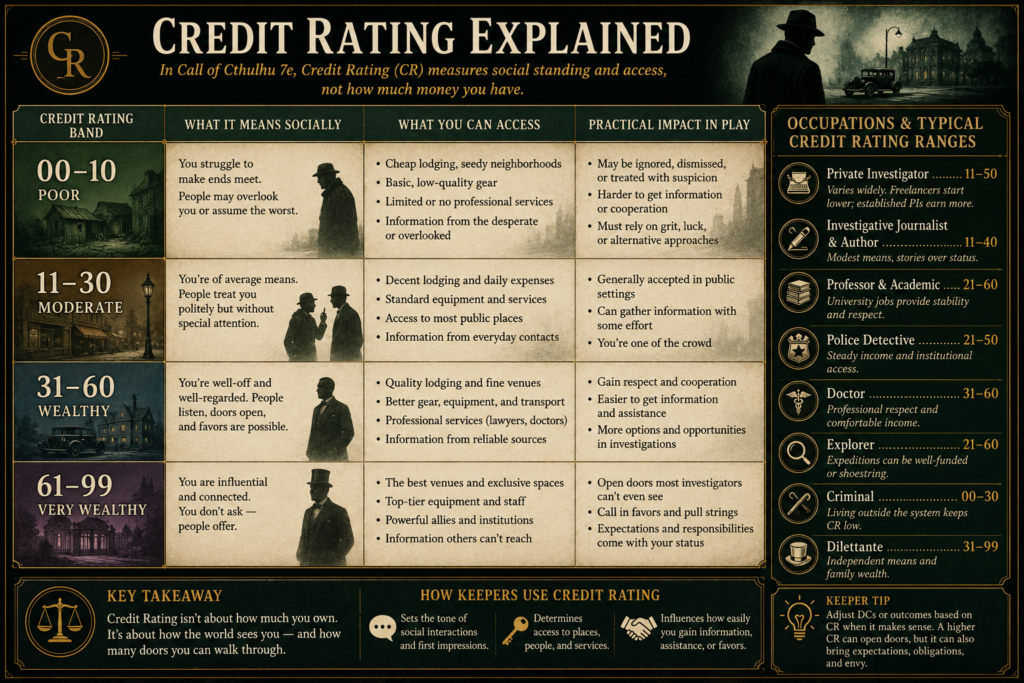
In CoC 7th Edition, your occupation determines which skills you get to invest your main pool of points into, sets your Credit Rating range, and usually implies a network of contacts relevant to your professional world. Your Credit Rating isn’t just flavour — it affects where you can walk in without questions, how much gear you can afford, and whether NPCs treat you as a credible source or a suspicious stranger.
Importantly, your occupation doesn’t lock you into a combat role the way a class might in other systems. You’re not picking between being good at hitting things or being good at research. You’re picking which slice of a very dangerous world you know best — and hoping that slice has something to offer when the stars align and something ancient starts waking up.
The Cthulhu Mythos primer gives useful context on the forces your investigator will inevitably be going up against, which helps frame what skills are worth investing in.
The Eight Occupations Worth Your Time
Private Investigator
The private investigator is the closest thing CoC has to a default protagonist, and for good reason. They’re built to do exactly what every scenario requires: find clues, follow people, talk their way into places, and occasionally pick a lock. A well-built PI covers Library Use, Spot Hidden, Disguise, Law, an interpersonal skill, and usually something physical like Locksmith or Firearms.
The real strength is versatility. PIs belong in interrogation scenes and crime scenes and library montages with equal credibility. They have a professional excuse for snooping that other characters have to invent. Roleplaying one is also intuitive: you’re the one who pushes to knock on doors, tail suspects, and take jobs that sensible people turn down.
Investigative Journalist and Author
These two occupations are close enough to treat together, and both consistently appear near the top of “best for new players” recommendations in the CoC community. The key skills — Library Use, History, Own Language, Psychology, an interpersonal skill, and usually Photography or another Art/Craft — cover most of what a typical scenario demands. The Credit Rating is modest, which creates interesting pressure around money and access.
The built-in story hook is what really earns the spot. A journalist needs a story. They go where they’re not supposed to go, talk to people who don’t want to talk, and write things down. That’s an investigative adventure in a single sentence. Authors and academics are natural repositories for strange knowledge, which gives the Keeper a clean justification for feeding them Mythos-adjacent exposition.
Professor and Academic
If the journalist is the engine that drives the investigation forward, the professor is the one who knows what everything means when you get there. Library Use, at least one Other Language (Latin, Arabic, and Aklo all appear frequently in the Mythos), Psychology, Persuade, and two specialist academic fields give them a broad knowledge base that becomes very useful very often.
The occupation also benefits from decent Credit Rating, which translates into access to university collections, museum contacts, and academic colleagues who might have seen this sort of thing before. Play them as curious but cautious. They’re the character who insists on taking the strange tome back to the lab instead of reading it in the basement at midnight — which is exactly the kind of restraint that keeps investigators alive in the early game.
Police Detective
A police detective brings something no other occupation provides quite as cleanly: legitimate authority. They can access official records, secure crime scenes, carry weapons without raising questions, and request backup. Law, Listen, Psychology, Persuade or Fast Talk, Spot Hidden, and a physical skill or two cover the investigative side, and the contacts they can pull in are often more useful than the skills themselves.
The interesting roleplay tension is the gap between procedure and reality. Your detective operates in a world with rules, chains of command, and report-writing. The Mythos does not care about any of that. Leaning into that friction — the “by the book” cop confronting something that is definitively not in the book — makes for compelling character work, and it requires zero mechanical effort to set up.
Dilettante
The dilettante is frequently underestimated by players who focus on skill efficiency, and consistently overperforms at actual tables. High Credit Rating solves problems that skills can’t: transport, accommodation, equipment, bribes, and access to spaces where the rest of the party would be turned away at the door. The occupation’s mixed skill list — Art/Craft, Ride, interpersonal skills, Firearms, and personal interests — is broad but shallow, which suits a character who knows a little about everything and a lot about their own comfort.
The key is embracing the archetype fully. The dilettante is the spoiled socialite who is simultaneously out of their depth and surprisingly resourceful when the situation demands it. They throw money at problems, call in favours, and host dinner parties that go terribly wrong. They’re often the most fun person at the table to watch, even when they’re not rolling dice.
Antiquarian
Antiquarians are a natural fit for the most common CoC scenario structure: strange artefacts, weird tomes, and cursed heirlooms that need to be identified before they finish destroying everyone involved. History, Library Use, Art/Craft, Spot Hidden, and usually a smattering of languages or Appraise skills put them in the middle of most investigation scenes. They have solid Credit Rating and connections to the auction house and museum world that can move a plot along quickly when time is short.
They’re less flashy than a PI and less socially powerful than a dilettante, but in scenarios built around objects with history — which is most CoC adventures — they pull consistent weight. Good companions to the CoC expansion books if you want to see how deep the antiquarian rabbit hole goes.
Doctor and Nurse
Medical professionals don’t have the investigative tools of a PI or the social reach of a professor, but they keep people alive. Medicine, First Aid, and Biology are reliable in a system where a single encounter can leave half the party wounded, and Psychology is one of the most consistently useful skills in the entire game. Doctors also have natural authority in hospital settings, which appear frequently in horror-adjacent scenarios.
Play the doctor as the practical one. They’re the person who insists on patching wounds before the group runs into whatever’s making the noises upstairs. They’re also often the one whose sanity starts slipping the fastest, because medical knowledge and Mythos biology interact in very uncomfortable ways.
Criminal
The criminal — cat burglar, bank robber, confidence trickster — fills a specific niche that no other occupation covers as well: getting into places that are supposed to be off-limits. Sneak/Stealth, Locksmith, Disguise, Handgun, and Fast Talk address a set of problems that arise in most scenarios and that other party members simply can’t handle cleanly. Their Credit Rating is low, which creates some friction in formal settings, but their underworld contacts are often more immediately useful than the law enforcement connections of a detective.
The roleplay angle is to lean into the scheming. Criminals are always looking for the angle, the shortcut, the escape route. They push the party toward unconventional solutions — burglary instead of polite inquiry, blackmail instead of persuasion — and that can generate some of the most memorable sessions in a campaign.
Building a Party That Works
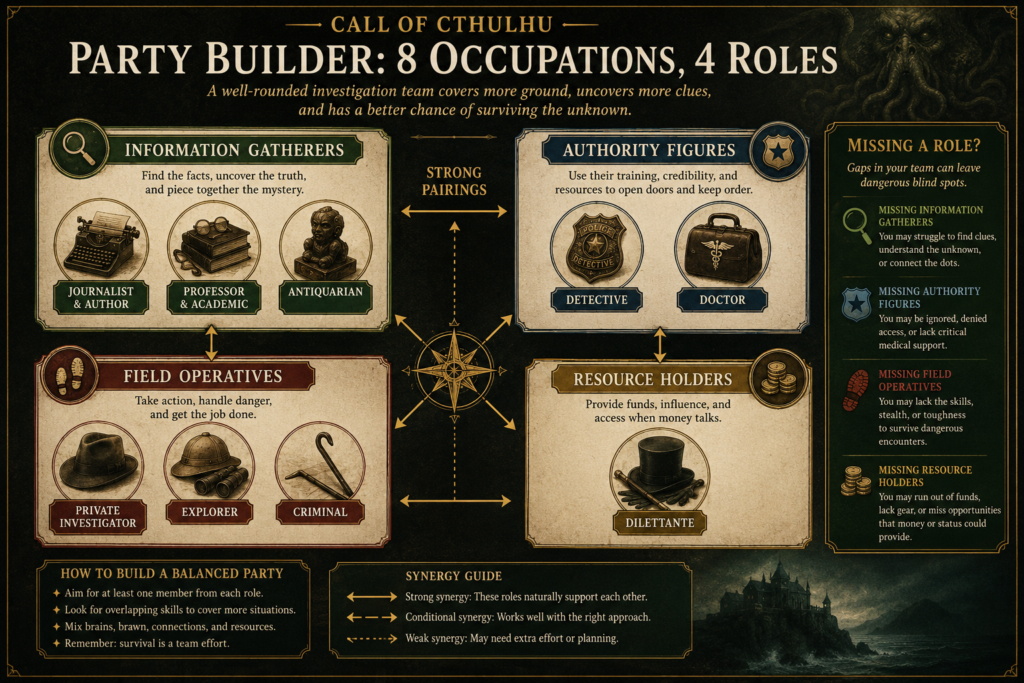
These occupations pair well together. A professor, a PI, and a dilettante cover research, field investigation, and social access with minimal overlap. Add a journalist for additional information-gathering and a criminal for situations where polite methods have been exhausted. If you’re running or playing a longer campaign, it’s worth considering how your party will handle the full range of scenes — library research, social encounters, crime scene analysis, and the occasional physical confrontation that should probably be avoided but rarely is.
The 10 essential things to know about Call of Cthulhu covers the broader rules context if you’re building a party from scratch and want to understand how the system distributes skill use across different scenario types.
A Note for Keepers
If you’re running a scenario with a mixed occupation group, the most valuable thing you can do is build scenes that let each occupation’s key skills matter at least once. Library scenes for academics and antiquarians, infiltration scenes for criminals and PIs, social scenes for dilettantes and journalists. When every player feels like their occupation had a moment, the session lands better regardless of whether the investigators survived.
Credit Rating is worth using actively too. High Credit Rating characters can charter boats, secure loans, and access exclusive clubs without making it a plot point. Low Credit Rating characters feel real financial pressure — rent, repairs, medical bills. Letting that distinction play out in small ways throughout a campaign adds texture that most players appreciate.
Occupation-specific hooks are worth the small effort to write. “Your editor sent you a clipping” and “your lieutenant wants a report” and “the dean called about a break-in at the library” are each one sentence that hands a different character a personal stake in the adventure before the first scene even starts. It’s a technique that works in virtually every system, but CoC’s occupation structure makes it unusually easy to apply.
If you’re expanding beyond vanilla CoC, Call of Cthulhu vs Delta Green covers how these occupation archetypes shift in a government-agency horror context, where the Criminal becomes an intelligence asset and the Dilettante becomes a political liability.
Which Occupation Should You Pick?
For players new to Call of Cthulhu, the Private Investigator, Journalist, or Police Detective will give the smoothest entry point. They’re intuitive to roleplay, well-supported by core skills, and carry built-in story hooks that take the pressure off inventing a reason to be involved.
For experienced players who want something different, the Dilettante and Antiquarian both reward players who lean into their quirks rather than optimising for skill efficiency. The Criminal is particularly rewarding in groups that appreciate unconventional problem-solving.
None of these occupations will save you from the Mythos. That’s the point. But the right occupation can make you genuinely useful until the end, interesting to watch even when the dice are unkind, and memorable long after the campaign wraps.
Continue Your Journey
How to Create an Investigator in Call of Cthulhu 7th Edition — The full step-by-step character creation process, from characteristics to backstory.
A Beginner’s Guide to the Cthulhu Mythos: Who Are the Great Old Ones? — Understanding what your investigator is actually up against.
Call of Cthulhu vs Delta Green: Same Universe, Very Different Tone — How the occupation landscape changes in a modern government-agency horror setting.
10 Essential Things to Know About Call of Cthulhu RPG — A broad orientation to the rules, the tone, and what makes CoC different from other systems.
The Essential Guide to Call of Cthulhu Expansion Books — Where to go next once you’re ready to expand beyond the core rulebook.
Which occupation did you end up choosing for your investigator? Did it perform the way you expected at the table? Drop your experience in the comments.
The Scriptorium newsletter goes out every Wednesday with new articles, a GM tip, and updates from the site. Sign up here if you’d like it in your inbox.
RPG news, GM tips, and system deep dives — straight to your inbox, no filler.